

Date:2026-08-08 Click:365
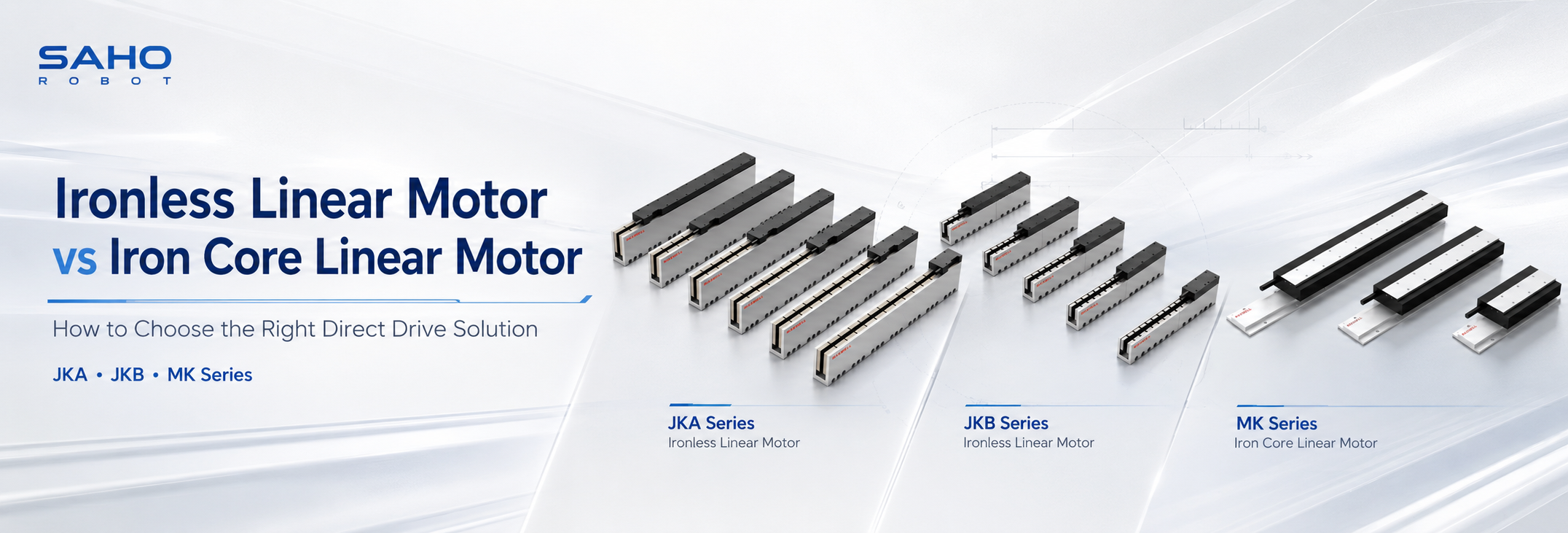
For direct-drive automation, choosing between an Ironless Linear Motor and an Iron Core Linear Motor is not simply a question of light load versus heavy load. Ironless designs reduce cogging and normal magnetic attraction, which can help smooth scanning and velocity-sensitive motion. Iron core designs generally provide higher force density in a compact motor envelope, but the machine structure must also manage magnetic attraction, heat and dynamic reaction forces.
A useful ironless vs iron core linear motor comparison therefore starts with the motion profile: what the axis carries, how fast it accelerates, whether the process happens while the axis is moving, how long it runs continuously, and how much installation space is available. Cogging, force density, thermal stability, encoder feedback, guide rigidity and cable drag all influence the final result.
This guide connects those decisions with SAHO JKA and JKB ironless motor families and MK, WJM and WKM iron core motor families. Direct-drive motion is commonly considered for semiconductor equipment, precision inspection, laser processing, electronic component assembly, medical automation, lithium battery equipment, TFT-LCD production and other high-response automation systems. For broader motion-control and industrial automation resources, the Association for Advancing Automation (A3) also provides industry information.
Quick selection direction
If stable scanning, low cogging and low magnetic attraction are the priority, start by reviewing JKA or JKB. If the axis needs high force density, aggressive acceleration or strong force within limited installation space, start with MK, WJM or WKM. High force alone does not automatically rule out an ironless motor; larger JKB models should still be checked when smooth motion remains important.
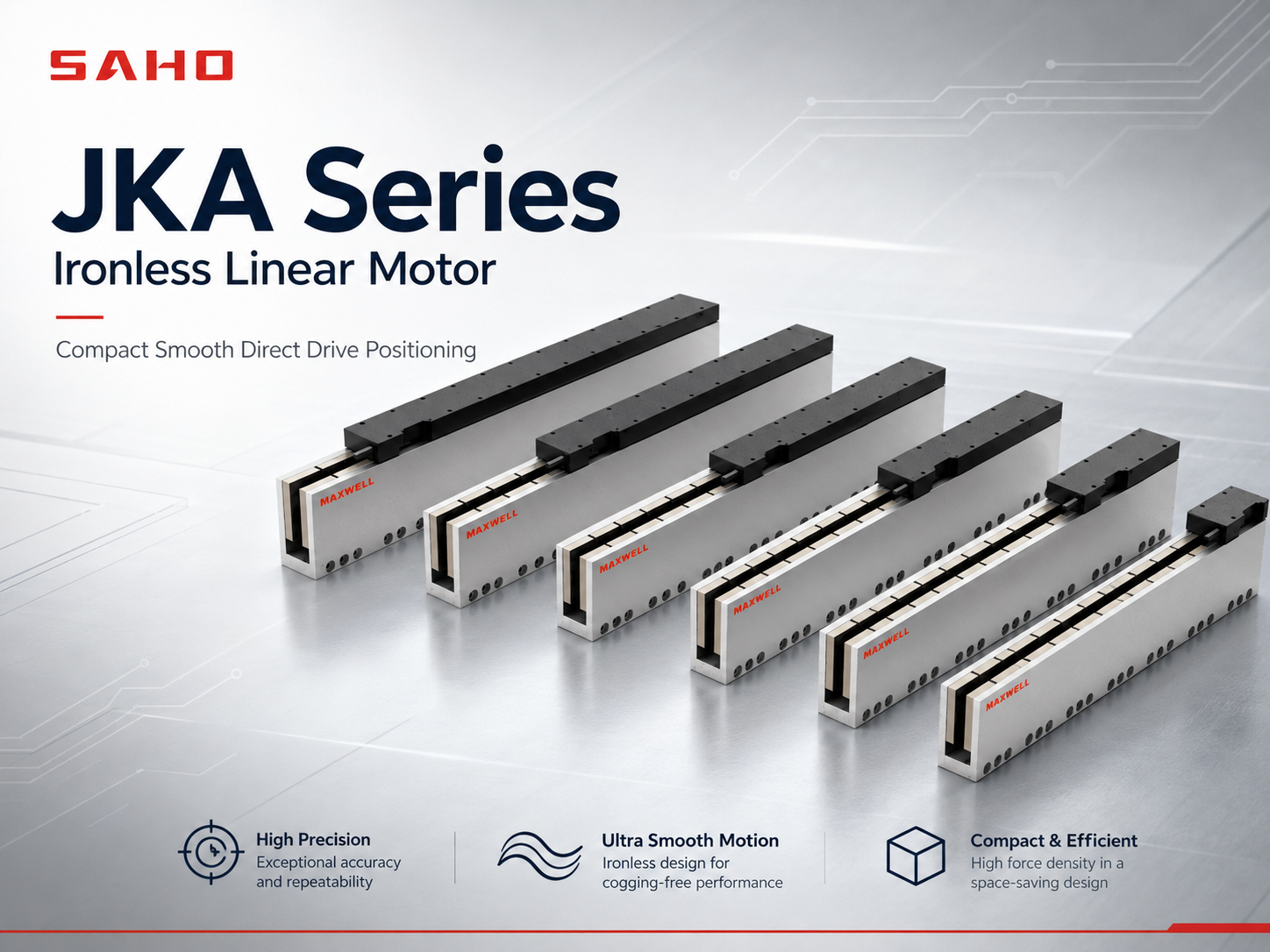
SAHO JKA ironless linear motor for smooth, low-cogging direct-drive positioning.
Ironless vs Iron Core Linear Motor: What Changes in Real Machine Design?
A linear motor generates force directly through electromagnetic interaction. There is no belt, ball screw, coupling or gear reducer in the force path. Removing those transmission components can reduce backlash and mechanical wear while supporting fast response and precise motion.
The important difference is the magnetic structure. In an ironless motor, the moving coil does not contain an iron core. This greatly reduces cogging and normal magnetic attraction between the coil assembly and magnet track, which is useful when velocity stability, vibration and smooth settling matter.
An iron core motor uses iron in its magnetic circuit. The stronger magnetic path generally allows more force to be produced within a compact motor size. That makes iron core designs attractive for high acceleration and force-dense axes, but the guide system, base plate and machine frame must be designed for the resulting magnetic attraction and dynamic loads.
Neither structure determines final machine performance by itself. Encoder resolution, guide accuracy, base flatness, payload centre, cable drag, servo tuning and heat dissipation remain part of the same motion system. A strong motor mounted on a weak structure can still produce vibration or long settling time, while a smooth motor that is undersized for the real motion profile can limit cycle time.
| Selection Point | Ironless Type | Iron Core Type |
| Cogging / force ripple | Very low cogging; useful for smooth scanning and velocity-sensitive motion. | Force ripple requires more attention in magnetic design, feedback and servo tuning. |
| Magnetic attraction | Low normal magnetic attraction between the moving coil and magnet track. | Higher normal attraction; guide, bearing and base structure must support it. |
| Force density | Can provide substantial force, although more motor volume may be needed as force demand rises. | Usually stronger force output for a given installation envelope. |
| Motion behaviour | Strong starting point for low-ripple scanning, inspection and precision movement. | Strong starting point for force-dense, high-dynamic direct-drive axes. |
| Mechanical design | Guide alignment, cable drag and thermal stability remain important. | Base stiffness, rail capacity and support for magnetic attraction need careful review. |
| Typical starting point | Inspection, optics, measurement, fine scanning and low-vibration positioning. | High-acceleration transfer, laser equipment, larger moving structures and compact high-force axes. |
When an Ironless Linear Motor Is the Better Starting Point
Cogging is a small periodic force variation created by magnetic interaction as a motor moves. In a precision system, that variation may appear as velocity ripple, vibration, noise or longer settling time. It becomes particularly important when the process is taking place while the axis is still moving rather than only after the carriage stops.
A vision inspection axis is a good example. The camera may collect image data continuously during travel, so small changes in velocity can influence image consistency. Similar concerns apply to optical scanning, dispensing, measurement and other processes where stable motion is part of the process itself.
An ironless motor is often a useful starting point in these situations because it removes the iron teeth that create conventional cogging behaviour. Low normal magnetic attraction can also reduce one source of load on the guide structure. The final design still depends on moving mass, required force, acceleration, encoder feedback, rail quality and thermal conditions.
JKA for Smooth Precision Direct Drive
SAHO JKA belongs to the ironless linear motor route and is suitable for precision direct-drive systems where smooth motion, low cogging, low vibration and stable settling are important. It can be considered for inspection, optical positioning, semiconductor-related equipment, laser positioning and other precision stages.
JKA should not be treated as a low-speed-only solution. Model selection should be based on continuous force, peak force, moving mass, acceleration, usable stroke and installation space. Encoder resolution, guide rigidity and cable routing also influence whether the finished axis can achieve the required dynamic response.
JKB When Smooth Motion Still Needs More Force
JKB extends the ironless selection path across a wider force range. This matters because a high-force requirement does not automatically mean that an ironless structure must be rejected. When low cogging and smooth motion remain important, JKB can be reviewed before moving directly to an iron core solution.
Potential applications include larger inspection stages, laser and optical systems, semiconductor-related automation, medical equipment and other direct-drive systems that need both smooth movement and stronger force. The exact model should still be selected from the real motion profile rather than from a general application label.
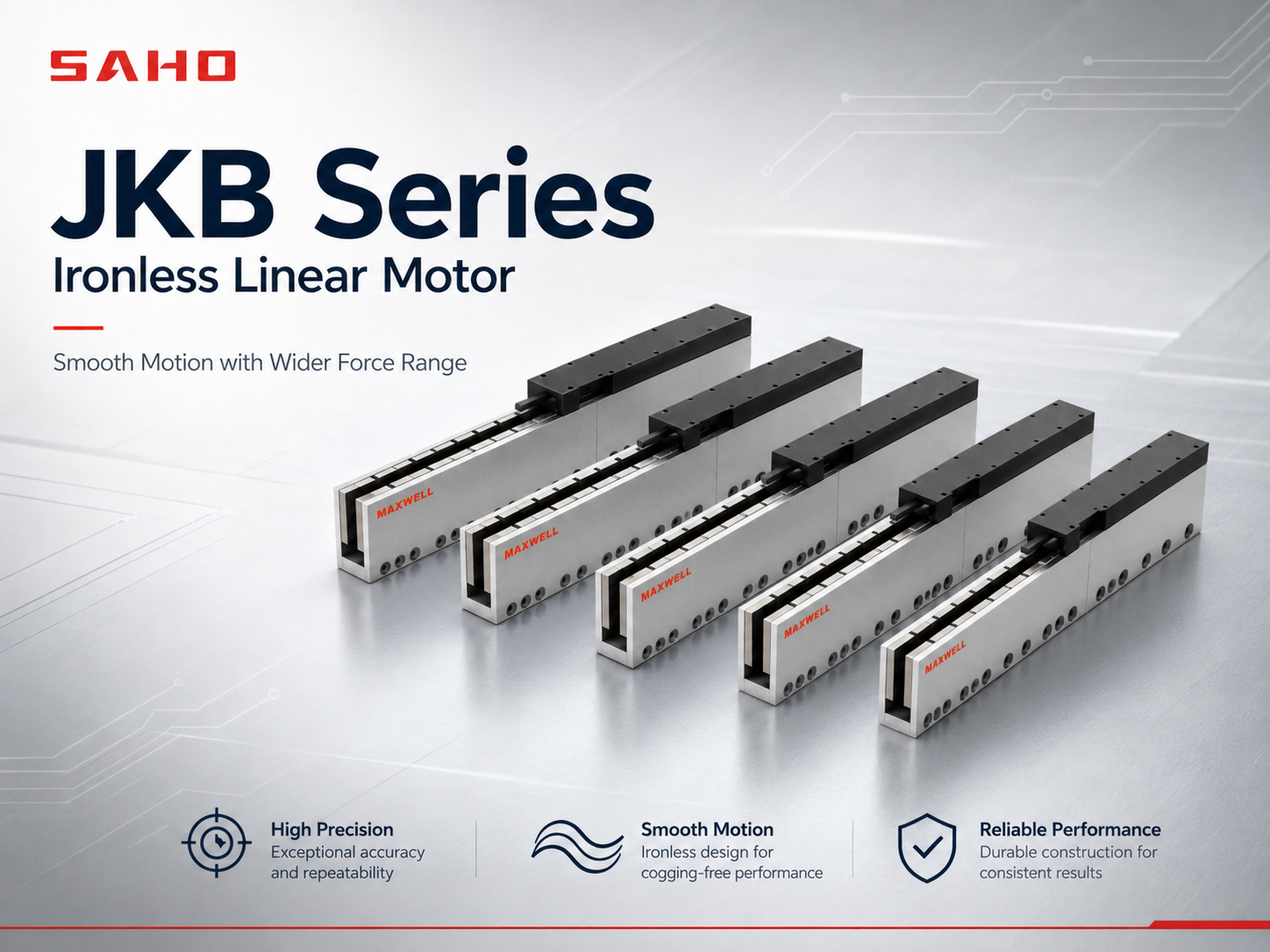
SAHO JKB ironless linear motor for smooth direct-drive motion across a wider force range.
When an Iron Core Linear Motor Is the Better Starting Point
Force density becomes a major consideration when an axis must accelerate a substantial moving assembly or when the motor has to fit into a limited machine envelope. An iron core structure strengthens the magnetic circuit, making it possible to obtain strong thrust from a compact motor package.
A laser processing axis may carry the laser head, optical components, support plate, cables, air lines and protective hardware. A battery-production axis may move fixtures, workpieces and additional tooling at a demanding cycle rate. In these cases, force margin and continuous-force capability can become just as important as positioning accuracy.
The extra force density comes with mechanical design requirements. Normal magnetic attraction can load the guide rails and base plate, so rail capacity, bearing arrangement, mounting flatness and frame stiffness should be reviewed together. Good servo tuning cannot fully compensate for a flexible mechanical platform.
Peak force should not be the only value used for selection. Continuous force, duty cycle, motor temperature, cooling conditions and repeated acceleration determine whether the axis can maintain performance during real production.
MK for High-Dynamic Iron Core Motion
SAHO MK is an iron core linear motor family for high-response direct-drive applications where strong force density, acceleration and precision positioning need to work together. It can be considered for semiconductor equipment, laser processing, precision measurement, electronic manufacturing and other advanced automation systems.
Different motor sizes allow the designer to match the required force range and installation envelope. Model confirmation should include continuous force, peak force, moving mass, duty cycle, heat dissipation, cable routing, encoder configuration and base rigidity rather than selecting only from the largest available thrust value.
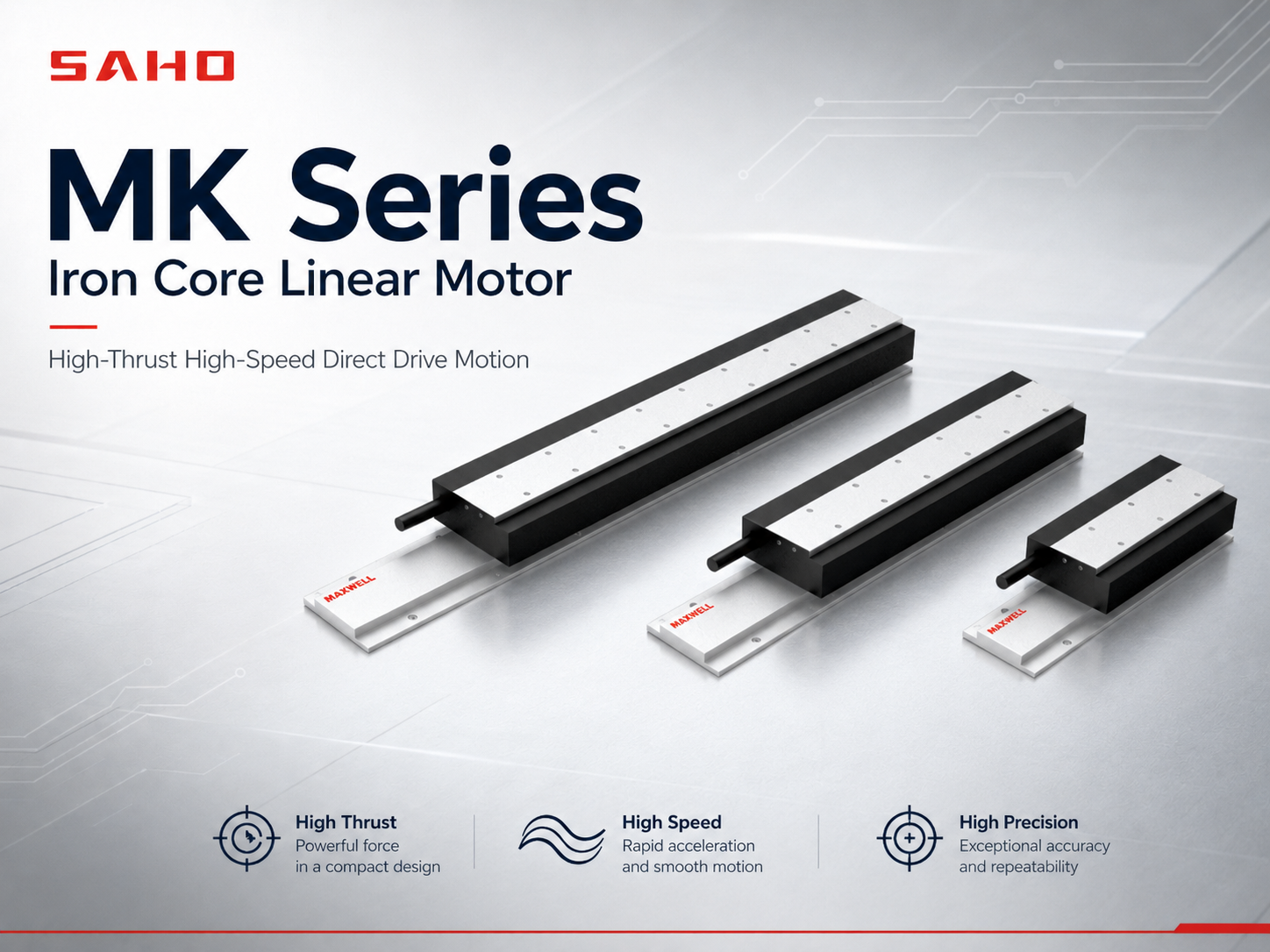
SAHO MK iron core linear motor for force-dense, high-response direct-drive motion.
Where WJM and WKM Enter the Comparison
WJM and WKM provide additional SAHO iron core motor routes. They are worth comparing when the required force, motor envelope, mover and stator dimensions, cooling conditions or mounting layout do not point clearly to one MK configuration.
The useful question is not whether one series is universally stronger than another. The engineering comparison should look at the required continuous force, peak force, available motor width and length, magnet-track arrangement, thermal path and the surrounding mechanical structure. These details often change once the machine frame, rail spacing and payload centre are fixed.
For this reason, MK, WJM and WKM should remain part of the same iron core evaluation until the motion profile and installation drawing are available. This avoids choosing a motor family early and later redesigning the base plate or guide arrangement around an unsuitable package.
View WJM Series View WKM Series
Heat, Duty Cycle and Accuracy Stability
Heat can change the behaviour of an otherwise correctly sized direct-drive axis. A linear motor generates force through current, and the coil produces heat as current increases. That heat can move into the motor mount, base plate, guide structure and nearby machine components.
Thermal expansion matters when the process depends on stable geometry over a long production run. Inspection equipment may see measurement drift, laser equipment may become more sensitive to alignment changes, and precision assembly systems may require additional compensation or calibration when the motion structure changes temperature.
Continuous force should therefore be checked against the real duty cycle. A short acceleration move and a long continuous scan can place very different thermal demands on a motor even when the peak force requirement looks similar.
Ironless and iron core motors both require thermal review. An ironless solution may need a larger motor as force demand rises, while a force-dense iron core solution can place considerable heat into a compact area. Cooling, mounting contact and surrounding airflow should be part of the selection rather than an afterthought.
The thermal review should include the motor, mounting plate, moving table, guide blocks, enclosure, cable chain and nearby process heat sources. Long-term accuracy is a system result, not a motor specification alone.
Matching the Motor Structure to the Equipment
Precision Inspection and Vision Scanning
Inspection equipment often cares about what happens between two positions, not only the final stopping point. A camera may acquire images while the stage is moving, making velocity ripple, vibration and settling behaviour relevant to image quality.
JKA or JKB is a logical starting point when low cogging and smooth scanning are priorities. If the inspection bridge, lighting, camera assembly and tooling create a much larger moving mass, higher-force JKB models and the iron core families should all be compared rather than assuming that one motor structure will fit every inspection axis.
Semiconductor and Electronic Component Assembly
Semiconductor and electronics equipment may combine measurement, alignment, transfer and process motion inside the same machine. A fine scanning axis can prioritise low force ripple, while another axis carrying tooling may need stronger acceleration and a compact motor package.
That means ironless and iron core motors can both appear in one multi-axis system. JKA or JKB may suit fine-motion axes, while MK, WJM or WKM can be evaluated for force-dense motion. Encoder quality, electrical shielding, guide accuracy and frame stiffness remain important whichever motor structure is chosen.
Laser Processing and Marking Equipment
Laser motion requirements vary widely. A light optical head moving through a scanning path can favour smooth velocity behaviour, while a larger assembly carrying optics, support plates, protective components and service lines may place much greater demand on motor force.
JKB can be considered when low cogging remains important but the application needs more force than a smaller ironless layout. MK, WJM and WKM become strong comparison candidates as force density and installation space become more important. Heat from the laser process should also be considered together with motor heat when alignment stability is critical.
Lithium Battery Equipment
Battery production equipment can contain scanning, inspection, stacking, transfer and handling axes within the same line. The motor calculation should include the complete moving assembly: carriage, tooling, fixtures, workpieces, cables, pneumatic lines and covers.
Ironless motion can be useful for inspection and scanning tasks where smooth travel matters. Iron core motion may be attractive for force-dense transfer and aggressive acceleration. Long shifts also make continuous force and temperature rise especially important; a motor selected only from peak force can be unsuitable for the actual production duty.
Medical Automation and Laboratory Instruments
Medical and laboratory equipment may value smooth movement, low vibration, compact integration and repeatable positioning. Ironless JKA or JKB can be considered where those priorities dominate, particularly for light scanning, measurement and positioning stages.
The final selection still has to reflect the actual moving assembly. A larger tray, fixture or sample platform can change the required force significantly. Quiet direct drive also does not eliminate every source of noise; rail condition, cable-chain movement and servo tuning can still influence the complete machine.
TFT-LCD and Large Panel Equipment
Large-panel equipment may combine long travel with substantial bridge mass. Motor force, rail support, straightness, frame stiffness and cable management can all become limiting factors. A force-dense iron core system may be attractive when a large structure has to accelerate quickly.
Panel inspection can create a different priority if a relatively light sensor carriage must scan smoothly across the work area. In that case, an ironless solution should remain in the comparison. Cable-chain direction and drag also deserve attention because long cable systems can add varying resistance across the stroke.
What Data Should Be Prepared Before Model Selection?
Choosing the motor structure is only the first stage. The final SAHO model cannot be confirmed reliably without the real machine data. Missing tooling weight, unrealistic acceleration or an incomplete duty cycle can change the selection after the mechanical design is already fixed.
Stroke: usable travel and total space available for the motor track, encoder and cable system.
Moving mass: carriage, workpiece, tooling, camera, brackets, sensors, cables, air tubes and moving covers.
Speed and acceleration: maximum speed alone is not enough; the complete move profile controls force demand.
Accuracy and repeatability: these are different requirements and should be specified separately.
Velocity stability: especially important for inspection, measurement and scanning processes performed during travel.
Duty cycle: running time, idle time, acceleration frequency and any continuous holding-force requirement.
Installation direction: horizontal, vertical, side-mounted or inverted layouts create different mechanical and safety conditions.
Available space: motor width, track length, moving plate, encoder location, rail spacing and cable-chain clearance.
| Required Data | Why It Matters | What It Changes |
| Stroke | Defines travel and total motor-track requirements. | Motor-track length, encoder length, cable layout and base design. |
| Moving mass | Sets acceleration-force demand. | Required continuous and peak force range. |
| Speed and acceleration | Defines dynamic force and cycle behaviour. | Motor size, force margin and servo requirements. |
| Accuracy / repeatability | Defines the required positioning behaviour. | Encoder, guide, base and control-system requirements. |
| Duty cycle | Shows the thermal load over time. | Continuous-force requirement and cooling design. |
| Installation direction | Changes gravity, moment and support conditions. | Guide design, safety planning and force calculation. |
How to Choose Between JKA, JKB, MK, WJM and WKM
The table below is best used as a starting path rather than a final model decision. Two machines in the same industry can need different motor structures if their moving mass, acceleration, process behaviour or installation space is different.
| Main Requirement | Starting Series | What to Check Next |
| Low cogging, smooth scanning, low vibration | JKA / JKB | Moving mass, force, encoder resolution, rail accuracy and cable drag. |
| Smooth ironless motion with higher force demand | JKB | Continuous force, peak force, motor size, acceleration and thermal conditions. |
| High force density and aggressive acceleration | MK / WJM / WKM | Base stiffness, magnetic attraction, rail capacity, installation envelope and heat path. |
| Long continuous operating periods | Compare both structures | Continuous force, RMS demand, cooling method and allowable temperature rise before peak force. |
| Restricted machine space | Compare actual dimensions | Mover width, stator dimensions, rail spacing, encoder position and cable clearance. |
Do not choose only by peak thrust. A motor with the highest short-duration force is not automatically the best choice for the machine. Smoothness, continuous force, heat, installation space, magnetic attraction, guide support and the real motion cycle should be considered together.
Compare the SAHO Linear Motor Series
Once the required motor structure is clearer, use the product pages below to compare the available series before preparing the final sizing information.
| Series | Motor Structure | Useful Starting Point |
| JKA | Ironless | Smooth low-cogging precision motion, scanning, inspection and positioning. |
| JKB | Ironless | Low-cogging direct drive with a wider force range for demanding precision systems. |
| MK | Iron core | High-response, force-dense direct-drive motion where acceleration and precision both matter. |
| WJM | Iron core | Alternative iron core route to compare by force range, physical dimensions and machine layout. |
| WKM | Iron core | Additional high-force iron core option to review against installation space, thermal conditions and motion requirements. |
FAQ
What is the main difference between ironless and iron core linear motors?
An ironless motor does not use an iron core in the moving coil, which reduces cogging and normal magnetic attraction. An iron core motor uses iron in the magnetic circuit and generally provides higher force density in a compact package. The better structure depends on smoothness, force, heat, installation space and the complete motion profile.
Is an ironless linear motor only suitable for light loads?
No. Ironless motors should not be classified only as light-load products. Higher-force ironless designs can support demanding motion applications. The trade-off is that the required motor size, thermal design and installation envelope must still be compared with an iron core alternative. SAHO JKB is particularly relevant when smooth low-cogging motion and higher force are both required.
Which type is better for smooth low-cogging motion?
Ironless motors are normally the stronger starting point when low cogging, stable velocity and low vibration are central to the process. Inspection, optical scanning and measurement are common examples. Force, acceleration and thermal requirements still need to be checked before the final model is selected.
Which type is better when installation space and force density are critical?
An iron core motor is often a strong starting point when the machine needs substantial force from a restricted motor envelope. MK, WJM and WKM can be compared for these layouts. The guide, base and bearing structure must also be designed for magnetic attraction and dynamic force.
What information does SAHO need for linear motor selection?
Prepare stroke, complete moving mass, maximum speed, acceleration, positioning accuracy, repeatability, duty cycle, installation direction, available mounting space and any velocity-stability requirement. Payload position, cable-chain arrangement, environmental conditions and cooling limitations can also affect the final recommendation.
Can ironless and iron core motors be used in the same machine?
Yes. Multi-axis equipment can use different motor structures for different axis roles. A fine scanning axis may prioritise low cogging and use an ironless motor, while another axis may prioritise compact high-force motion and use an iron core motor. Each axis should be sized from its own motion profile rather than applying one motor type to the whole machine.
Choose the Motor Around the Motion Profile
The most useful distinction between ironless and iron core linear motors is not simply payload. Start with what the process needs from the moving axis. Smooth scanning, low cogging and low magnetic attraction point toward an ironless solution, while force density and compact high-dynamic motion often make an iron core solution attractive.
SAHO JKA and JKB cover the ironless selection path, while MK, WJM and WKM provide iron core alternatives. Higher force does not automatically eliminate JKB, and choosing the strongest iron core motor does not guarantee the best axis. Continuous force, heat, guide support, encoder feedback and available machine space still decide whether the complete system will perform as intended.
Process priority: define whether scanning smoothness, force density, cycle time or settling behaviour matters most.
Real moving mass: include tooling, sensors, brackets, cables, fixtures, covers and workpieces rather than only the carriage.
Thermal check: compare continuous force and duty cycle before relying on peak-force figures.
Mechanical check: confirm guide capacity, base stiffness, rail spacing, cable path and installation space before freezing the motor layout.
For final sizing, provide SAHO with the stroke, moving load, speed, acceleration, accuracy target, repeatability target, duty cycle, installation direction, payload position, cable-chain direction and available mounting space. With that information, the engineering team can compare the appropriate ironless and iron core series against the actual machine requirement rather than relying on one catalog value.







-
-
 English
 -
 Français
 -
 Deutschland
 -
 Italia
 -
 Polska
 -
 España
 -
 Русский язык
 -
 日語
日語 -
 한국
한국 -
 Türkiye
 -
 português
 -
 بالعربيةês
 -
 Tiếng Việt
 -
 คนไทย
คนไทย -
 简体中文
简体中文 -
繁體中文
-