

Date:2026-08-03 Click:255
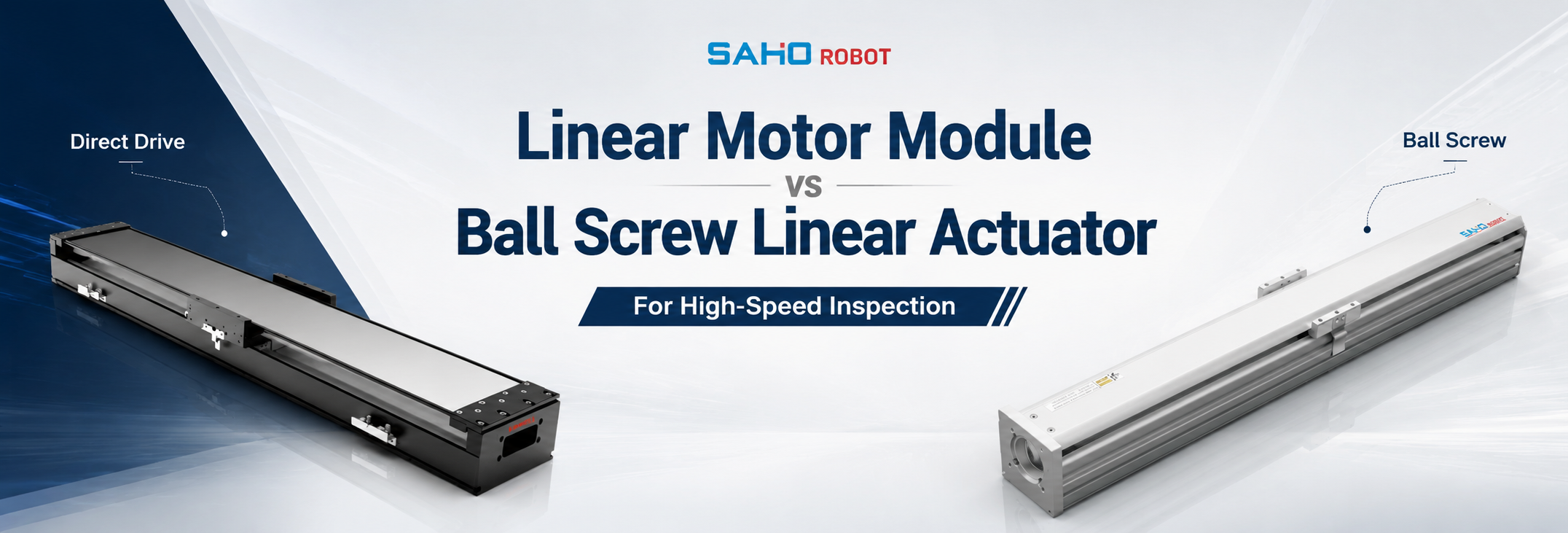
High-speed inspection equipment needs more than a fast axis. It needs stable motion while a camera, laser sensor or measuring probe collects data. The choice between a Linear Motor Stage and a ball screw linear actuator affects scan quality, settling time, repeatability, cycle time, load support and maintenance planning.
A direct-drive linear motor stage is usually the stronger starting point for continuous scanning, fast response and high-frequency short moves. A screw-driven module is usually the stronger starting point for stable indexed positioning, vertical adjustment, heavier inspection heads and compact stations that do not require extreme acceleration.
This guide compares the SAHO NK direct-drive linear motor module with the SAHO SDM ball screw linear actuator for line-scan vision, stop-and-capture inspection, laser measurement, semiconductor and electronics inspection, battery inspection and multi-axis machine layouts. It also explains how a linear motor stage works, what data should be prepared and when a combined NK and SDM system is the better engineering choice.
| Quick direction for inspection projects | |
| Choose SAHO NK first when: The camera or sensor collects data while the axis is moving, the inspection path contains many rapid moves, or shorter response and settling time are important. | Choose SAHO SDM first when: The camera captures after the axis stops, the moving structure needs stronger mechanical support, or the axis is used for height adjustment, indexing or vertical positioning. |
| Use both when: one machine has a high-speed scan axis plus camera-height, fixture-positioning or loading axes with different motion requirements. | |
What Is a Linear Motor Stage and How Does Direct Drive Work?
A linear motor stage is a precision positioning platform that converts electromagnetic force directly into straight-line movement. Unlike a conventional module that transfers rotary motor motion through a ball screw, timing belt or rack-and-pinion mechanism, a direct-drive stage produces force along the travel direction without an intermediate mechanical transmission.
This structure can support high acceleration, fast response, smooth motion and precise positioning while reducing transmission components that can introduce backlash, elasticity or wear. It does not remove every mechanical consideration: the guideway, encoder, cables, moving platform, machine frame and controller tuning still determine the final motion quality.
Linear Motor Mover & Stator
The mover is connected to the moving platform, while the stator provides the magnetic field required for direct motion. Their electromagnetic interaction generates thrust without a screw-nut pair, coupling or timing-belt transmission in the main drive path. The motor should be selected by continuous thrust, peak thrust, moving mass, acceleration, duty cycle and thermal margin rather than by maximum speed alone.
Precision Linear Guideway
The linear guideway supports the moving platform and controls straightness, rigidity and moment load. Smooth direct drive cannot compensate for an undersized guide, excessive tool offset or a flexible camera bracket. Guide load and center of gravity therefore need to be checked together with payload weight.
Rigid Structural Base & Feedback System
A rigid aluminum structure keeps the stage compact while supporting dynamic response. Encoder feedback closes the positioning loop and allows the controller to correct motion in real time. In inspection equipment, the base, optical bracket, cable carrier and controller settings must work as one system because vibration or cable drag can reduce the benefit of the direct-drive structure.
Why Inspection Motion Is Different from Simple Transfer Motion
A transfer axis mainly moves a part from one station to another. An inspection axis may carry a camera, lens, light source, laser head, measuring probe, cable carrier and protective cover. The useful result is not only that the carriage reaches the target, but that the sensor can collect reliable data at the required moment.
Continuous inspection and indexed inspection create different motion priorities. Line-scan vision and laser profile measurement depend on stable velocity while data is being captured. Stop-and-capture inspection depends on move time, deceleration, residual vibration and the delay before the image trigger can be released.
This is why maximum speed is not a sufficient selection value. A technically faster axis can still produce a slower inspection cycle when it requires a long settling delay, while a stable screw-driven axis may be more efficient for fixed-point measurement with moderate travel and acceleration.
Velocity Stability & Trigger Synchronization
In continuous scanning, the controller, encoder and inspection trigger must share a predictable relationship. The sensor may collect data by time interval, encoder position or an external trigger. Uneven speed can change the distance between samples, while communication delay or an unstable trigger can shift the inspection result away from the intended coordinate.
The actuator therefore needs to be evaluated together with the camera exposure, sensor sampling frequency and motion-control method. A direct-drive stage can provide a strong mechanical basis for smooth travel, but reliable inspection still requires correct synchronization and enough controller bandwidth for the planned acceleration and velocity profile.
Settling Time & Residual Vibration
In indexed inspection, the relevant value is not only positioning time. The camera may need to wait until the stage, bracket and lens stop oscillating within the acceptable image or measurement tolerance. A heavy light source, a tall bracket or an offset sensor can extend this delay even when the actuator reaches the commanded position quickly.
Settling performance should be checked with the real moving assembly and the planned machine base. Servo tuning can reduce residual movement, but it cannot fully correct a flexible frame or poor load distribution. Mechanical stiffness, load center, acceleration profile and controller settings need to be reviewed together.
SAHO NK Direct-Drive Linear Motor Stage for Fast Scanning
The SAHO NK Series is a direct-drive linear motor module with a protected stage structure. The steel belt in the product description is a protective covering element; it is not a timing-belt drive. Motion is generated by the linear motor, so the main drive path does not rely on a screw, coupling or pulley transmission.
NK is well suited to inspection paths that require high-speed movement, fast acceleration and smooth travel. In line-scan vision, more consistent carriage velocity can help maintain more uniform image sampling. In short-stroke indexed inspection, fast response can reduce non-inspection movement when the platform, frame and controller are properly matched.
Direct drive also reduces wear in the transmission path, but it should not be described as completely maintenance-free. Guideways, cables, encoder components, protective elements and the working environment still require inspection. Thermal behavior must also be reviewed when the stage operates with high duty cycle or demanding acceleration.
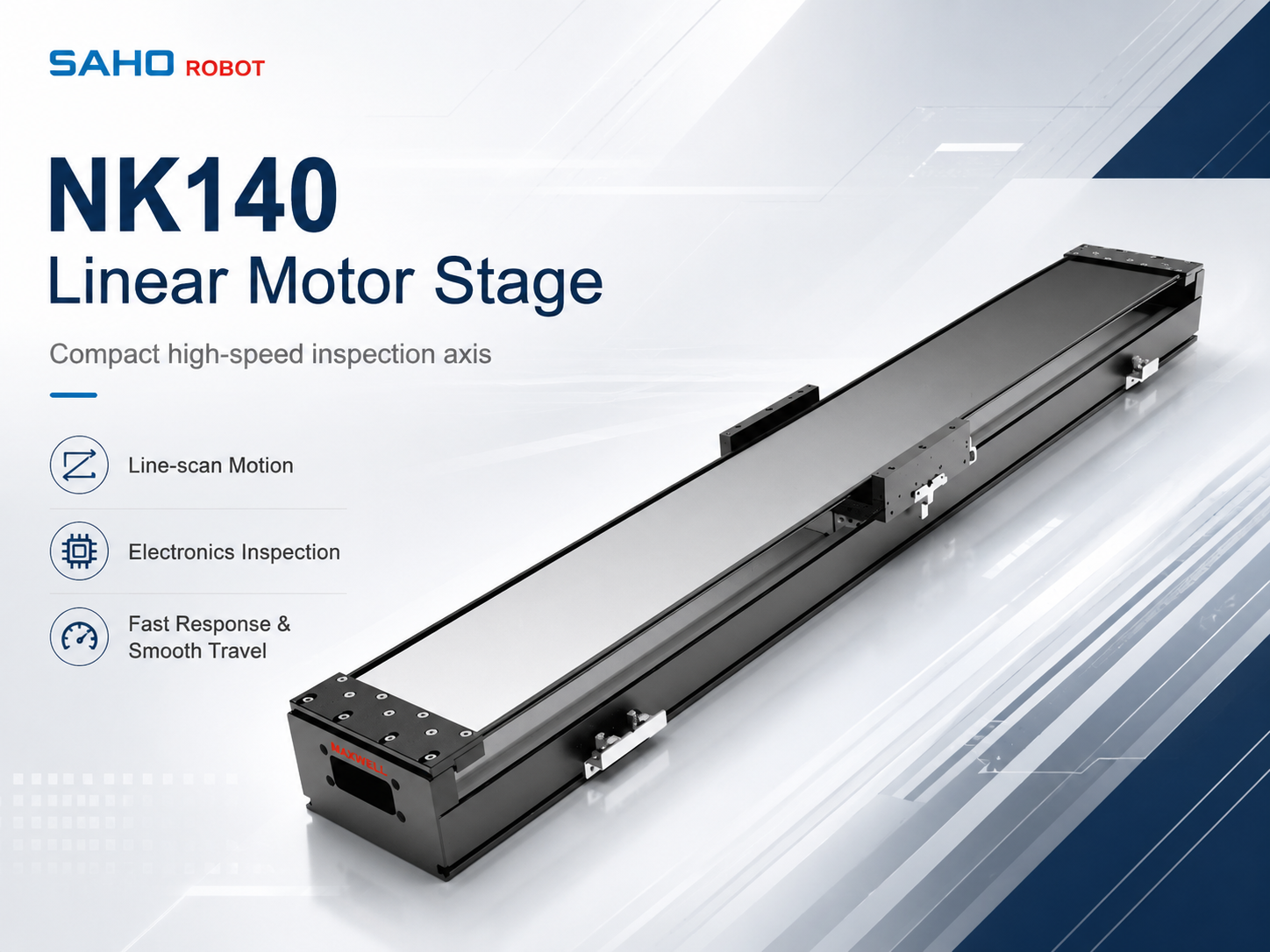
NK140 can be reviewed for compact high-speed inspection axes, line-scan motion, electronics inspection and precision positioning stations that need fast direct-drive response.
NK is usually the better starting point for:
Line-scan camera inspection where image data is collected during movement.
Laser profile or displacement scanning that needs stable sampling distance.
Dense inspection paths with many rapid moves and a tight cycle-time target.
Semiconductor, electronics, battery and optical equipment where direct-drive response and reduced transmission wear are valuable.
SAHO SDM Ball Screw Linear Actuator for Stable Indexed Positioning
The SAHO SDM Series combines a precision ball screw, linear guideway and rigid aluminum profile for stable positioning, repeatable stopping and practical load support. It is a strong choice when the inspection head moves to defined coordinates and the camera or sensor collects data after the carriage has settled.
SDM can be used for camera positioning, sensor-height adjustment, fixture indexing, probe movement and vertical inspection axes. The screw-driven structure is useful when thrust, rigidity, holding behavior or a compact standard servo arrangement matters more than extreme acceleration.
The final model still depends on screw lead, payload, center of gravity, stroke, speed, duty cycle and installation direction. Lubrication, coupling alignment, screw condition and guide movement should be included in the service plan. Vertical or inclined layouts may also require a brake motor, mechanical lock or other gravity-drop protection.
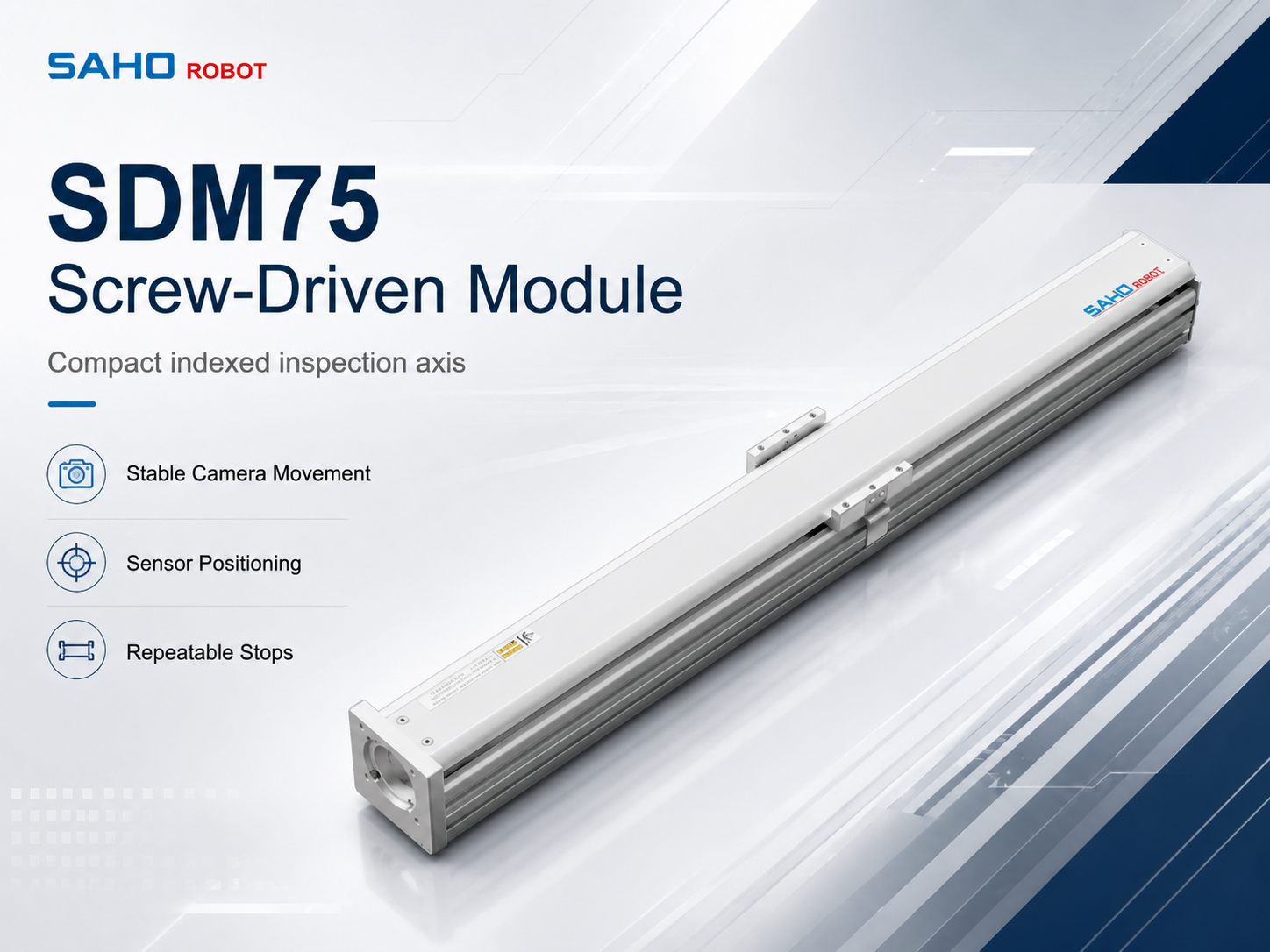
SDM75 can be reviewed for compact indexed inspection, camera movement, sensor positioning and automation layouts that need accurate repeatable stops.
SDM is usually the better starting point for:
Stop-and-capture inspection where the image trigger is released after settling.
Camera positioning, sensor-height adjustment and fixture indexing.
Heavier camera, lighting or probe assemblies that require practical thrust and rigidity.
Vertical or inclined axes where holding stability and safety planning are important.
Linear Motor Stage vs Ball Screw Linear Actuator for Inspection
The useful comparison is not simply “which technology is better.” Each drive structure solves a different motion problem. The comparison below focuses on the motion factors that directly affect inspection speed, stability and measurement quality.
| Acceleration and response | |
| NK direct drive: Better starting point for rapid acceleration and frequent short moves when thrust and thermal margin are correctly selected. | SDM screw drive: Suitable when acceleration stays within screw critical speed, motor, lead and duty-cycle limits. |
| Motion during data capture | |
| NK direct drive: Strong for line-scan vision, laser profile scanning and continuous measurement where velocity quality matters. | SDM screw drive: Strong for fixed-point measurement and stop-and-capture inspection after the carriage becomes stable. |
| Load support and vertical use | |
| NK direct drive: Selected by continuous thrust, peak thrust, guide capacity, moving mass and thermal condition; vertical use needs dedicated holding and safety review. | SDM screw drive: Practical for stronger thrust, load holding and vertical adjustment when the model, brake and safety structure are correctly sized. |
| Maintenance and long-term behavior | |
| NK direct drive: No screw, coupling or belt transmission in the drive path; guide, cable, encoder, protection and cleanliness still need attention. | SDM screw drive: Requires planned lubrication and inspection of the screw, guide, coupling alignment and operating condition. |
| Typical role in an inspection machine | |
| NK direct drive: Main scan axis, high-speed vision axis, laser scan axis or high-frequency positioning axis. | SDM screw drive: Camera-positioning axis, Z-adjustment axis, probe axis, fixture-indexing axis or stable stop axis. |
Application Scenarios and the Better Starting Direction
Line-scan camera inspection
A line-scan image is built while the camera or product moves. Velocity variation can change pixel spacing and distort the result. NK is normally the better starting direction because direct drive can support smooth travel and rapid response. The frame, optical bracket, encoder, trigger signal and cable carrier must still be designed as part of the scan system.
Stop-and-capture visual inspection
The axis moves to a coordinate, stops, waits for vibration to fall within the acceptable range and triggers the camera. SDM is often suitable for moderate-speed indexed inspection because it provides stable screw-driven positioning. NK should be reviewed when the number of points is high and the move-plus-settle time becomes the main cycle constraint.
Laser displacement and profile measurement
NK is normally preferred for continuous laser scanning across a surface because stable movement supports more consistent sampling distance. SDM can be a practical choice for point measurement, fixture checking, height inspection or alignment verification when the sensor records data only after the axis stops.
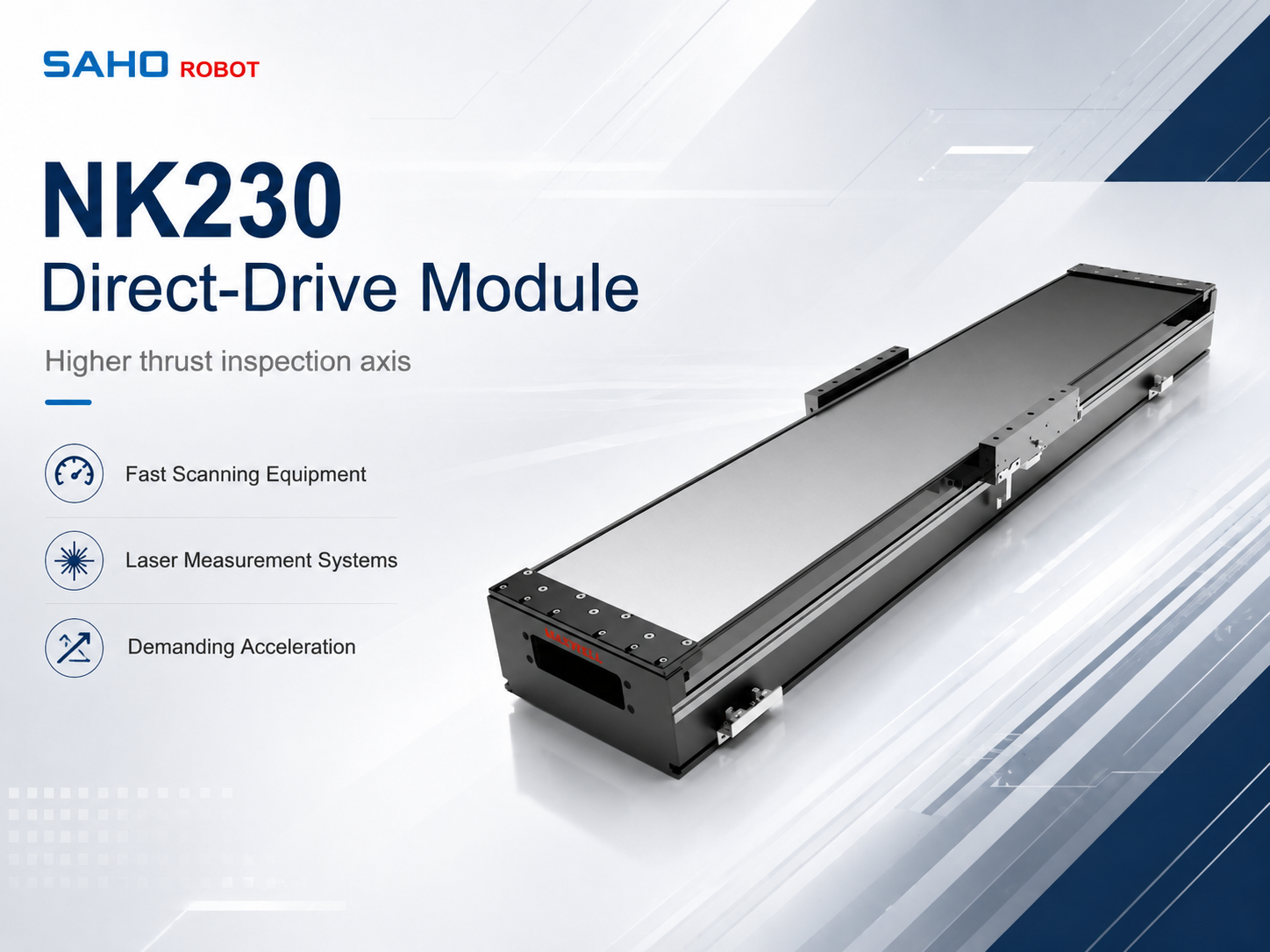
NK230 can be reviewed for higher-thrust direct-drive inspection axes, laser measurement systems and multi-axis platforms with demanding acceleration profiles.
View NK230 Direct-Drive Module
Semiconductor and electronics inspection
Wafer inspection, display inspection, PCB checking and fine-pitch component inspection may combine long scan paths with many local positioning moves. NK can serve the main high-speed scan axis, while SDM can position a camera, adjust sensor height or move a fixture. Selecting each axis by its own motion task is usually more reliable than applying one actuator structure to the entire machine.
Battery and new energy inspection
Cell-surface inspection, tab inspection, module dimension measurement and edge alignment can require both scanning and indexed motion. NK is suitable for continuous sensor paths, while SDM can support camera brackets, laser heads, probe movement and vertical adjustment where the moving assembly is heavier or offset from the carriage center.
Other precision automation applications
The same direct-drive stage structure can also be used in laser marking and precision laser positioning, semiconductor handling, high-speed automated assembly, testing equipment, optical measurement and laboratory automation. These applications should still be evaluated by load, stroke, acceleration, positioning target, environment and duty cycle rather than by industry name alone.
How to Select the Axis for a Real Inspection Station
Begin with the inspection method. State whether the sensor measures during movement or after stopping. This single decision separates constant-velocity scan requirements from indexed positioning and settling requirements.
Calculate the complete moving assembly, not only the camera or sensor. Include the lens, lighting, mounting plate, cable carrier, air tubes, protective cover and any offset between the load center and carriage center. An offset load creates moment force and can increase vibration even when the payload weight appears acceptable.
Review the full cycle: acceleration, constant-speed travel, deceleration, settling, exposure, sensor sampling and software processing. This makes it possible to compare useful inspection output instead of catalog speed alone.
| Data to prepare | How it affects the decision |
| Inspection method | Separates continuous scanning from stop-and-capture positioning. |
| Stroke and effective travel | Defines module length, usable scan range, cable path and installation space. |
| Moving load and center of gravity | Determines motor thrust, guide load, moment load and vibration risk. |
| Speed, acceleration and motion profile | Shows whether direct drive or screw drive better fits the cycle. |
| Accuracy, repeatability and settling time | Connects axis performance with the moment when reliable data can be captured. |
| Installation direction | Horizontal, side-mounted, inclined and vertical layouts have different load and safety requirements. |
| Duty cycle and environment | Affects heat, lubrication, protection, service interval and long-term stability. |
| Cable and air-tube routing | Cable drag can change smooth motion, servo tuning and settling behavior. |
Controller, encoder and motion-profile matching
A linear motor stage depends strongly on feedback and control quality because the controller acts directly on the moving platform. Encoder resolution, feedback type, driver compatibility, controller update rate and tuning method should be confirmed before the mechanical layout is frozen. The selected feedback system must also match the actual accuracy and repeatability target instead of being chosen only by the highest available resolution.
For both NK and SDM, provide a realistic motion profile rather than only maximum speed. Travel distance, target speed, acceleration time, constant-speed distance, deceleration, dwell and repeats per minute allow the supplier to review motor capacity, screw limits, thermal margin and expected cycle behavior with fewer assumptions.
Customized Linear Motor Stage and Multi-Axis Integration
A standard product category is only the first step. A direct-drive stage can be configured around stroke length, motor thrust, moving load, encoder feedback, installation direction, cable arrangement and machine interface. The required configuration should be based on the actual motion cycle and available machine space.
Multi-axis inspection platforms often combine different structures. An NK stage can be used for the main scanning direction, while SDM modules position the camera, adjust working height or move the fixture. XY, XYZ and gantry layouts should also consider cross-axis moving mass because an upper axis becomes part of the lower axis payload.
Before requesting a customized solution, define the required stroke, motor and encoder expectations, payload, center of gravity, installation configuration, controller interface and whether drawings are needed for equipment integration. This helps the supplier review a real system instead of recommending a model from incomplete data.
Selection Mistakes That Reduce Inspection Performance
Choosing by maximum speed: the real cycle includes acceleration, deceleration, settling, exposure and processing time.
Treating all inspection methods as the same: continuous scanning needs stable velocity, while stop-and-capture work needs stable position after movement.
Counting only camera weight: lighting, brackets, cables, covers and tool offset can change guide and moment loads.
Ignoring frame and cable stiffness: a fast stage can reveal vibration from a weak base, flexible optical bracket or poorly routed cable carrier.
Using one technology on every axis: a machine may perform better when NK handles scanning and SDM handles adjustment or indexing.
Skipping vertical-axis safety review: brake, lock, gravity direction and safe stopping need to be confirmed before installation.
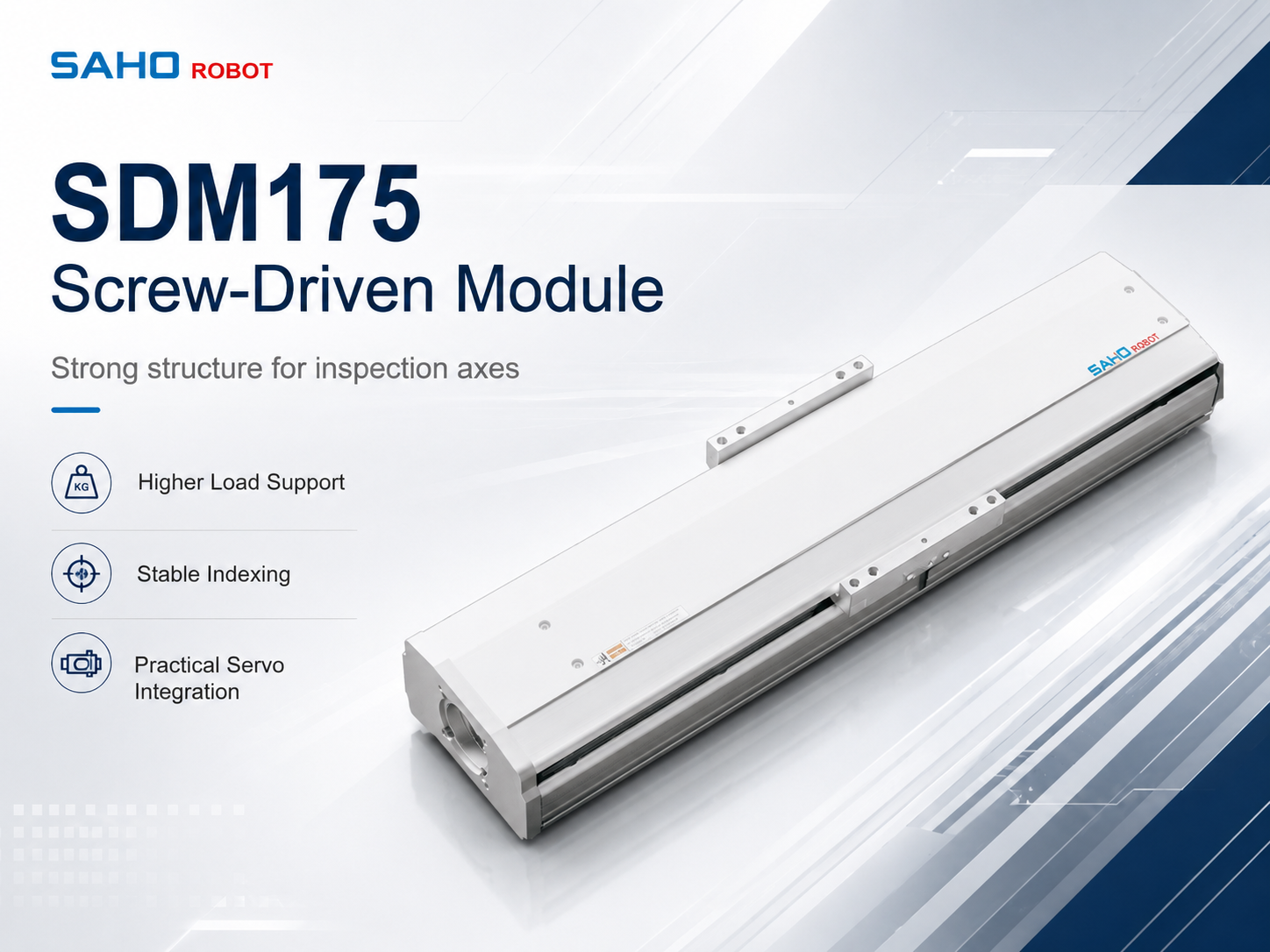
SDM175 can be reviewed when an inspection axis needs a larger frame, stronger structural support, stable indexing and practical servo integration.
Practical Purchasing Advice
Ask for selection based on the full inspection cycle, not a general statement that one actuator is faster or more precise. The proposal should explain how the selected model matches payload, acceleration, settling, duty cycle and installation direction.
Confirm what is included in the motion unit and what remains part of the machine design. Motor, encoder, guideway, protective cover, driver, controller, cable carrier, mounting plate and brake requirements may be handled differently from one project to another.
For a demanding inspection axis, request verification conditions that reflect the real machine: moving load, stroke, motion profile, mounting direction and capture method. A no-load demonstration cannot confirm the settling behavior of a complete camera and lighting assembly.
Plan maintenance access before finalizing the layout. SDM needs access for lubrication and screw-drive inspection. NK removes the screw or belt transmission from the drive path, but the guide, cable, feedback system and protective structure still need clean operation and periodic checks.
What to confirm before approving the axis
Usable travel: confirm that the stated stroke leaves enough space for acceleration, deceleration, sensor clearance, hard stops and cable movement.
Load condition: verify the complete moving mass, center of gravity and mounting orientation used for selection, not an unloaded catalog condition.
Motion result: agree on speed, repeatability and settling expectations under the planned motion profile instead of using isolated maximum values.
Control package: confirm motor, driver, encoder, controller interface, limit sensors and cable requirements, including which items are supplied and which are customer-provided.
Installation and safety: check mounting surfaces, flatness, vertical holding, brake requirements, emergency stopping and access for service.
Integration documents: request the drawings, interface dimensions and configuration details needed to complete the machine design before production release.
FAQ
Is a linear motor stage always more accurate than a ball screw actuator?
Not automatically. A direct-drive stage can support high-response precision motion, but final accuracy depends on the encoder, guideway, base stiffness, thermal condition and controller tuning. A correctly selected ball screw actuator can provide very stable repeatable positioning for indexed inspection.
When is NK the better choice for inspection?
NK is normally the better starting point for line-scan vision, continuous laser measurement, high-frequency short moves and other applications where fast response, smooth travel and reduced mechanical transmission wear are important.
When is SDM the better choice?
SDM is normally the better starting point for stop-and-capture inspection, camera or sensor adjustment, fixture indexing, heavier tooling and vertical positioning where thrust, rigidity and stable stopping are more important than extreme acceleration.
Does a direct-drive linear motor stage require no maintenance?
Direct drive reduces maintenance associated with screws, couplings and timing-belt transmission, but the complete stage is not maintenance-free. Guideways, cables, encoder components, protective structures and the operating environment still need inspection and suitable service.
Can NK and SDM be used in the same machine?
Yes. A common layout uses NK for the main scan axis and SDM for camera height, probe position or fixture indexing. This allows each axis to match its own speed, load, accuracy and safety requirement.
What information should be sent for model selection?
Provide the inspection method, stroke, effective travel, complete moving load, center of gravity, speed, acceleration, accuracy or repeatability target, settling requirement, installation direction, duty cycle, cable routing, working environment and available installation space.
Final Selection Direction
Choose a SAHO NK linear motor stage when the inspection result depends on smooth scanning, fast direct-drive response or a high number of rapid movements. Choose a SAHO SDM ball screw linear actuator when the equipment needs stable indexed positioning, practical thrust, compact mechanical support or vertical adjustment.
The best answer may be a combined system. A high-speed inspection platform can use NK for the motion that directly affects data capture and SDM for axes that position the camera, sensor or fixture. The final decision should be based on the complete motion profile and machine structure, not on a single catalog value.
| Prepare these details before contacting SAHO: inspection method, stroke, moving load, center of gravity, acceleration target, settling requirement, installation direction, duty cycle, cable arrangement and working environment. |







-
-
 English
 -
 Français
 -
 Deutschland
 -
 Italia
 -
 Polska
 -
 España
 -
 Русский язык
 -
 日語
日語 -
 한국
한국 -
 Türkiye
 -
 português
 -
 بالعربيةês
 -
 Tiếng Việt
 -
 คนไทย
คนไทย -
 简体中文
简体中文 -
繁體中文
-