

Date:2026-06-29 Click:383
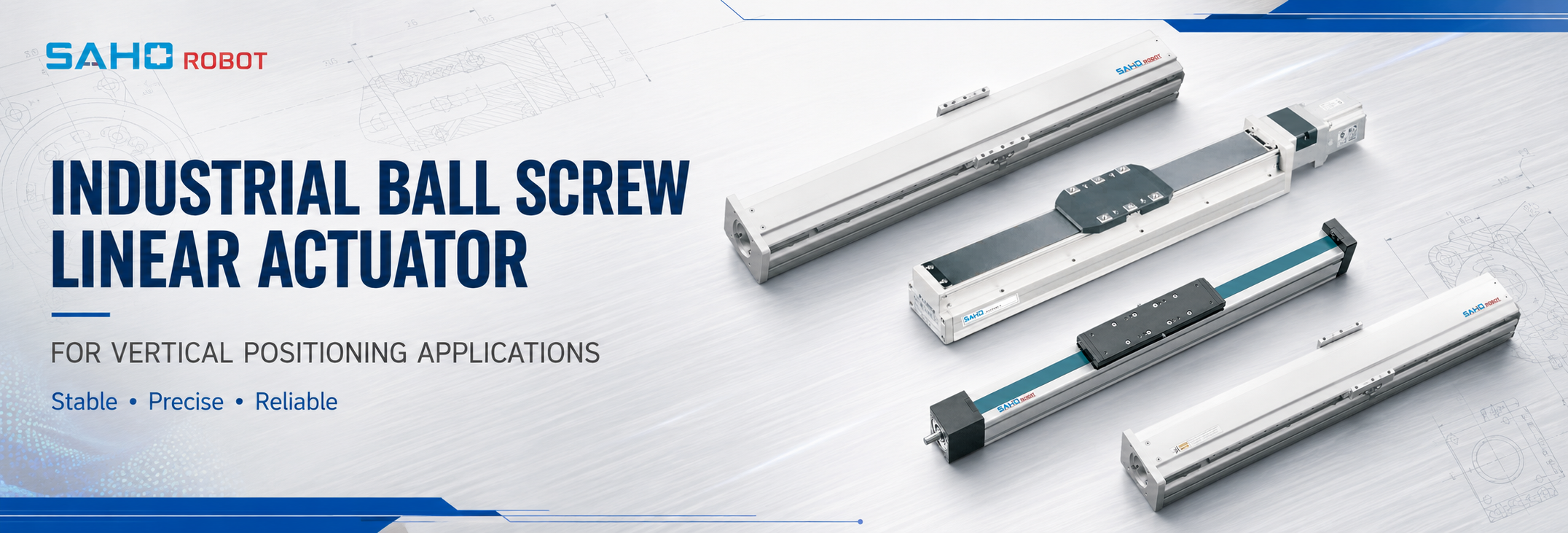
In vertical positioning equipment, an industrial ball screw linear actuator must do more than move a carriage up and down. It has to support constant gravity load, hold position during stop conditions, maintain stable repeatability, and fit into a compact machine frame without creating excessive vibration, deflection, or moment load.
For vertical Z-axis automation projects, the key is not only choosing a screw drive module by catalog payload. The full motion structure should be reviewed according to moving mass, stroke, speed, screw lead, brake motor demand, rigidity, safety margin, mounting direction, and working environment. SAHO Robot provides SDM, SDH, and JTS screw drive actuator series for different vertical positioning requirements, including rigid load support, compact built-in installation, and cleaner protected machine structures.
Vertical Ball Screw Actuator Selection FocusA vertical ball screw actuator should be selected by real application data, not only by rated load. Gravity acts on the axis during every movement, pause, alarm, emergency stop, and power-off state.
|
Why Vertical Z-Axis Motion Requires Special Engineering Review
Horizontal linear axes mainly overcome friction, inertia, and process resistance. A vertical axis is different because gravity constantly pulls the moving structure downward. This means the actuator must lift the load, lower it in a controlled way, stop it at a defined height, and keep it stable when the machine pauses or loses servo power.
The moving load usually includes more than the part being carried. It may include the carriage, adapter plate, gripper, fixture, press head, inspection camera, cable chain, sensor bracket, hose, and maximum workpiece weight. If the center of gravity is away from the actuator face, even a light tool can create high moment load on the guide structure.
For this reason, a vertical ball screw linear actuator should be reviewed as part of the complete machine structure. Screw drive, guide rail, slider spacing, motor torque, brake torque, mounting plate flatness, and safety logic should work together to support stable Z-axis positioning.
Key Benefits of Ball Screw Actuators in Vertical Positioning
Stable Load Holding During Stop Conditions
In a vertical installation, stopping performance is as important as moving performance. A Z-axis may stop while holding a suspended fixture, camera, dispenser, gripper, or press head. The selected screw lead, motor torque, brake motor, and controller sequence all influence whether the carriage stays stable after motion ends.
For example, a gripper may wait above a conveyor before picking a part. A vision camera may hold a fixed focus height during inspection. A press-fit head may pause before applying force. In each case, the vertical axis should avoid slipping, settling, shaking, or unexpected height change.
Repeatability for Consistent Process Height
Many automation machines repeat the same vertical movement hundreds or thousands of times per shift. Small height differences can affect insertion depth, dispensing gap, laser focus, inspection distance, pressing position, or pick-and-place stability.
A properly selected ball screw actuator provides a predictable relationship between motor rotation and linear travel. When the ball screw, linear guide, slider, coupling, servo tuning, and mounting surface are matched correctly, the vertical axis can return to the required working height with stable repeatability.
High Rigidity for Tooling and Offset Moment Loads
Vertical modules often carry tooling that extends outward from the carriage. This creates cantilever moment load on the guide rails and sliders. If the actuator frame, slider spacing, or mounting plate is not rigid enough, the axis may lose repeatability, create vibration, or wear prematurely.
A stiff actuator also needs a stiff machine base. The mounting plate should support the full actuator body without twist, and the tooling plate should reduce unnecessary overhang whenever possible. For multi-axis systems, the horizontal axis carrying the Z-axis must also support the full actuator, motor, tooling, and workpiece mass.
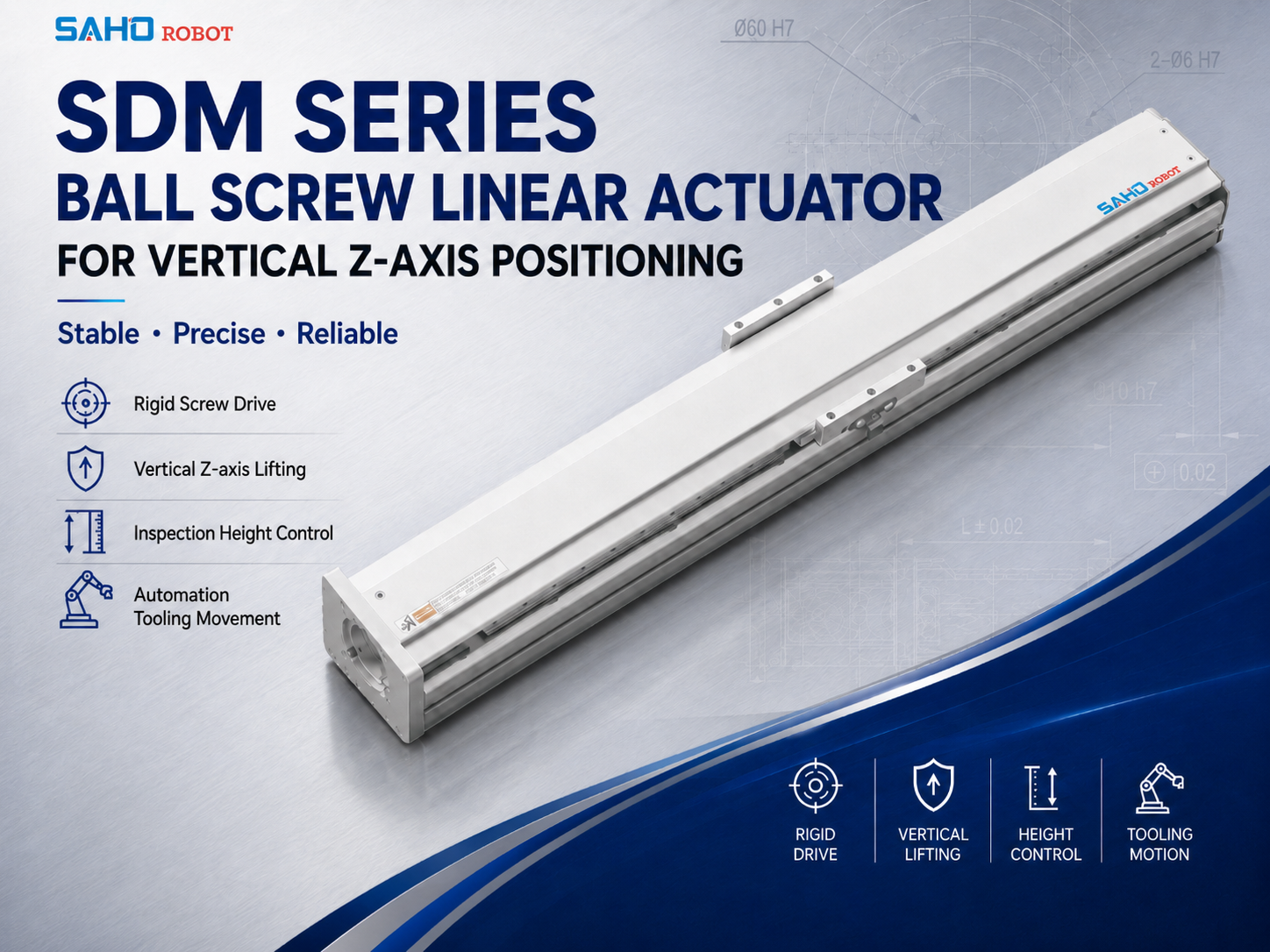 SDM Series supports rigid screw-driven positioning for vertical Z-axis lifting, inspection height control, and automation tooling movement. |
Applications for Vertical Ball Screw Linear Actuators
In industrial automation, vertical ball screw actuators usually work as Z-axis motion modules. They lift, lower, position, focus, press, clamp, inspect, and support different tools inside automatic equipment. The main goal is controlled vertical movement with stable height, proper safety margin, and reliable structure.
For broader automation context, the Association for Advancing Automation covers robotics, vision, motion control, and factory automation technologies. In a real machine, a vertical actuator turns these automation requirements into repeatable linear movement.
Precision Assembly Equipment
Precision assembly equipment often needs a controlled approach to the workpiece. A tool head may lower to place a component, insert a pin, press a connector, close a fixture, or align small parts. The Z-axis should move smoothly, stop cleanly, and avoid bounce at the working height.
Many assembly cycles require multiple stop heights, such as safe height, approach height, working height, and return height. Stable repeatability helps keep insertion depth, pressure position, and assembly quality consistent across repeated production cycles.
Electronic Component Manufacturing
Electronic component equipment often uses delicate tooling such as vacuum pick-up heads, micro dispensing valves, test probes, and small inspection cameras. These tools may be light, but they still require stable vertical travel and smooth acceleration to prevent scratches, vibration, or part damage.
Compact structure is also important in electronics machinery. Several axes may be installed close together inside one frame. The actuator body width, motor direction, wiring exit, sensor position, and cover clearance should be reviewed before final model selection.
Lithium Battery and New Energy Production
Battery and new energy production equipment may use vertical axes for stacking, loading, pressing, inspection, transfer, coating support, and fixture positioning. Because the workpieces can be thin, sensitive, or easily deformed, controlled vertical movement is often more important than simple lifting.
Many battery production lines run for long duty cycles. The vertical actuator should be checked for screw life, guide lubrication, motor heat, brake use, dust protection, and stable performance after repeated movement.
Laser Focus and Optical Inspection
Laser and optical inspection systems may use a short vertical axis to adjust focus height or measurement position. Even when the stroke is short, the stop position can be critical. The actuator should move with low vibration and hold a stable working height near the inspection point.
Optical assemblies can react strongly to vibration from brackets, cable chains, or sudden deceleration. A rigid mounting plate and a smooth approach profile help reduce image jitter and support stable inspection results.
Medical and Laboratory Automation
Medical and laboratory equipment often needs compact, clean, and controlled vertical travel. Sample tray lifting, pipette positioning, small instrument movement, and microscopic imaging adjustment may all require precise Z-axis positioning.
Machine space may be limited by covers, protective doors, sensors, and adjacent mechanisms. A compact built-in actuator structure can help the design stay organized, but load capacity, moment load, stroke, and brake demand still need full review.
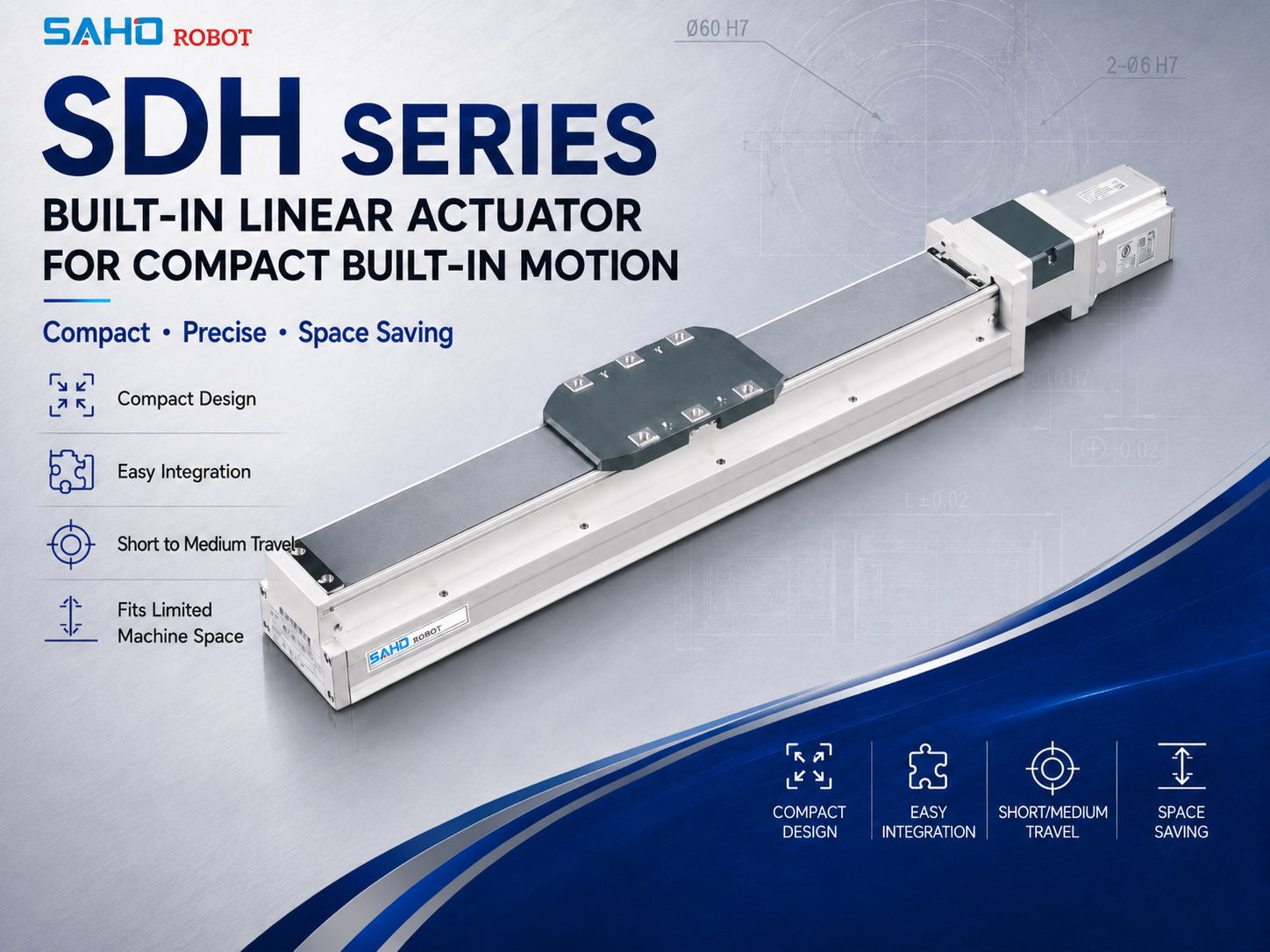 SDH Series is suitable for compact built-in motion where short to medium vertical travel must fit inside limited machine space. |
Gravity Load: The Main Difference in Vertical Axis Design
Gravity load is the first design difference between horizontal and vertical axes. In a horizontal axis, the motor mainly handles friction and acceleration. In a vertical axis, the motor and brake system must also manage the constant downward force created by the full moving mass.
The full moving mass should include every component that moves with the carriage: tool plate, fixture, gripper, camera, dispenser, workpiece, hose, cable chain, sensor bracket, and any moving cover or adapter. If the load is mounted away from the carriage center, the offset distance should be included because it increases moment load on the guide structure.
Vertical selection should not rely on payload alone. Static load, dynamic load, moment load, stop behavior, brake holding, stroke reserve, and mounting rigidity should all be reviewed before the actuator series and motor configuration are confirmed.
| Vertical Axis Factor | Core Risk Without Proper Sizing | Required Application Data |
| Total moving mass | Insufficient lifting thrust, motor overload, brake stress, or position settling. | Tooling, fixture, workpiece, cable chain, hose, and moving bracket weight. |
| Effective stroke | Overlong screw, vibration, high machine height, or insufficient process clearance. | Working travel, safe height, home position, overtravel, and maintenance reserve. |
| Speed and acceleration | Excessive dynamic load, unstable stop behavior, screw fatigue, or vibration. | Target speed, cycle time, acceleration time, and deceleration time. |
| Cantilever moment load | Premature guide wear, carriage deflection, vibration, or repeatability loss. | Tool overhang length, center of gravity distance, bracket size, and force direction. |
| Power-off brake demand | Uncontrolled drop, product damage, tooling collision, or machine safety risk. | Suspended load weight, stop positions, emergency stop logic, and risk level. |
Brake Motor and Multi-Layer Safety for Vertical Positioning
Brake motor review is important for vertical positioning because gravity still acts on the moving mass when the axis stops. When servo power is disabled, a brake motor can help hold the axis in position and reduce the risk of downward movement during pause, alarm, emergency stop, or power-off conditions.
However, a brake motor should not be treated as the only safety device. A complete vertical axis design may also require proper screw lead selection, mechanical hard stops, counterbalance cylinders, safety lock devices, interlock sensors, controller logic, and safe motion programming.
Moving torque and holding torque are not the same. An axis may lift the load during normal movement but still need additional holding support during stop or power-off. Motor data should include rated torque, peak torque, brake torque, inertia ratio, duty cycle, and expected load changes after future tooling upgrades.
As an engineering reference, many vertical-axis projects should reserve a practical safety margin for brake torque, dynamic load, and screw thrust instead of selecting components close to the limit. A commonly used review direction is to leave around 1.5 times margin for higher-risk suspended loads, while the final value should be confirmed according to actual load, speed, installation direction, and equipment safety requirement.
When Brake Motor Review Becomes Necessary
The vertical axis carries suspended tools, fixtures, grippers, cameras, or workpieces.
The axis stops at several working heights during one production cycle.
Fast acceleration or deceleration increases dynamic load during movement.
The equipment has collision risk if the carriage moves downward unexpectedly.
Heavy-load vertical lifting or high-risk production stations require safety redundancy.
Why Ball Screw Drives Are Often Preferred for Vertical Axes
Belt drive linear modules are useful for many fast horizontal transfer applications, but vertical positioning usually requires stronger holding stability and more direct thrust control. Under gravity load, belt elasticity and tension change can influence height stability, especially when the axis carries suspended tooling or stops at multiple working positions.
A ball screw drive offers a more rigid mechanical transmission path for lifting, lowering, and stopping. This makes it suitable for vertical Z-axis tasks that require stable height repeatability, controlled approach motion, brake motor review, and accurate position holding. The final choice should still be based on load, stroke, speed, environment, installation space, and safety requirements.
SAHO SDM, SDH, and JTS Series for Vertical Ball Screw Motion
Different vertical load conditions lead to different actuator series choices. The selection process should start with application data, not only with a model number. After load, stroke, speed, accuracy, installation space, and protection needs are clear, SDM, SDH, and JTS can be compared according to machine structure.
| SAHO Series | Recommended Use | Vertical Positioning Value |
| SDM Series | General automation, rigid screw drive motion, higher load Z-axis structures, and multi-axis layouts. | Suitable for lifting heads, tool plates, inspection units, pressing stations, and stable vertical modules. |
| SDH Series | Compact built-in motion, short to medium stroke equipment, and narrow internal machine layouts. | Suitable for compact Z-axis travel where space saving, neat installation, and integrated structure matter. |
| JTS Series | Protected screw drive layouts, cleaner machine structures, and reduced exposure of moving components. | Suitable for cleaner vertical motion where protection, appearance, and organized structure are important. |
SDM Series: Rigid Vertical Z-Axis Support
The SDM Series is a strong choice for many vertical automation layouts. It supports screw-driven linear motion with a rigid structure and stable guide support. It can be used for lifting, positioning, inspection height adjustment, tool movement, and multi-axis XZ, YZ, or XYZ systems.
In practical equipment, SDM is useful when the vertical axis needs stronger frame support, larger tooling plates, or stable movement under repeated production cycles. Model size should match moving mass, stroke length, desired speed, repeatability demand, and brake motor configuration.
SDH Series: Compact Built-In Vertical Motion
The SDH Series is suitable for compact built-in structures. Small machines often need vertical motion inside limited space, behind covers, or close to other moving parts. SDH is useful when installation space, width control, and machine enclosure layout are key selection factors.
Compact design still requires load review. A small actuator can become overloaded if the bracket is long or the center of gravity is far from the carriage. Load weight and load offset should be shared together before selecting the final SDH model.
JTS Series: Cleaner Protected Screw Drive Layout
The JTS Series is suitable where a covered or cleaner screw drive layout is preferred. It can help reduce direct exposure of the ball screw and guide area while supporting a more organized machine structure. This makes JTS relevant for equipment with cleanliness, protection, appearance, or maintenance requirements.
A protected structure does not remove the need for engineering review. Stroke, payload, moment load, speed, motor direction, brake demand, mounting plate rigidity, and environmental conditions still decide whether the axis is suitable.
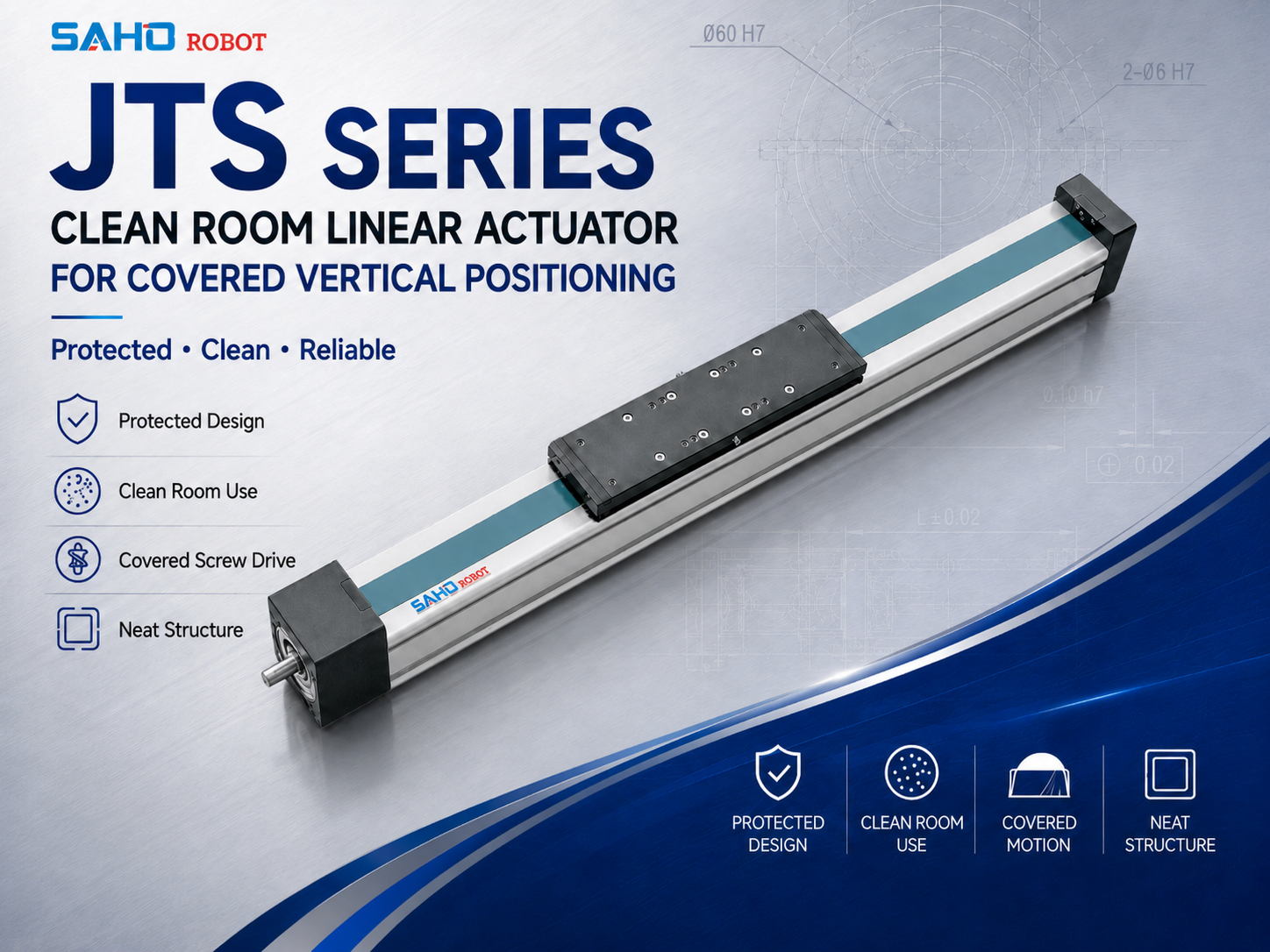 JTS Series supports clean and protected screw drive layouts for vertical positioning where covered motion and neat structure are important. |
Common Selection Mistakes to Avoid
Only Checking Catalog Payload
Payload is important, but it does not show the full vertical-axis stress. A heavy load mounted close to the carriage may be easier to support than a lighter tool installed on a long bracket. Moment load, speed, acceleration, brake demand, and mounting rigidity must also be included.
Ignoring Brake and Stop Behavior
Some projects focus only on travel speed and stroke. A vertical actuator also needs safe stop behavior. The review should include what happens during pause, alarm, servo-off, emergency stop, and power-off conditions.
For higher-risk lifting structures, a brake motor may not be enough by itself. A mechanical stop, counterbalance, lock device, or safety sensor may also be required according to the equipment risk level.
Choosing Stroke Without Clearance
Stroke should include more than the working travel. A vertical axis may need safe approach height, part loading clearance, home return distance, sensor space, and maintenance height. Effective stroke should be defined before the actuator model is chosen.
Overly long travel can also create problems. It may increase screw length, machine height, cost, and vibration risk. The best stroke is usually the shortest travel that still supports safe process movement and service access.
Treating the Vertical Axis as a Separate Part
A vertical module often works inside a larger motion system. It may attach to a horizontal actuator, gantry frame, rotary table, or fixed machine plate. If an X-axis carries the Z-axis, the base axis must support the actuator body, motor, tooling, and workpiece. Combined-axis stiffness is important for stable positioning.
Parameter Checklist Before Model Recommendation
A clear parameter list makes vertical actuator selection faster and more accurate. The following information helps SAHO review model size, screw lead, stroke length, brake motor needs, motor mounting direction, and safety margin.
Total moving mass, including tooling, fixture, workpiece, cable chain, hose, bracket, and adapter plate.
Center of gravity distance from the carriage mounting surface.
Effective stroke, safety clearance, home position, overtravel, and maintenance height.
Target speed, acceleration time, deceleration time, and production cycle time.
Repeatability requirement and working position accuracy demand.
Installation direction, vertical mounting method, and whether the load is suspended.
Servo motor preference, brake motor requirement, sensor position, and wiring direction.
Working environment, dust level, cleanliness requirement, temperature, and continuous duty cycle.
Need Vertical Axis Selection Support?SAHO can help review stroke, load, speed, repeatability, installation direction, brake motor demand, safety margin, and actuator series selection for vertical positioning equipment. Clear application data helps match SDM, SDH, JTS, or another suitable screw drive linear module solution. |
FAQ
What makes a ball screw actuator suitable for vertical positioning?
A ball screw actuator is suitable for vertical positioning when it provides enough thrust, rigidity, repeatability, and holding stability for the moving load. The guide structure must also support the moment load created by tooling and brackets.
Selection should include payload, stroke, speed, screw lead, motor torque, brake torque, installation direction, and safety margin. A single payload number is not enough for reliable vertical-axis sizing.
Why is a ball screw drive often preferred over a belt drive for vertical Z-axis motion?
A ball screw drive is often preferred for vertical Z-axis motion because it provides stronger thrust transmission, more stable position control, and better holding behavior for suspended loads. Belt drives can be useful for fast horizontal movement, but belt elasticity and tension change may affect height stability in vertical installations.
The final choice should still be reviewed according to load, stroke, speed, precision, installation space, and safety requirements. For precision vertical positioning, brake motor demand and stop behavior should be checked together with the actuator type.
When should a brake motor be used?
A brake motor should be considered when the vertical axis needs to hold a load during stop, alarm, servo-off, or power-off conditions. Because gravity continues to act on the moving mass, brake review is important before final motor selection.
The brake should be part of a wider safety plan. For higher-risk vertical structures, mechanical stops, counterbalance cylinders, safety sensors, or lock devices may also be required.
How should load and stroke be shared for selection?
Load information should include the full moving mass, workpiece weight, tooling weight, bracket length, cable chain weight, and center of gravity offset. Stroke information should include effective travel, safe clearance, home position, overtravel, and maintenance space.
Speed, acceleration, repeatability, installation direction, brake requirement, and environmental conditions should be provided together. With these details, the selection review can compare SDM, SDH, and JTS more accurately.
Which SAHO series is better for compact vertical motion?
For compact vertical motion, the SDH Series is often a suitable direction because it supports built-in actuator layouts. It can fit equipment where the motion axis must stay inside a limited machine structure.
Compact design does not replace calculation. Payload, offset distance, stroke, speed, brake demand, and mounting rigidity should be checked before model confirmation.
Can a vertical ball screw actuator be used in multi-axis automation systems?
Yes. A vertical ball screw actuator can work as a Z-axis in XZ, YZ, or XYZ systems. The complete structure should be reviewed because the base axis must carry the actuator body, motor, tooling, workpiece, and dynamic load during motion.
Conclusion: Select Vertical Motion by Load, Safety, and Real Machine Layout
Vertical positioning requires a careful balance of load support, brake motor use, rigidity, repeatability, compact structure, and safety margin. A screw drive module should not be selected by catalog payload alone. Real application data should guide the choice between SDM, SDH, JTS, or another SAHO screw drive linear module solution.
For a stronger selection process, three practical steps help reduce risk:
Calculate full moving mass and center of gravity before choosing the actuator frame size.
Review brake motor demand, stop behavior, and safety margin for vertical installation.
Compare SDM, SDH, and JTS based on load, stroke, speed, protection needs, and available installation space.
For an industrial ball screw linear actuator used in vertical positioning, SAHO can review the required stroke, load, speed, repeatability, brake requirement, installation direction, and working environment before recommending a suitable screw drive series.
Send Application Parameters to SAHOShare stroke, total moving load, speed, accuracy, installation direction, brake motor requirement, motor preference, and working environment. SAHO can help match the vertical motion requirement with SDM, SDH, JTS, or a related screw drive linear module solution. |







-
-
 English
 -
 Français
 -
 Deutschland
 -
 Italia
 -
 Polska
 -
 España
 -
 Русский язык
 -
 日語
日語 -
 한국
한국 -
 Türkiye
 -
 português
 -
 بالعربيةês
 -
 Tiếng Việt
 -
 คนไทย
คนไทย -
 简体中文
简体中文 -
繁體中文
-