

Date:2026-06-15 Click:543
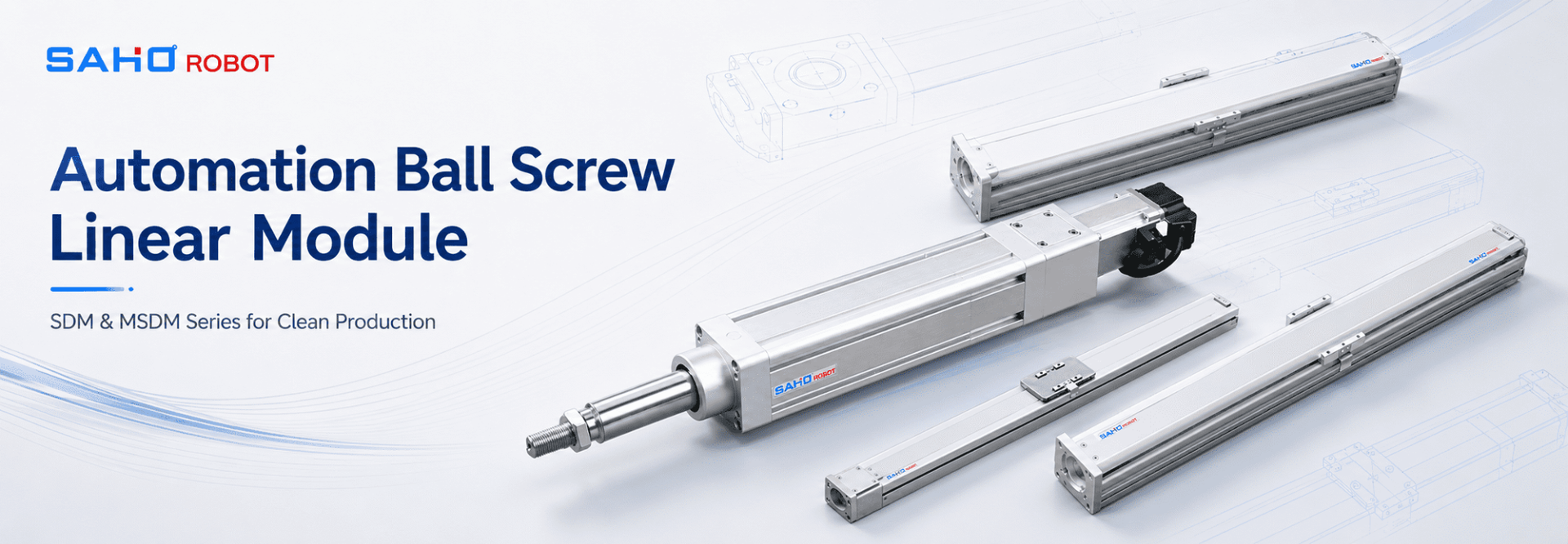
Clean production depends on motion that stays stable, accurate, compact, and easy to maintain. For equipment that needs controlled positioning, repeatable stops, and a tidy machine layout, an Automation Ball Screw Linear Module can support the process without adding unnecessary dust traps, unstable vibration, or difficult service work.
In many precision production lines, the motion task looks simple at first. A fixture moves forward, a camera shifts position, a tray reaches the next station, or a tool approaches the product. However, each movement affects cycle rhythm, product quality, machine layout, and long-term maintenance.
For that reason, a finished screw-driven actuator should be selected from the application itself. The useful question is not only whether the axis can move. The better question is whether the module can carry the real load, fit the clean layout, and repeat the movement with stable control.
Clean Production Motion Starts With the Process
Clean production should begin with the real movement inside the station. The axis may transfer trays, align products, move camera systems, lift a fixture, or position a testing head. The motion module should follow the process instead of being selected only from a broad product category.
Clean production does not always mean a formal cleanroom. In many factories, it means fewer exposed moving parts, less dust retention, smoother part handling, and easier maintenance. Display equipment, electronic assembly, medical device equipment, optical inspection, battery-related processes, and compact automation cells often share these requirements.
In a precision line, unstable motion can create hidden losses. A fixture may stop slightly out of position, an inspection camera may need extra settling time, or a transfer action may shake a sensitive part. A small mechanical mismatch can affect product quality, takt time, and machine uptime.
Clean production also places pressure on the whole machine layout. Cables, covers, brackets, sensors, lubrication points, and maintenance paths must work together. A packaged screw-driven actuator helps because the core motion structure arrives as a controlled assembly.
Equipment planning becomes clearer when the selection discussion focuses on moving load, stroke, speed, mounting direction, duty cycle, environment, motor interface, sensor layout, and service access. This approach usually supports better integration than building every motion axis from separate mechanical parts.
A finished actuator also keeps the structure more consistent across repeated machine builds. The body, ball screw drive, moving table, linear guide structure, and motor connection can be reviewed as one motion unit, making the final equipment easier to assemble, inspect, and maintain.
Why an Automation Ball Screw Linear Module Matters
A screw-driven linear module converts motor rotation into controlled linear travel. In practical equipment, that movement supports positioning, adjustment, lifting, pressing, inspection, and transfer. The packaged form also reduces the number of separate parts that must be aligned during machine assembly.
Unlike a loose screw assembly, a complete actuator includes a body, ball screw drive, linear guide structure, moving table, cover concept, and motor connection space. The module becomes an automation axis rather than a single mechanical component. This distinction matters when stability, repeatability, rigidity, and service access all affect production.
In clean production equipment, the main value is not only precision. The module also brings controlled structure, a cleaner appearance, easier mounting, and simpler repeat builds. A finished actuator can reduce design variation across several stations in the same machine family.
However, screw-driven modules should not be treated as universal answers. Long travel at very high speed may require another motion structure. Severe chemical exposure, washdown areas, vacuum environments, or strict cleanroom rules may also need special engineering review.
For many precision line tasks, the screw-driven module offers a useful balance. It supports controlled thrust, repeatable stopping, compact machine length, and direct position control. As a result, it often fits stations where accuracy and stiffness matter more than maximum travel distance.
Where Screw Drive Fits in Precision Lines
A ball screw drive is useful when a station needs a strong relationship between motor command and linear position. The screw converts rotary motion into linear movement through a defined mechanical path, allowing the axis to support repeatable positioning and useful thrust in a compact structure.
Many clean production stations use short to medium strokes. They move parts between nearby positions, adjust inspection heads, or lift tools over a controlled distance. In these cases, screw drive can provide stable travel without creating a large machine footprint.
A camera inspection station may need smooth movement and stable stopping. A testing station may need a repeatable approach position and controlled force direction. A tray transfer unit may need consistent movement without excessive shock. In each case, the actuator supports the process by reducing uncertainty.
Screw-driven modules can also help with compact machine frames. Because the drive structure sits inside a defined body, the surrounding equipment can be planned more neatly. This helps when several stations sit close together in a clean production line.
Selection still depends on real duty. Speed, load, moment, mounting direction, process force, and environmental exposure all change the result. A screw-driven module should be matched to the application rather than selected by frame size alone.
Screw drive can also support predictable stop points. If the axis stops cleanly, the next process can start faster. A stable motion profile can help the production line reach better rhythm without forcing the control program to wait too long.
Application Scenarios in Clean Production Equipment
In electronics assembly, a screw-driven module can move fixtures, align parts, position test heads, or adjust inspection cameras. The equipment often has limited space and many cables, so a compact actuator can help keep the station organized.
For display-related equipment, smooth positioning is important because panels, sheets, masks, and optical parts can be sensitive to vibration. A stable linear axis can support camera movement, panel alignment, loading positions, and fixture indexing. Repeatable movement also helps reduce unnecessary correction time in the control program.
In medical device equipment, motion usually needs to stay controlled and predictable. A module may carry a fixture, move a dispensing head, press a cap, or position a small inspection tool. Smooth travel and repeatable stopping can support process quality without adding complexity to the station.
In battery-related production, modules may appear around film handling, tab-related fixtures, inspection stations, or small assembly steps. Fine particles and sensitive surfaces make clean layout important, so the actuator should work with covers, cable routing, and service planning.
For optical inspection and laser-related equipment, a stable axis can position sensors, lenses, light sources, or workpiece carriers. The mechanical structure should not introduce unwanted vibration after every move. A rigid screw-driven module can help the station reach a stable state faster.
Electronics Assembly
Electronics assembly often combines small parts, precise locations, and repeated movements. A screw-driven actuator can support fixture movement, component presentation, camera adjustment, and testing positions. The packaged structure also helps reduce exposed mechanics inside a compact machine.
In this scenario, the module should be reviewed for short-stroke response, low vibration, and clean cable routing. If the axis shakes after stopping, inspection timing may become longer. The selection should consider settling time as well as travel speed.
Display and Optical Inspection Equipment
Display-related production may involve thin panels, glass, films, lighting parts, and camera systems. These stations often require stable positioning and gentle handling. The actuator should move smoothly and stop without excessive vibration.
Display and optical equipment may use multiple axes in a limited space. One axis may move a fixture while another adjusts an inspection head. Stacked load and moment should be checked before final model selection.
Medical Device and Small Assembly Machines
Medical device assembly often values consistency and clean presentation. A screw-driven linear actuator can support careful positioning for small fixtures, dispensing heads, inspection tools, and press actions. Packaged motion also helps keep the machine easier to clean and inspect.
Process force should be included from the beginning. Pressing, inserting, sealing, or testing can add more load than simple transfer. The actuator calculation should include both movement and work action.
Battery and New Energy Equipment
Battery-related production may include films, cells, tabs, modules, inspection stations, and loading fixtures. Since local dust and residue control can affect process stability, clean motion planning matters. The module should support orderly cable paths, protected movement, and accessible maintenance.
Battery equipment may also run long shifts. Duty cycle, lubrication interval, and heat behavior should be considered. Otherwise, an axis that performs well during testing may become less stable during continuous production.
SDM Series for General Production Environments
The SDM Series is suitable when a clean production machine needs a ball screw linear actuator for general automation environments. Its product direction matches applications that need stable positioning, high repeatability, higher thrust force, and a rigid linear guide structure.
In a horizontal transfer station, an SDM actuator may move a tray or fixture between process points. In a positioning station, it may move a camera, sensor, probe, or small tooling plate. It can support both material movement and process adjustment.
For vertical or inclined movement, the selection needs more care. Gravity affects motor torque, stop behavior, and load holding. Brake selection and safety strategy should be discussed before the machine layout becomes fixed.
The SDM Series also helps when a machine frame needs a clean and simple appearance. A packaged actuator reduces exposed mechanisms and simplifies installation. Housing and cover surfaces can support a tidier line layout than open mechanical assemblies.
The correct SDM size depends on more than payload. Stroke length, speed, acceleration, moment load, center of gravity, mounting method, and duty cycle all affect the final choice. A long offset tool can overload the moving table even when the total weight looks small.
For repeated equipment builds, SDM Series can also support platform consistency. Once the size, motor interface, sensor plan, and mounting method are confirmed, later machines can follow the same structure. This makes repeated design work easier to manage.
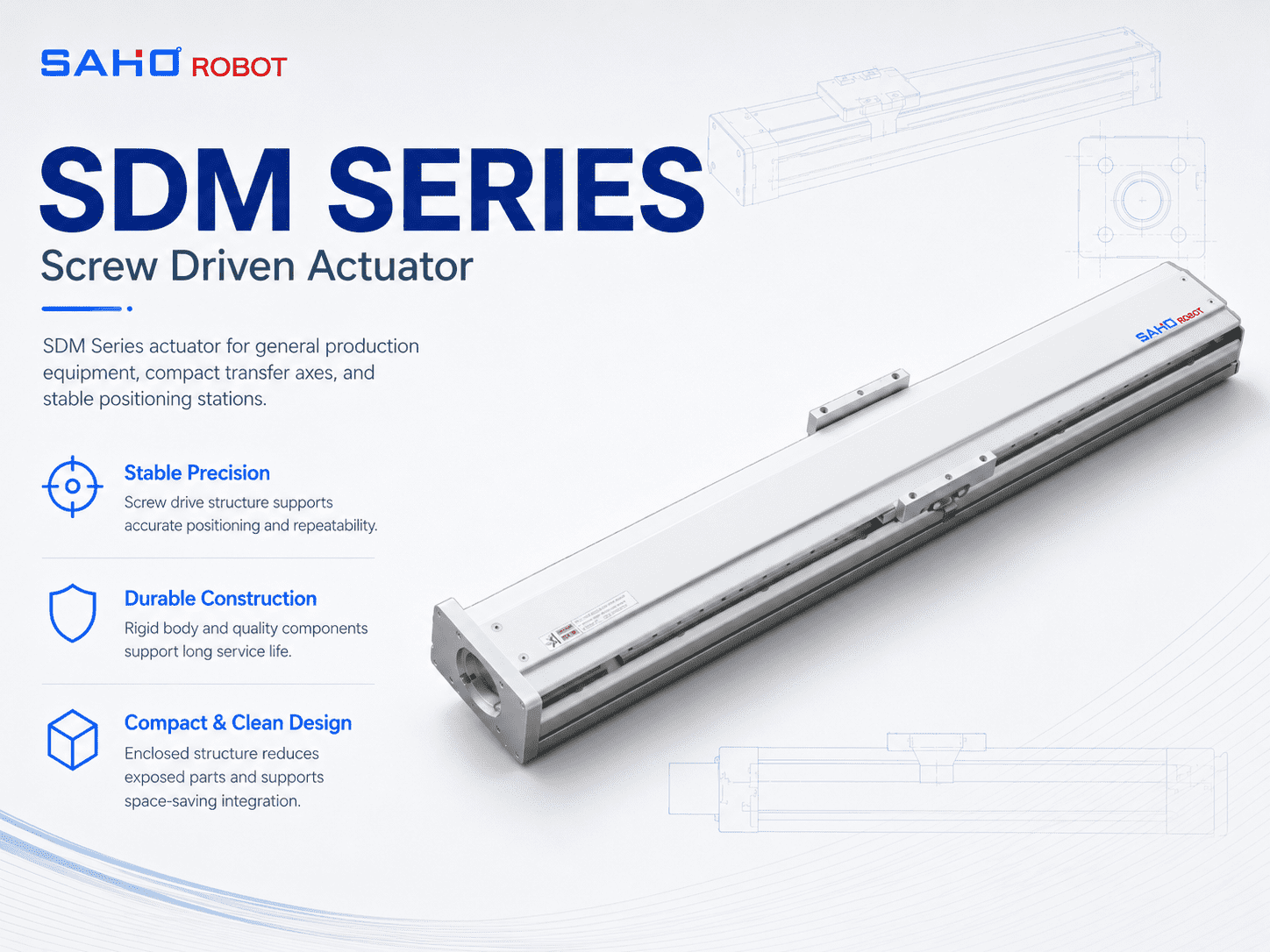
SDM Series actuator for general production equipment, compact transfer axes, and stable positioning stations.
MSDM Series for Standard Screw Drive Layouts
The MSDM Series can fit equipment programs that prefer a European standard ball screw drive module structure. This matters when the machine platform needs familiar mounting logic, consistent envelopes, and scalable sizes. A standard structure can reduce mechanical discussion time across repeated builds.
In many projects, the actuator does not stand alone. It must connect to a motor, sensors, brackets, cable carriers, machine frames, and safety covers. A module with predictable form helps the machine design move faster.
The MSDM Series can support multi-axis layouts where several screw-driven axes work together. One axis can move a fixture while another axis adjusts a tool position. In another layout, an X-axis and Z-axis can work as a compact inspection head positioning unit.
Multi-axis design adds moment load and stack height. A top axis creates mass and leverage on the lower axis. Combined load, dynamic moment, and vibration risk should be reviewed instead of selecting each axis separately.
For compact clean production equipment, this type of standard screw drive layout can support inspection units, small transfer axes, and fixture movement. The final choice should still follow the actual load, stroke, speed, installation direction, and precision requirement.
Standardization should not mean oversimplification. A common platform can use related module sizes while still respecting each station’s duty. This helps avoid both oversizing and hidden overload.
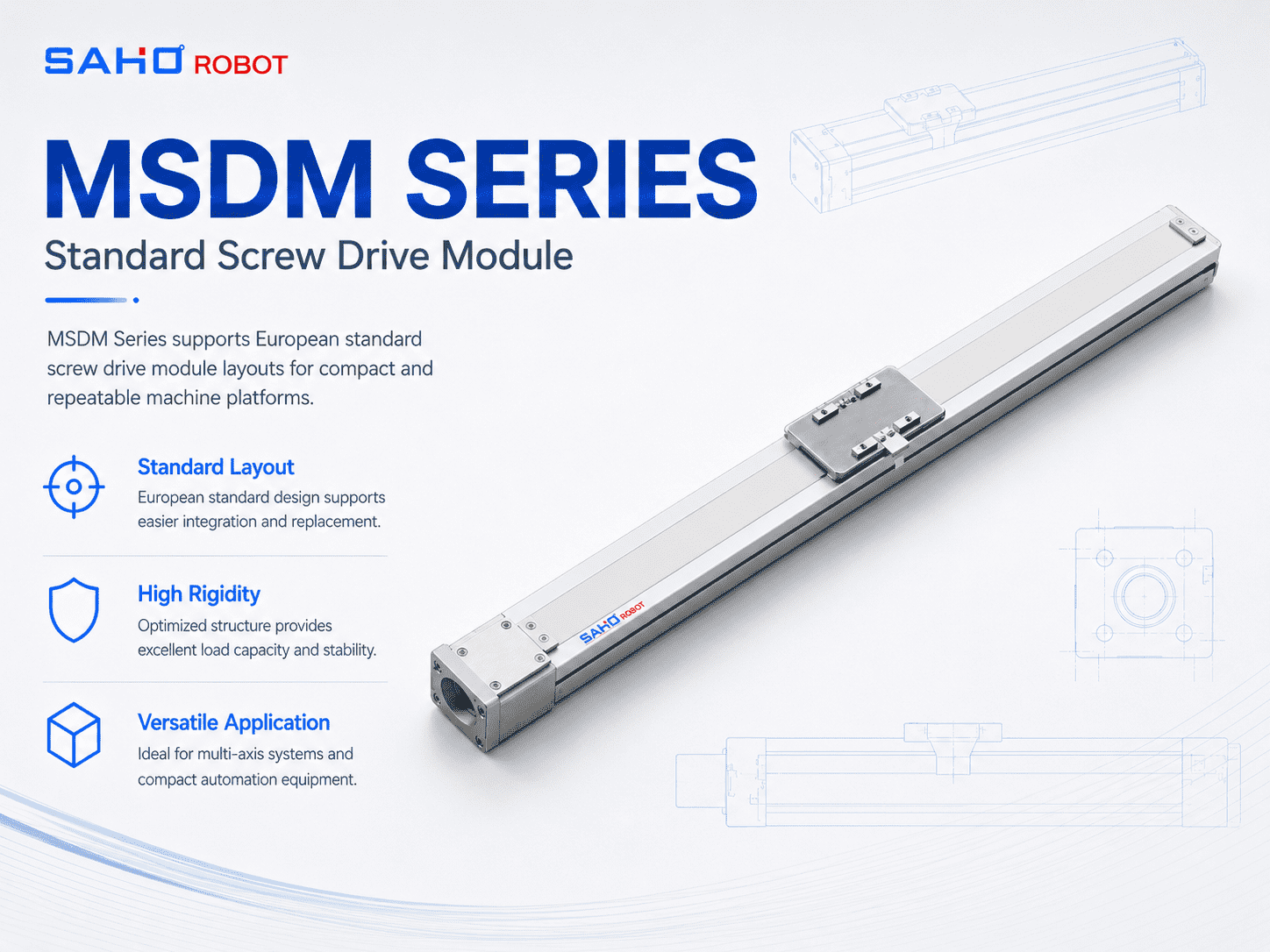
MSDM Series supports European standard screw drive module layouts for compact and repeatable machine platforms.
Load, Stroke, Speed, and Accuracy Checks
Load should include every moving item. Tooling, product, fixture plates, brackets, sensors, clamps, cables, and grippers all add mass. The center of gravity can also create moment load even when total weight looks moderate.
Stroke should include working travel and safe margin. A process may need only a short movement, yet homing space, overtravel, tooling clearance, and future adjustment can increase the required length. The module stroke should not be chosen from nominal movement alone.
Speed should come from the real cycle. A short move may never reach top speed because acceleration and deceleration dominate the motion profile. Acceleration, settling time, and vibration control can matter more than a high speed number.
Accuracy should match the process result. Some stations need repeatability at the same point, while other stations need controlled position across the full stroke. The required motion quality should be described in process terms before model selection begins.
Mounting direction changes the calculation. Horizontal, vertical, wall-mounted, and inverted installations create different load paths. For vertical movement, brake selection, gravity holding, and stop behavior deserve special attention.
Process force should also be added to the motion calculation. Pressing, inserting, dispensing, pulling, cutting, and testing forces can exceed the effect of simple payload. The work action should be described together with the moving mass.
The surrounding environment affects selection as well. Dust, oil mist, fiber, powder, static-sensitive products, and cleaning routines can all influence the cover plan and maintenance method. Environmental notes should be written clearly during the early review.
| Selection item | Why it matters | Practical check | Risk if ignored |
| Moving load | Defines screw, bearing, motor, and moving table stress. | Add tooling, product, cables, brackets, and fixtures. | Vibration, overload, and shorter service life. |
| Stroke | Controls reach, clearance, and machine envelope. | Include working travel, homing, and safe margin. | Late redesign or limited process range. |
| Speed profile | Affects cycle time, stability, and motor sizing. | Calculate move time, acceleration, and settling. | Missed rhythm or excessive shock. |
| Mounting direction | Changes gravity force and safety requirements. | State horizontal, vertical, wall, or inverted use. | Brake mismatch or load-holding risk. |
| Clean environment | Influences covers, lubrication, and service method. | Check dust, fibers, oil mist, and cleaning routine. | Particle issues and difficult maintenance access. |
Clean Layout, Covers, Lubrication, and Maintenance Access
Clean production depends on the whole station, not only the actuator. A well-selected module can still perform poorly if the base plate flexes, cables rub, or fasteners create stress during installation. The surrounding structure deserves the same attention as the module itself.
A stiff and flat mounting surface helps protect motion quality. If the machine base twists the actuator body, repeatability and smoothness may suffer. Poor alignment between connected axes can also introduce side forces that reduce service life.
Cable routing also affects clean production. Loose cables can rub against covers, collect dust, or shed particles near sensitive products. Cable carriers, clamps, bend radius, and sensor wiring should be placed early in the layout.
For projects with formal cleanroom requirements, the cleanliness class should be confirmed according to the project specification and relevant controlled-environment standards, such as ISO 14644-1 cleanroom air cleanliness classification.
Lubrication planning is equally important. Too little grease may increase wear, heat, and noise. Uncontrolled grease can also move toward the product area. Grease access should be planned without forcing large guard removal.
Covers help reduce exposure of the screw drive area, but they do not replace good machine design. Airflow, nearby cutting debris, fibers, powder, and cleaning habits all affect the actual cleanliness level. Actuator selection and station layout should be reviewed together.
Maintenance access should remain visible after the machine is assembled. A module may look easy to service in a single-axis drawing, yet become difficult after neighboring stations, cable trays, lights, and guards are installed. A final access check should occur before drawings are released.
A tidy cable path improves both appearance and reliability. Cables should not drag across moving surfaces, hang near product zones, or rub during repeated cycles. Bend radius and cable carrier travel should be checked at both ends of the stroke.
Common Selection Mistakes That Increase Downtime
One frequent mistake is selecting only by payload. A light fixture may still create a large moment if the tool sits far away from the moving table center. The center of gravity should be checked together with mass.
Another mistake is using top speed as the main target. For short moves, acceleration, deceleration, and settling time often define the real cycle. A stable motion profile can be more valuable than a higher speed figure.
A third mistake is ignoring vertical load behavior. Gravity affects holding force, brake needs, and emergency stop response. The safe state after power loss should be reviewed for every lifting axis.
A fourth mistake is choosing stroke without service space. The actuator may fit inside the machine, but sensor adjustment or lubrication may become awkward. This can make maintenance slower and less consistent.
Another common issue is treating clean production as a cover-only problem. A cover can protect the drive area, yet cable dust, rubbing brackets, and poor airflow can still create contamination. Cleanliness should be handled as a system-level design topic.
A related mistake is copying a previous axis without checking the new station. Similar-looking machines may have different tooling height, cycle time, process force, or cleanliness needs. A familiar model can become unsuitable in a changed process.
Matching the Actuator With Motor, Sensor, and Controls
A screw-driven module becomes a complete motion system when the motor, coupling, sensors, cable path, and controller are added. The mechanical model should be selected together with control requirements. A suitable actuator can still feel unstable if motor sizing or tuning does not fit the task.
Servo motors are common in precision production because they support position control, speed planning, and tuning flexibility. Some simpler tasks may use other motor options. However, torque, speed, inertia, brake needs, and duty cycle must always match the axis calculation.
Sensors define reference positions and safety limits. Home sensors, limit sensors, and feedback devices should fit the control logic and the service plan. Sensor positions should be protected from impact while remaining reachable for inspection.
Coupling choice also affects motion feel. A flexible coupling can absorb small alignment errors, yet it must still handle torque and speed. If it is too soft, response may lag. If it is too rigid and alignment is poor, extra bearing stress may occur.
Control tuning should respect the machine structure. Aggressive acceleration may shorten cycle time on paper, but it can add vibration and increase settling time. Clean production often benefits from smooth acceleration, controlled jerk, and a stable stop profile.
In vertical installations, motor brake planning becomes more important. The brake should support load holding when the axis stops. The control system should also handle power loss and emergency stops with a clear safety method.
Cable management should be reviewed early. A cable path that works in a simple drawing may rub after guards and neighboring stations are added. Cable carriers and sensor routes should be included in the first layout review.
Homing logic also influences cycle stability. If the axis homes slowly or from an awkward location, startup and recovery time may increase. Sensor placement should support both normal operation and maintenance recovery.
Practical Matching Logic for Clean Production Equipment
The strongest selection method starts with the station function. Transfer, lifting, pressing, inspection, adjustment, and loading all create different requirements. The module should be matched to the motion task before detailed sizing begins.
The moving load should then be measured as a system. Fixture plates, tools, product, cables, air tubes, clamps, and brackets should all be included. The distance between load center and moving table surface should also be checked.
The motion profile should be defined next. The required stroke, move time, dwell time, acceleration, and daily cycle count help define the real duty. Without this information, motor sizing and screw drive selection can become uncertain.
After that, the machine layout should be reviewed. Motor direction, mounting surface, side clearance, sensor access, and cable path all influence the final choice. In clean production, this review should also include cleaning space and particle control.
Maintenance should be considered before release. Grease access, cover inspection, sensor replacement, and fastener checks should not require excessive disassembly. This keeps service work predictable during long-term operation.
A short requirement sheet can make the selection process more reliable. It should include moving mass, center of gravity, stroke, target cycle, acceleration, mounting direction, process force, duty cycle, motor preference, and available space. Environmental notes should describe dust, fibers, oil mist, cleaning method, and nearby process debris.
Benefits for OEM Machine Programs
OEM machine programs need repeatable design choices. A prototype may tolerate small compromises, but repeated builds expose every weak detail. Actuator selection should support the full equipment platform rather than one isolated station.
A packaged module can reduce assembly variation. The screw drive, support structure, moving table, and body belong to one controlled actuator design. Repeated machines can keep the same motion logic more easily.
The module can also simplify drawings and spare part planning. A repeated actuator family makes it easier to organize product data, maintenance instructions, and replacement logic. The same installation method can be reused across related machines.
Standard actuator structures can improve commissioning. If the machine team already understands the axis behavior, motor tuning and mechanical setup can move faster. Less time is spent solving repeated mechanical issues.
Standardization should remain flexible. A machine family may use SDM in one station and MSDM in another. The goal is not to force one model everywhere. Instead, the goal is to choose related modules that match each station and still support platform consistency.
How SAHO Linear Motion Solutions Support Equipment Integration
SAHO Robot provides linear motion solutions for different automation requirements, including screw drive modules, belt drive modules, linear motor products, and electric linear actuators. This allows equipment projects to compare several motion structures within one product system while keeping product categories clear.
For screw-driven clean production tasks, SDM Series can serve as a main product path for general automation environments. MSDM Series can support equipment that needs a European standard screw drive module layout. The correct choice depends on the station task, not only the product family name.
Useful application data includes moving mass, center of gravity, stroke, speed, acceleration, mounting direction, duty cycle, environment, motor preference, sensor needs, and available space. Process force and cleanliness expectations should also be included.
For broader product context, visit SAHO linear motion solutions. For the main screw drive actuator page, review SDM Series. For European standard screw drive layouts, compare MSDM Series.
Extended Reading
The following pages can help engineers compare related SAHO motion products and review suitable product families for clean production equipment.
SAHO Robot home page for overall linear motion solutions and product navigation.
SDM Series for ball screw linear actuators in general automation environments.
MSDM Series for European standard ball screw drive module layouts.
FAQ
When does a screw-driven module fit better than a belt-driven module?
Generally, a screw-driven module fits stations that need higher stiffness, controlled thrust, and precise stopping over moderate stroke. Belt-driven modules often suit longer travel and high-speed transfer. The choice should follow stroke, load, accuracy, cycle time, and process force.
Can SDM Series be used in clean production equipment?
Yes. SDM Series can fit general clean production equipment when the environment, cover needs, mounting direction, and maintenance access are suitable. Formal cleanroom or special process requirements should be reviewed separately with full application details.
What information helps confirm the right module size?
The most useful data includes moving load, center of gravity, stroke, speed, acceleration, mounting direction, duty cycle, process force, available space, sensor needs, and motor preference. A layout image can also clarify cable routing and service space.
Can a screw-driven module be installed vertically?
Vertical installation can be possible, but gravity changes the selection logic. The design should review brake needs, load holding, emergency stop behavior, motor torque, and safety factor before final release.
How does maintenance planning affect clean production?
Maintenance planning affects cleanliness because lubrication, sensor access, cover inspection, and cable checks can introduce downtime or particles when poorly planned. Grease points, covers, and service paths should remain accessible after the full machine is assembled.
Why does the center of gravity matter?
The center of gravity affects moment load on the moving table and support structure. A light tool mounted far from the carriage area can create vibration or uneven load. Mass and offset distance should be reviewed together.
Why should process force be included in selection?
Process force can be higher than the force needed for simple movement. Pressing, inserting, clamping, testing, or dispensing may add extra load to the screw drive and motor. The work action should be described together with the moving mass.
How can clean layout reduce downtime?
Clean layout reduces downtime by keeping cables organized, covers accessible, sensors protected, and lubrication points reachable. A tidy station also makes inspection easier and reduces the chance that small service tasks become long shutdowns.
Conclusion and Practical Next Steps
Clean production needs motion axes that support the process without adding unnecessary mechanical risk. A packaged screw-driven actuator can help when the station requires accurate positioning, controlled thrust, neat installation, and maintainable structure.
For practical selection, start with the motion task, then confirm the mechanical and environmental details. This method reduces vibration, hidden overload, difficult service access, and late redesign.
Define the real moving load, center of gravity, stroke, cycle time, mounting direction, and process force.
Review covers, lubrication access, cable routing, cleaning method, airflow, and service space before locking the machine layout.
Compare SDM Series and MSDM Series based on the machine platform, not only the actuator size.
For clean production equipment that needs stable, compact, and maintainable linear motion, the Automation Ball Screw Linear Module selection process should begin with application data and end with a confirmed actuator, motor, mounting, and service plan.
If the machine requires compact positioning, stable thrust, and maintainable screw-driven motion, review SDM Series first and compare MSDM Series when a European standard screw drive layout is preferred.







-
-
 English
 -
 Français
 -
 Deutschland
 -
 Italia
 -
 Polska
 -
 España
 -
 Русский язык
 -
 日語
日語 -
 한국
한국 -
 Türkiye
 -
 português
 -
 بالعربيةês
 -
 Tiếng Việt
 -
 คนไทย
คนไทย -
 简体中文
简体中文 -
繁體中文
-