

Date:2026-06-10 Click:538
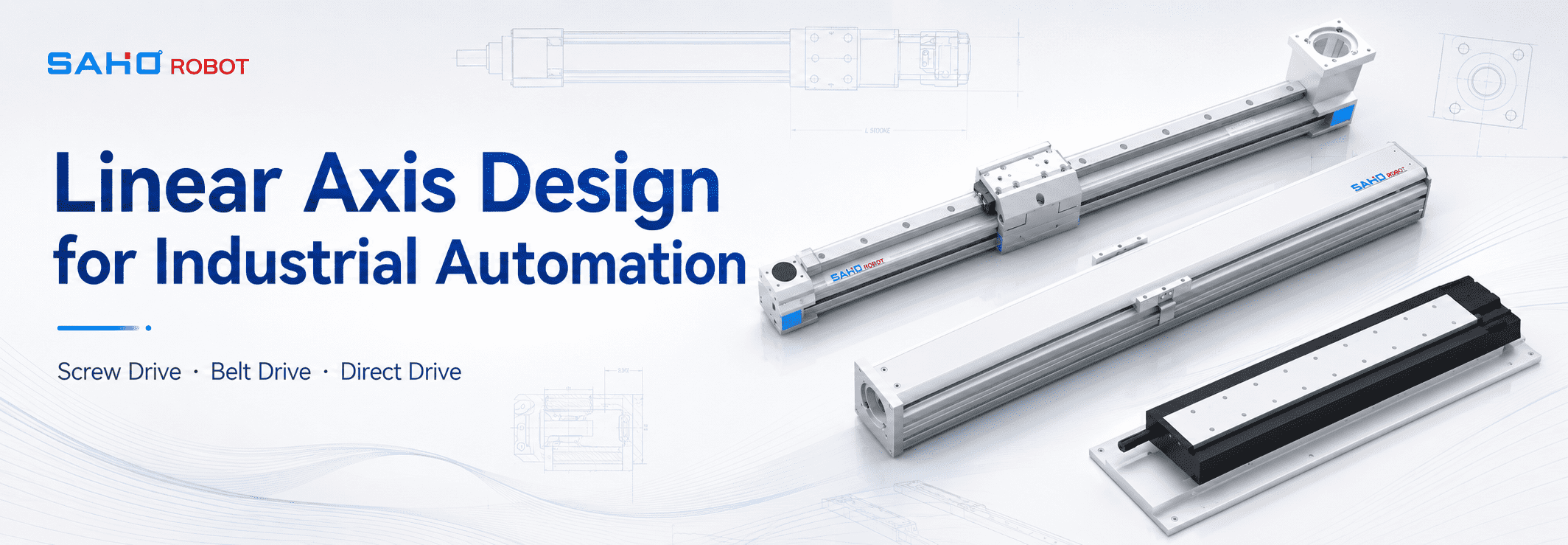
Industrial automation systems rely on efficient and reliable linear motion to achieve productivity, accuracy, and long-term operational stability. Whether a machine is moving products between stations, positioning tooling, adjusting process equipment, or performing precision manufacturing tasks, the design of the linear axis has a direct impact on machine performance.
Selecting a linear axis should never begin with a catalog specification alone. Successful motion system design starts with the application itself, including stroke length, payload, speed, positioning requirements, mounting orientation, environmental conditions, and production cycle demands. The best solution is not always the fastest, strongest, or most precise product. It is the motion structure that best supports the real production process.
This guide compares the main motion technologies used in industrial automation: belt drive linear modules, ball screw actuators, and linear motor products. Belt drive modules and ball screw actuators belong to module-based motion products, while linear motor products belong to a separate direct-drive category. This distinction helps engineers avoid mixing different product types when designing a reliable linear axis system.
Start with the Motion Task
Every automation project begins with a specific motion requirement. A packaging machine may need to transfer products rapidly across a long distance. A dispensing system may require stable and repeatable positioning. A semiconductor application may demand high-speed precision motion with minimal vibration. Although these applications all use linear motion, their design requirements are very different.
Before selecting a motion solution, engineers should define the required stroke length, payload and tooling weight, speed and acceleration, positioning accuracy, repeatability, installation orientation, operating environment, and expected duty cycle. These values decide whether a belt drive module, ball screw actuator, or linear motor product is the better fit.
The machine layout should also define whether the axis works horizontally, vertically, inverted, wall-mounted, or as part of a gantry system. Gravity, moment load, cable routing, and service access all change with installation direction. Selection based only on speed and payload can miss several real production risks.
Quick Selection Path: Linear Modules vs Linear Motors
Use belt drive linear modules when the machine needs longer stroke, fast transfer, fixture shuttle movement, tray handling, material handling, or practical horizontal travel.
Use ball screw actuators when the process needs compact positioning, stable endpoints, higher thrust, vertical motion, controlled feed, or precision assembly support.
Use linear motor products when the application belongs to a high-response direct-drive category, such as semiconductor equipment, laser processing, precision inspection, electronics manufacturing, or high-speed positioning platforms.
Do not treat linear modules and linear motors as the same product type. TR and SDM belong to module-based motion products, while MK belongs to the linear motor product category.
Three Common Linear Motion Technologies
Modern industrial automation commonly uses three motion technology families. Each technology has a different structure, motion behavior, maintenance requirement, and cost-performance balance. Understanding these differences helps engineers avoid over-designing or under-sizing a motion system.
| Product category | SAHO series example | Best fit | Main selection focus |
| Belt drive linear module | TR Series | Long stroke, high-speed transfer, tray handling, gantry robots, multi-axis Cartesian systems | Stroke length, speed, acceleration, payload offset, moment load, belt tension, service access |
| Ball screw actuator | SDM Series | Compact positioning, controlled feed, vertical motion, precision assembly, stable endpoints | Thrust, repeatability, screw lead, rigidity, lubrication, duty cycle, brake planning |
| Linear motor product | MK Series / ironcore and ironless options | High-response precision motion, laser equipment, semiconductor equipment, inspection platforms | Frame rigidity, feedback system, servo tuning, cable routing, fast settling behavior |
Belt Drive Linear Modules for Long Travel and High-Speed Motion
When long travel distances and fast transfer speeds are required, belt drive linear modules are often the preferred solution. The timing belt mechanism enables efficient motion over long strokes while maintaining smooth operation and relatively low moving mass. This makes belt drive modules suitable for material handling, packaging equipment, tray transfer systems, loading and unloading stations, automated assembly lines, and multi-axis positioning systems.
The SAHO TR Series belt drive modules are designed for these applications. TR64 is suitable for general-purpose automation, compact transfer layouts, and standard Cartesian systems. TRW64 uses a wider body design to provide greater rigidity and improved resistance to moment loads in gantry and long-span applications. For machines where speed and stroke length are more important than high thrust, TR Series belt drive modules provide an efficient and economical solution.
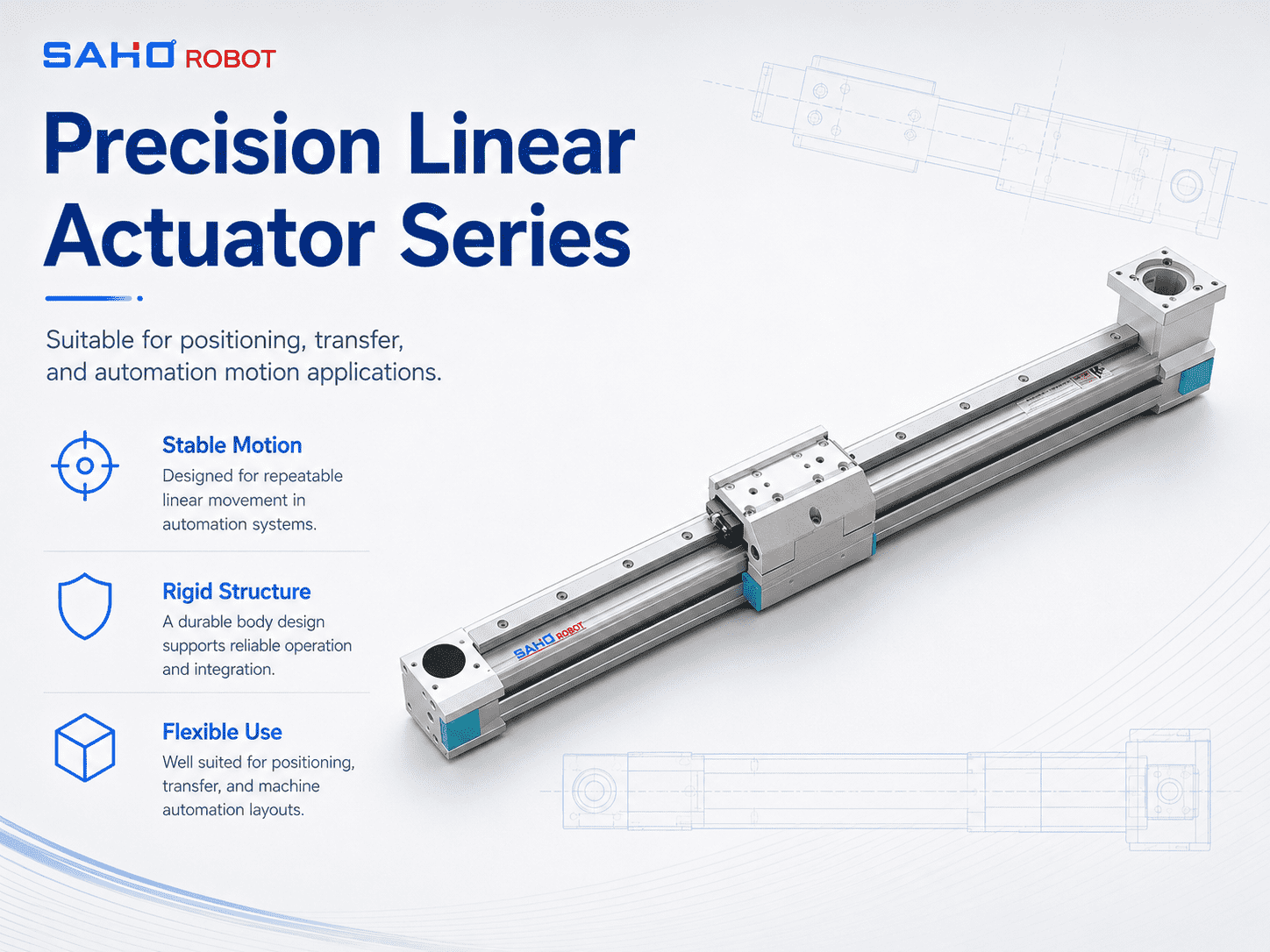
SAHO TR Series belt drive linear module for long-stroke transfer, fixture shuttle, tray handling, and fast linear axis layouts.
For conveyor-side systems, a belt drive module can move a small gripper, sensor, or marking head along the line. In assembly machines, it can move fixtures between loading, assembly, inspection, and unloading points. The benefit is not only speed. It also creates a cleaner machine layout with fewer custom parts around the core motion structure.
Belt drive modules should not handle every job. A process that needs high thrust at a controlled low speed may need a ball screw actuator instead. A process that needs very high dynamic precision may need a linear motor product. Belt drive modules work best when the main goal is fast, stable, and practical transfer across a useful stroke.
Ball Screw Actuators for Stable and Precise Positioning
Many industrial processes require controlled positioning, stable endpoints, and higher thrust capability. In these applications, ball screw actuators often provide the best balance between precision and mechanical rigidity. They are commonly used in dispensing systems, inspection equipment, precision assembly stations, press-fit assistance, height adjustment mechanisms, and vertical positioning systems.
The SAHO SDM Series ball screw actuators integrate the screw drive mechanism, carriage structure, and mounting platform into a compact motion unit. Compared with belt-driven systems, ball screw actuators provide greater thrust and improved positioning performance, making them suitable for applications where accuracy and load control directly affect process quality.
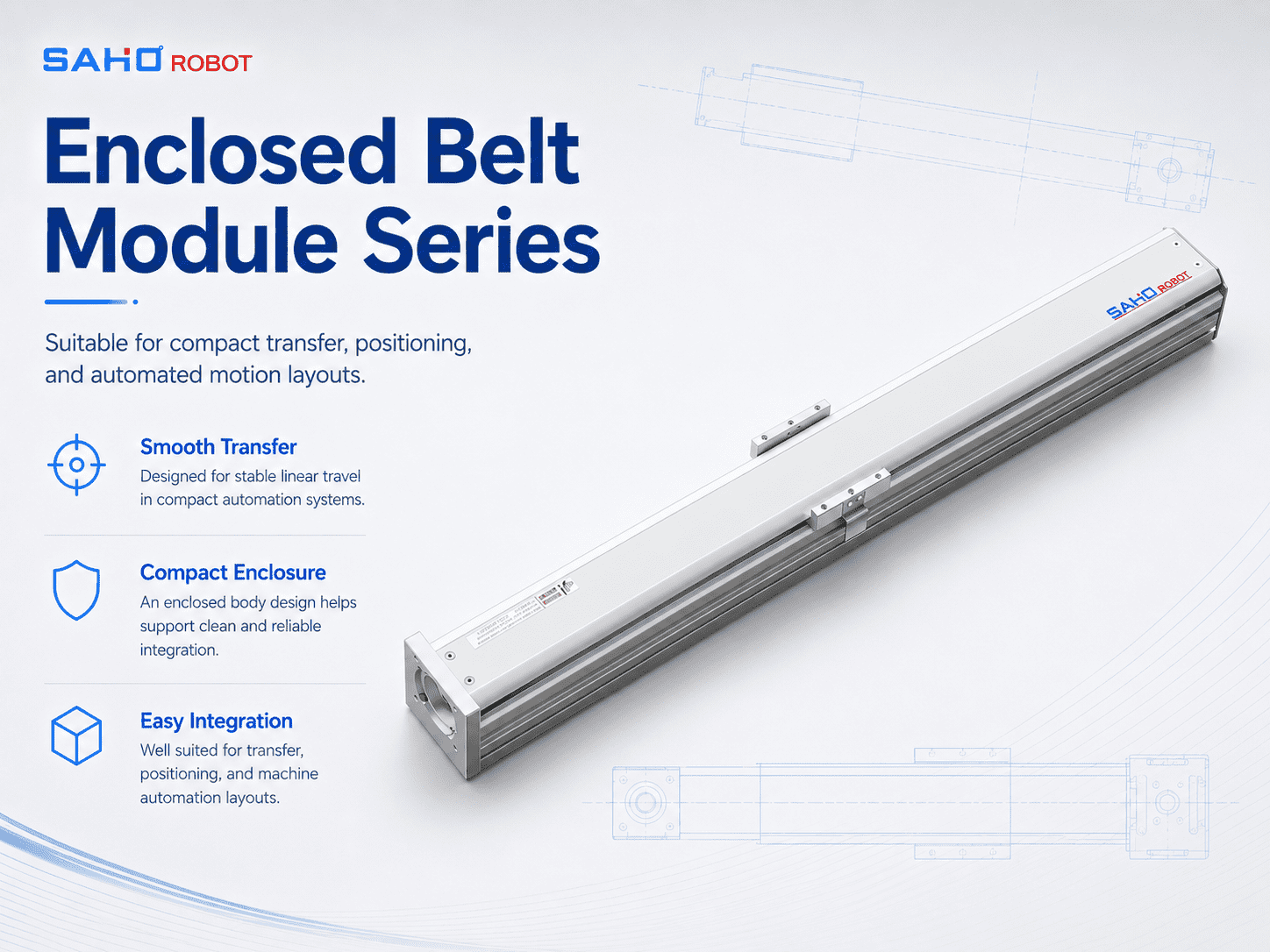
SAHO SDM Series ball screw actuator for compact positioning, controlled feed, higher thrust, and stable endpoint motion.
Screw motion should be selected with realistic speed and stroke expectations. A long screw running at high speed can create vibration, and repeated high-duty movement can increase heat. Screw selection should check lead, stroke, load, speed, duty cycle, lubrication access, and installation direction.
When designing vertical axes, engineers should also consider brake motors, safety stops, and gravity-related loading conditions. Gravity adds constant load, and a power-off event can create drop risk. This is especially important when tooling sits above fixtures, test parts, or operators.
Linear Motor Products for High-Performance Automation
As automation equipment becomes faster and more precise, linear motor products are increasingly used in advanced manufacturing systems. Unlike traditional mechanical transmission systems, linear motors generate motion directly through electromagnetic force without belts or screws. This design provides high acceleration, fast settling time, smooth motion, reduced mechanical wear, and excellent dynamic response.
SAHO linear motor products include ironcore and ironless configurations, allowing engineers to select the most appropriate balance of thrust, smoothness, and dynamic performance. This is a separate product category from belt drive modules and ball screw actuators. Linear motor products are usually selected for semiconductor equipment, precision inspection systems, laser processing machines, electronics manufacturing, and high-speed positioning platforms.
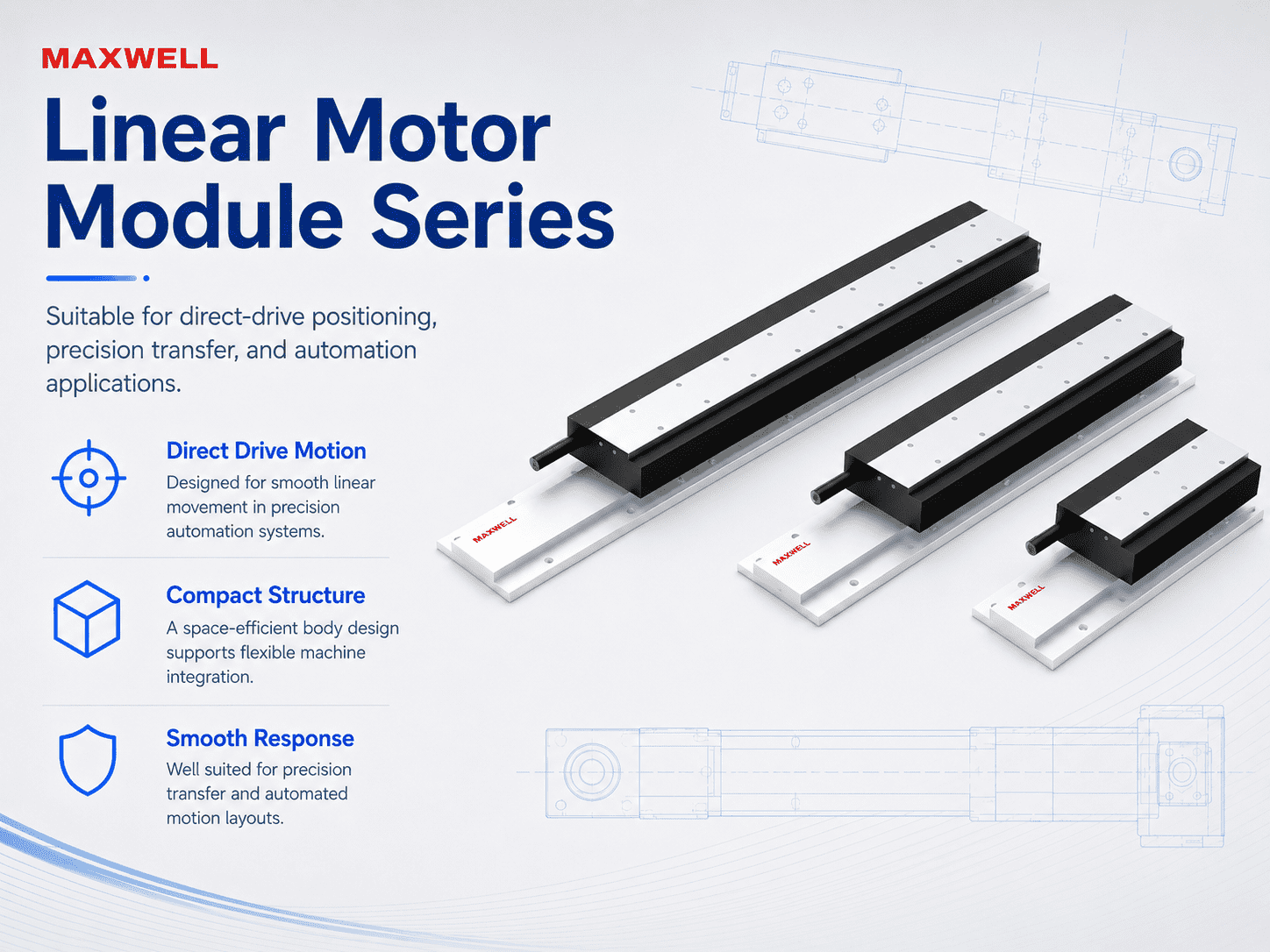
SAHO MK Series ironcore linear motor product for high-response precision motion in electronics, laser, measurement, and semiconductor-related equipment.
Linear motor products provide the greatest value when combined with rigid machine structures, high-resolution feedback systems, and advanced servo control technology. The machine base must resist reaction forces, the controller must tune the motion correctly, and cable management must support repeated high-speed movement without adding drag or signal instability.
Environmental planning also matters. Magnets, dust, particles, and surrounding metal structures can affect design choices. The right result comes from matching the linear motor product, machine frame, feedback system, cable path, and controller as one complete motion system.
Critical Design Factors Beyond Payload
Many motion system problems are caused by factors other than payload. Static load is only the first number in a motion calculation. Dynamic force, offset distance, acceleration, moment load, frame stiffness, and usable travel often decide whether a linear axis performs reliably in real production.
Moment Loads
Offset tooling, camera brackets, grippers, sensors, and extended fixtures can generate significant moment loads even when the actual weight is relatively low. In many cases, moment load capacity is more important than payload rating. Selecting the correct carriage structure and actuator width can significantly improve stability and service life.
Stroke Length and Usable Travel
Total stroke and effective working travel are not always identical. End clearances, sensor positions, cable routing, tooling overhang, and safety margins can reduce usable travel. Design calculations should always consider actual working travel before finalizing the stroke.
Cycle Time and Settling Behavior
Maximum speed alone does not determine productivity. Acceleration, deceleration, process dwell time, sensor confirmation, and settling behavior all contribute to overall cycle performance. In short-stroke applications, acceleration and settling time are often more important than peak velocity.
Duty Cycle
Applications operating continuously require greater attention to motor temperature, bearing life, lubrication intervals, belt wear, cable durability, and maintenance access. A motion unit that moves once every minute has different demands from one that moves every few seconds.
Environmental Conditions
Dust, moisture, oil mist, adhesive mist, metal particles, and temperature variations influence long-term reliability. Selecting appropriate protection and maintenance strategies improves equipment lifespan. The product should match the real plant environment rather than a clean office assumption.
For production scenarios such as semiconductor-related equipment, assembly stations, inspection platforms, and precision handling, SAHO’s Electronic Component Assembly application page can also help engineers understand how different motion products are used in real automation systems.
Typical Application Recommendations
| Choose this solution | When the application requires | Typical examples |
| Belt Drive Linear Module | Long stroke, fast transfer, multi-axis gantry motion, material handling | Packaging equipment, tray transfer, loading and unloading, gantry robots |
| Ball Screw Actuator | Higher thrust, stable positioning, vertical motion, precision assembly | Dispensing systems, inspection stations, press-fit assistance, height adjustment |
| Linear Motor | High dynamic performance, fast settling time, smooth motion, precision manufacturing | Semiconductor equipment, laser processing, precision inspection, electronics manufacturing |
Common Linear Axis Design Mistakes
Selecting by payload alone: dynamic forces, acceleration, and moment loads often have a greater impact than static weight.
Focusing only on maximum speed: in short-stroke applications, acceleration and settling time may be more important than peak velocity.
Ignoring structural rigidity: a high-performance actuator cannot compensate for a weak machine frame or flexible mounting structure.
Poor cable management: improper cable routing can increase drag, cause electrical faults, and reduce system reliability.
Limited maintenance access: belt tension points, lubrication areas, sensors, fasteners, and cable carriers should remain accessible after machine assembly.
Using one motion technology for every application: successful automation systems match the motion technology to the process requirement instead of forcing one solution into every machine.
Building Complete Linear Motion Systems
Many modern machines combine multiple motion technologies. A TR Series belt drive module may transfer products between stations. An SDM ball screw actuator may perform precision positioning at the process point. A linear motor product may provide ultra-fast inspection, alignment, or high-response processing motion.
Combining the strengths of each technology often creates a more efficient and cost-effective automation system than relying on a single motion platform. However, the product categories should remain clear: belt and screw products are module-based motion solutions, while linear motor products are direct-drive solutions.
SAHO linear motion solutions include belt drive modules, ball screw actuators, electric linear actuator products, and linear motor products. These product families support different machine layouts instead of forcing one structure into every task.
Why Standard Motion Modules Simplify Machine Design
Using standardized motion modules can significantly reduce engineering effort. Integrated linear motion products provide pre-engineered structures, simplified installation, consistent performance, reduced design time, easier spare parts management, and faster machine development.
Rather than designing every motion axis from individual components, engineers can focus on machine functionality, process optimization, tooling, safety, and control system development. Standardized modules also improve repeatability across machine builds because assembly teams can use similar mounting methods and service procedures.
Linear motor products should still be reviewed separately because they rely on direct-drive motion, feedback performance, control tuning, and machine-frame rigidity. They can provide excellent dynamic performance, but they should not be treated as the same category as belt or screw modules.
Maintenance Planning Before Installation
Maintenance starts during design. The layout should keep service areas visible and reachable. A compact cover may look clean, but it can slow adjustment if it blocks belt tension points, lubrication access, sensor brackets, mounting bolts, or cable carriers.
Belt systems may require checks for belt condition, tension, pulley alignment, and debris. Screw systems require attention to lubrication and contamination. Linear motor systems reduce some mechanical transmission wear, but they still need clean installation, stable feedback devices, careful cable movement, and a rigid mounting surface.
The exact maintenance plan should follow the selected product, duty cycle, and operating environment. A clean moderate-duty machine will not have the same service pattern as a dusty high-cycle station. Designing for service access early helps reduce downtime after installation.
FAQ
What is the main benefit of a linear axis in automation?
A linear axis provides controlled straight-line motion in automation equipment. It can move products, fixtures, tools, cameras, sensors, or process heads between defined positions. The right design improves productivity, repeatability, and long-term machine reliability.
When does a belt drive linear module make sense?
A belt drive linear module makes sense when the machine needs long stroke, fast transfer, material handling, tray movement, fixture shuttle motion, or gantry-style movement. It is generally selected when speed and travel distance matter more than high thrust.
When does a ball screw actuator fit better?
A ball screw actuator fits better when compact positioning, stronger thrust, stable endpoint control, vertical motion, or controlled feed is required. It is commonly used in dispensing, inspection, precision assembly, press-fit assistance, and height adjustment applications.
How is a linear motor product different from a linear module?
A linear module usually uses a belt or screw transmission inside a finished mechanical motion unit. A linear motor product uses direct electromagnetic drive and belongs to a separate product category. It is usually selected for high-response precision motion rather than general module-based transfer.
Can different motion technologies work together in one machine?
Yes. A belt drive module may transfer a fixture, a ball screw actuator may adjust height or apply controlled feed, and a linear motor product may handle precision alignment or high-speed inspection. This mixed layout can match each process step more effectively than using one structure everywhere.
What is the most common mistake in linear axis design?
One common mistake is selecting by payload or maximum speed alone. Dynamic force, moment load, acceleration, usable travel, settling time, structural rigidity, cable management, and maintenance access often have a greater impact on real machine performance.
Conclusion and Practical Selection Advice
Effective linear axis design begins with understanding the application rather than selecting a product from a catalog. Stroke length, payload, positioning requirements, cycle time, environmental conditions, machine layout, and maintenance access should guide the selection process.
TR Series belt drive linear modules provide strong solutions for long-stroke and high-speed transfer applications. SDM Series ball screw actuators deliver precise positioning and higher thrust performance. Linear motor products offer exceptional dynamic response for advanced automation systems requiring high-speed precision motion.
By evaluating motion requirements, payload characteristics, environmental conditions, and production goals, engineers can select the most appropriate linear motion technology and build automation equipment that delivers reliable performance for years to come. For a practical next step, review product families through SAHO linear motion solutions and match the selected linear axis to the real production rhythm.
First: define stroke length, payload, speed, acceleration, accuracy, repeatability, mounting orientation, and duty cycle.
Next: separate module-based products from linear motor products, then match the task to the correct motion technology.
Finally: review the complete system, including frame stiffness, motor sizing, sensors, cable routing, maintenance access, and safe stopping behavior.







-
-
 English
 -
 Français
 -
 Deutschland
 -
 Italia
 -
 Polska
 -
 España
 -
 Русский язык
 -
 日語
日語 -
 한국
한국 -
 Türkiye
 -
 português
 -
 بالعربيةês
 -
 Tiếng Việt
 -
 คนไทย
คนไทย -
 简体中文
简体中文 -
繁體中文
-