

Date:2026-05-31 Click:532
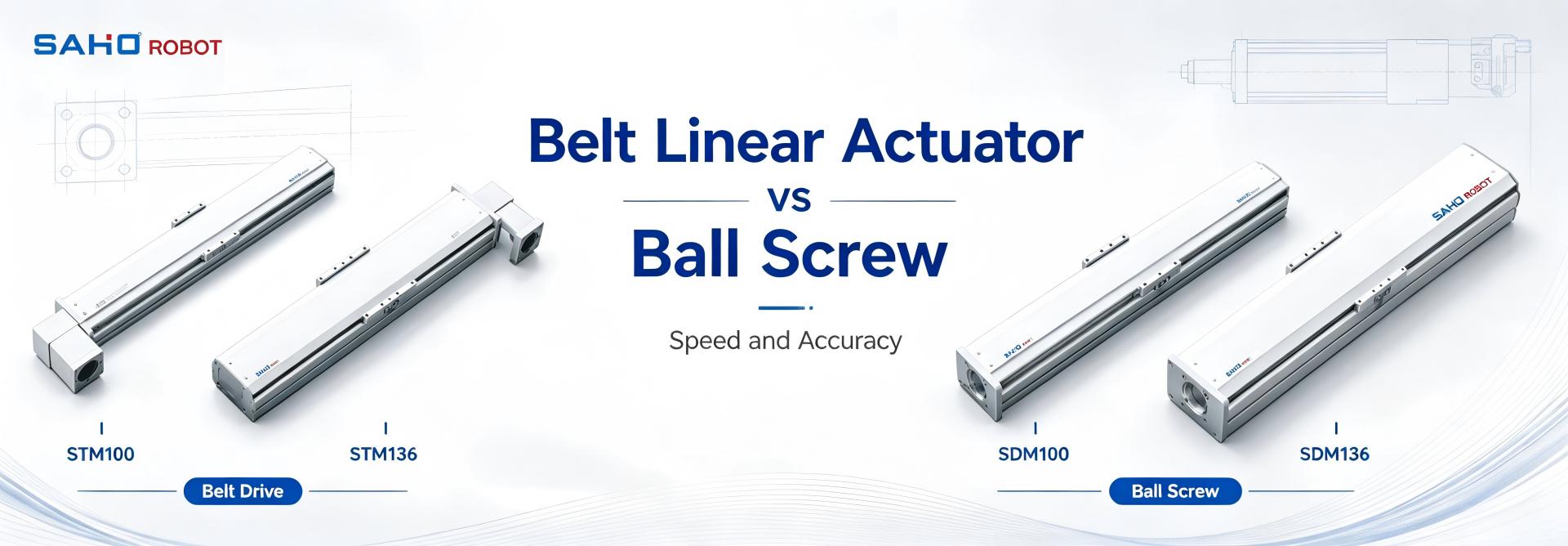
In industrial automation, selecting the right linear actuator structure affects speed, positioning stability, payload behavior, maintenance work, and long-term machine productivity. A belt driven linear actuator and a ball screw linear actuator can both create reliable linear motion, but they are designed for different priorities. The right choice depends on stroke length, required accuracy, thrust demand, cycle time, mounting direction, and the real work being done on the machine.
Quick Reading Path
Understand the working difference between belt driven and ball screw linear actuator structures.
Compare speed, accuracy, stroke length, load capacity, thrust, and maintenance requirements.
Match SAHO STM Series with Belt Driven Linear Module applications and SDM Series with ball screw linear module applications.
Use the selection checklist to decide whether your machine needs long-stroke transfer, compact precision, or a mixed linear axis system.
Understanding the Two Technologies
A belt driven linear actuator uses a timing belt and pulley system to convert rotary motion into linear movement. This structure is often selected when the machine needs fast travel, long stroke, smooth transfer, and efficient station-to-station movement. It is commonly used in packaging equipment, material handling, gantry systems, pick-and-place layouts, and conveyor interface automation.
A ball screw linear actuator uses a screw and nut mechanism to convert rotary motion into controlled linear motion. This structure is often selected when the machine needs higher positioning stability, stronger axial thrust, compact movement, and repeatable short-stroke control. It is commonly used in dispensing, inspection, pressing, fine adjustment, precision assembly, and vertical positioning systems.
Neither structure is automatically better in every case. A linear robot may use a belt driven linear rail for a long X-axis transfer and a Screw Type Linear Actuator for a short Z-axis process movement. This mixed structure can help the system balance speed, accuracy, payload control, and cost.
Belt Driven Linear Actuator vs Ball Screw Linear Actuator: Core Comparison
| Selection factor | Belt driven linear actuator | Ball screw linear actuator |
| Main advantage | Fast travel and long-stroke motion. | Higher rigidity, thrust, and compact precision control. |
| Speed | Usually better for high-speed transfer and rapid return movement. | Usually better for controlled movement where speed is not the only priority. |
| Accuracy | Suitable when moderate repeatability and stable transfer are enough. | Suitable when tighter repeatability and fine motion control are required. |
| Stroke length | Better for longer stroke and wider body machine layouts.. | Better for shorter, compact, and rigid positioning tasks. |
| Load and thrust | Better for light to medium loads with good support. | Better for higher thrust, pressing, lifting, or controlled feed. |
| Maintenance focus | Belt inspection, belt tension, pulley condition, and alignment. | Lubrication, contamination protection, screw condition, and ball nut inspection. |
Note: exact speed, repeatability, stroke, and load values should always be checked against the selected SAHO model specifications and the real installation layout.
Speed Comparison: When Fast Transfer Matters Most
When speed is the main concern, a belt driven linear actuator often has the advantage. The belt transmission structure can support rapid movement across longer distances without requiring a long screw to rotate at high speed. This makes it suitable for high-throughput automation equipment where the carriage must move quickly between stations.
However, speed should not be judged only by maximum stroke speed. A real cycle includes acceleration, constant movement, deceleration, stop settling, sensor confirmation, and return travel. If the payload shakes after each stop, the machine may lose time even when the axis itself is fast. Therefore, payload shape, bracket stiffness, carriage support, and acceleration profile should be reviewed together.
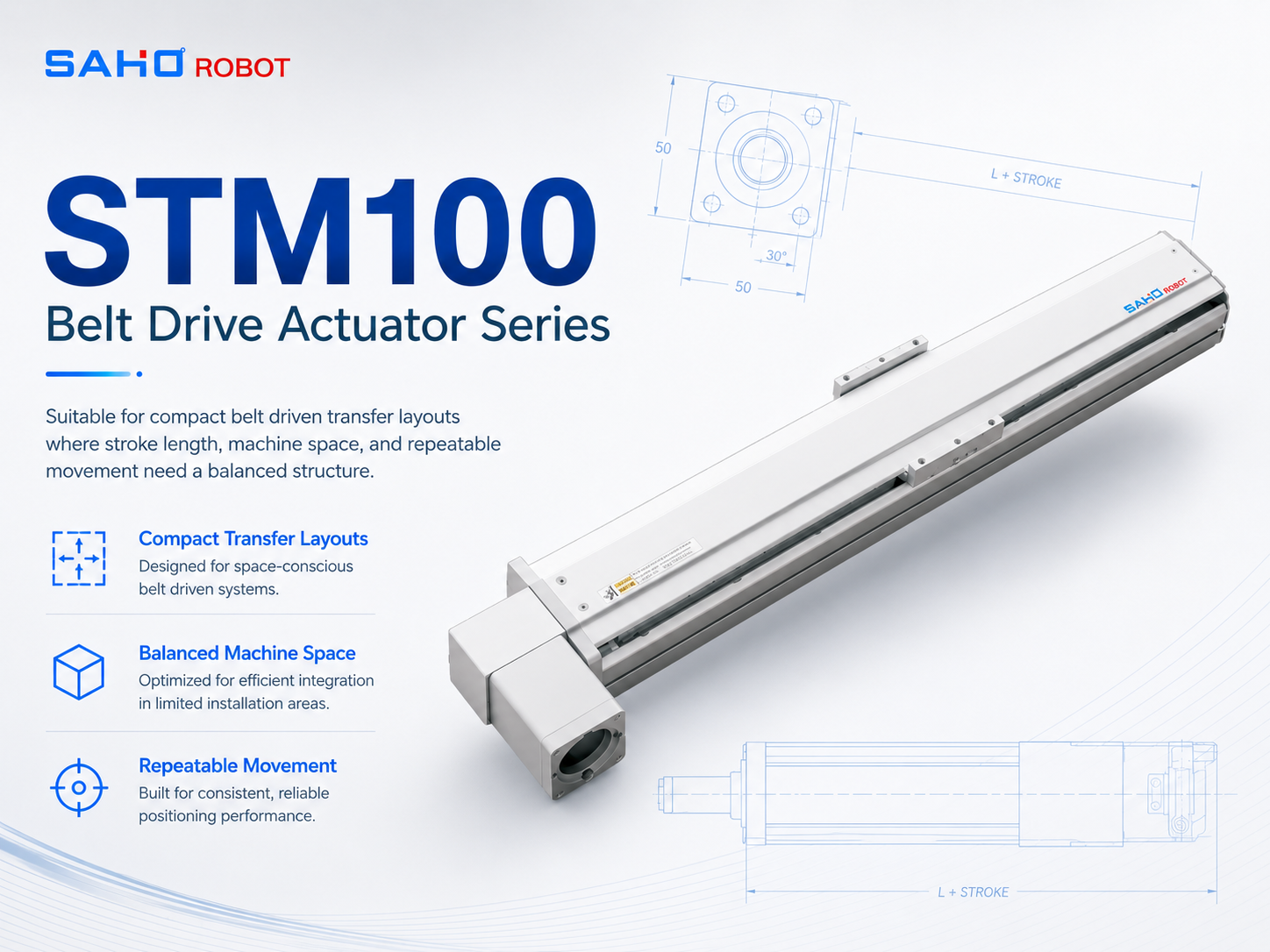
STM100: Suitable for compact belt driven linear actuator layouts where stroke length, machine space, and repeatable movement need a balanced structure.
Accuracy Comparison: Repeatability, Rigidity, and Process Stability
For applications requiring precise positioning, a ball screw linear actuator usually provides stronger advantages. The screw mechanism creates a direct mechanical relationship between motor rotation and linear travel, which helps the system achieve stable positioning, controlled feed, and better rigidity in compact movement.
Accuracy should be understood as more than one number. It includes repeatability, absolute position, rigidity, vibration behavior, tool stability, and process tolerance. For dispensing, inspection, pressing, focusing, and precision assembly, the final result often depends on how stable the moving head remains during acceleration, stopping, and work contact.
Still, the actuator cannot fix a weak machine frame. If the mounting plate twists or the tool bracket flexes, final process accuracy can drop. As a result, actuator selection, machine frame stiffness, tooling design, and motor tuning should be reviewed as one system.
Stroke Length Comparison: Long Travel vs Compact Positioning
Stroke length is one of the most important selection factors. As travel distance increases, a ball screw system may face limitations related to screw length, rotational speed, support structure, and possible deflection. For this reason, using a ball screw linear module for every long transfer axis may add unnecessary mass and reduce speed efficiency.
A Belt Driven Linear Module is usually more practical when the machine requires long travel, wide frame coverage, gantry movement, transfer automation, or fast return movement. It allows the system to cover longer distances while keeping the motion structure efficient for repetitive station-to-station work.
Load Capacity and Thrust: What the Axis Must Actually Carry
Payload is not only the weight of the object. The distance between the payload center and the carriage center creates moment force. A light load can still become difficult when it is tall, offset, or mounted on a long arm. Therefore, payload mass, center of gravity, moment load, mounting direction, and acceleration should be checked together.
Belt driven systems are often suitable for light to medium loads where speed and travel distance are the main requirements. Ball screw linear actuators are often more suitable when the application needs stronger thrust, vertical motion, pressing force, controlled lifting, or compact rigid positioning.
Maintenance Requirements: Belt Tension, Lubrication, and Service Access
Maintenance planning should not be left until the end of machine design. A machine can meet acceptance targets and still become difficult to service after installation. Therefore, inspection space, cable routing, lubrication access, dust protection, and operating environment should be included in the early layout stage.
Belt driven systems usually require belt inspection, belt tension adjustment, pulley inspection, and alignment checks.
Ball screw systems usually require screw lubrication, contamination protection, ball nut inspection, and cleanliness control.
Both structures need a rigid mounting surface, suitable cable routing, and regular inspection based on duty cycle and working environment.
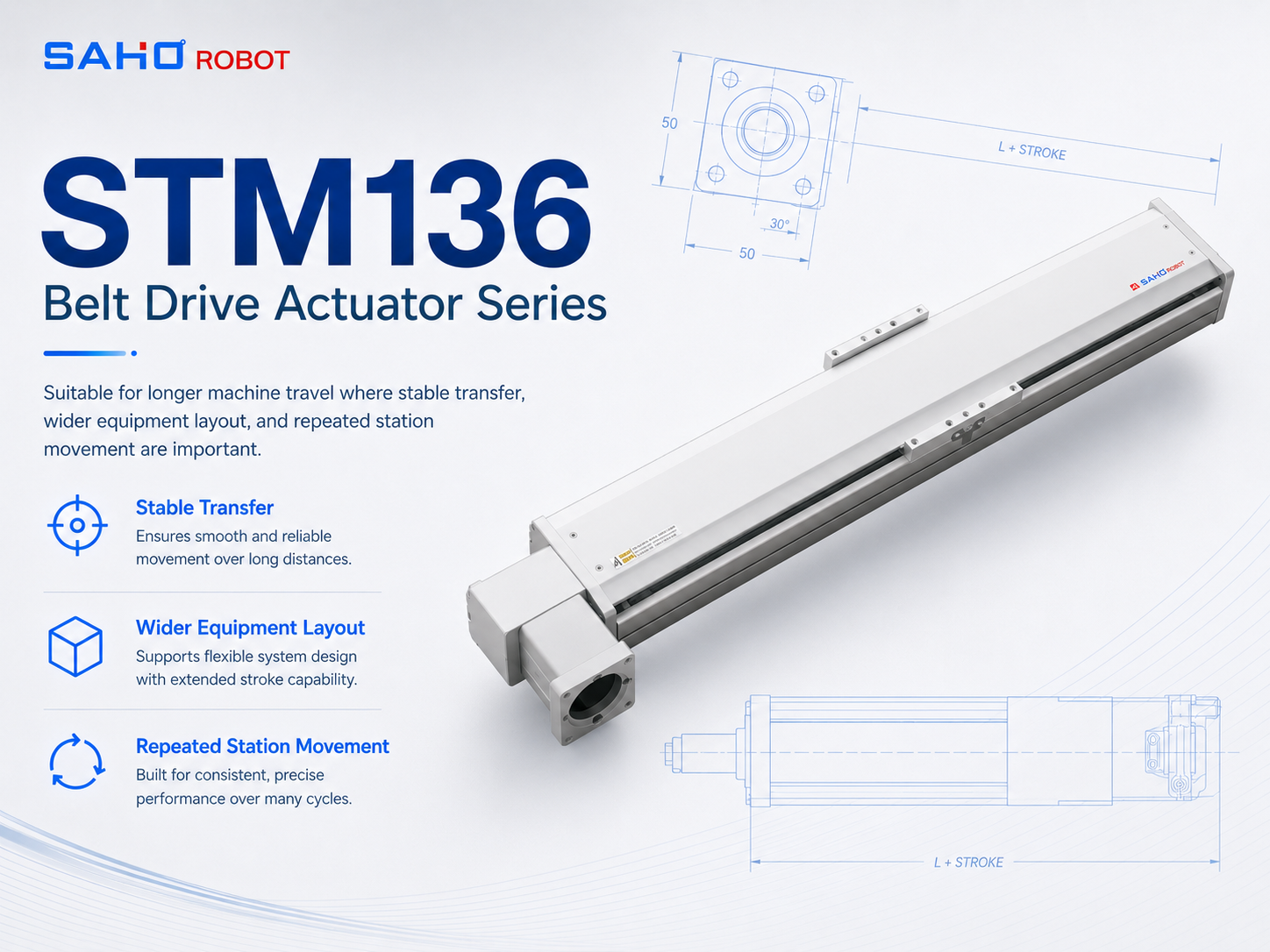
STM136: Suitable for longer machine travel where a Belt Driven Linear Module, stable transfer, wider equipment layout, and repeated station movement are important.
Choosing the Right Linear Actuator
The best actuator depends on the application requirements. Before choosing a model, define the working stroke, payload, speed, acceleration, repeatability, mounting direction, duty cycle, environment, and expected settling time. Then decide whether the main risk is slow transfer, poor final positioning, weak thrust, difficult service, or frame vibration.
| Choose this structure | When the application needs | Typical machine examples |
| Belt driven linear actuator | Long stroke, high speed, fast transfer, moderate accuracy, and cost-effective travel over a wider machine area. | Packaging machinery, material handling, pick-and-place systems, gantry robots, transfer automation, and conveyor interface systems. |
| Ball screw linear actuator | Higher positioning accuracy, stronger thrust, shorter travel, compact rigidity, and controlled precision motion. | Dispensing systems, inspection equipment, laser-related positioning, precision assembly, pressing, lifting, and fine adjustment systems. |
When a Ball Screw Linear Actuator Makes More Sense
A ball screw linear actuator makes more sense when the stroke is shorter and the process needs tighter control. For example, pressing, fine dispensing, probe contact, inspection focus, controlled lifting, and small-position adjustment often benefit from screw rigidity.
Moreover, a screw mechanism can create strong axial thrust in a compact space. This helps when the motion needs to push, lift, hold, or adjust with a stable force path. However, long travel and high speed may reduce the practical advantage of a ball screw linear module.
The phrase belt driven linear actuator vs ball screw linear actuator should not be treated as a simple contest. Instead, it should describe two different motion priorities. One side favors long travel and transfer speed, while the other favors compact precision and controlled thrust.
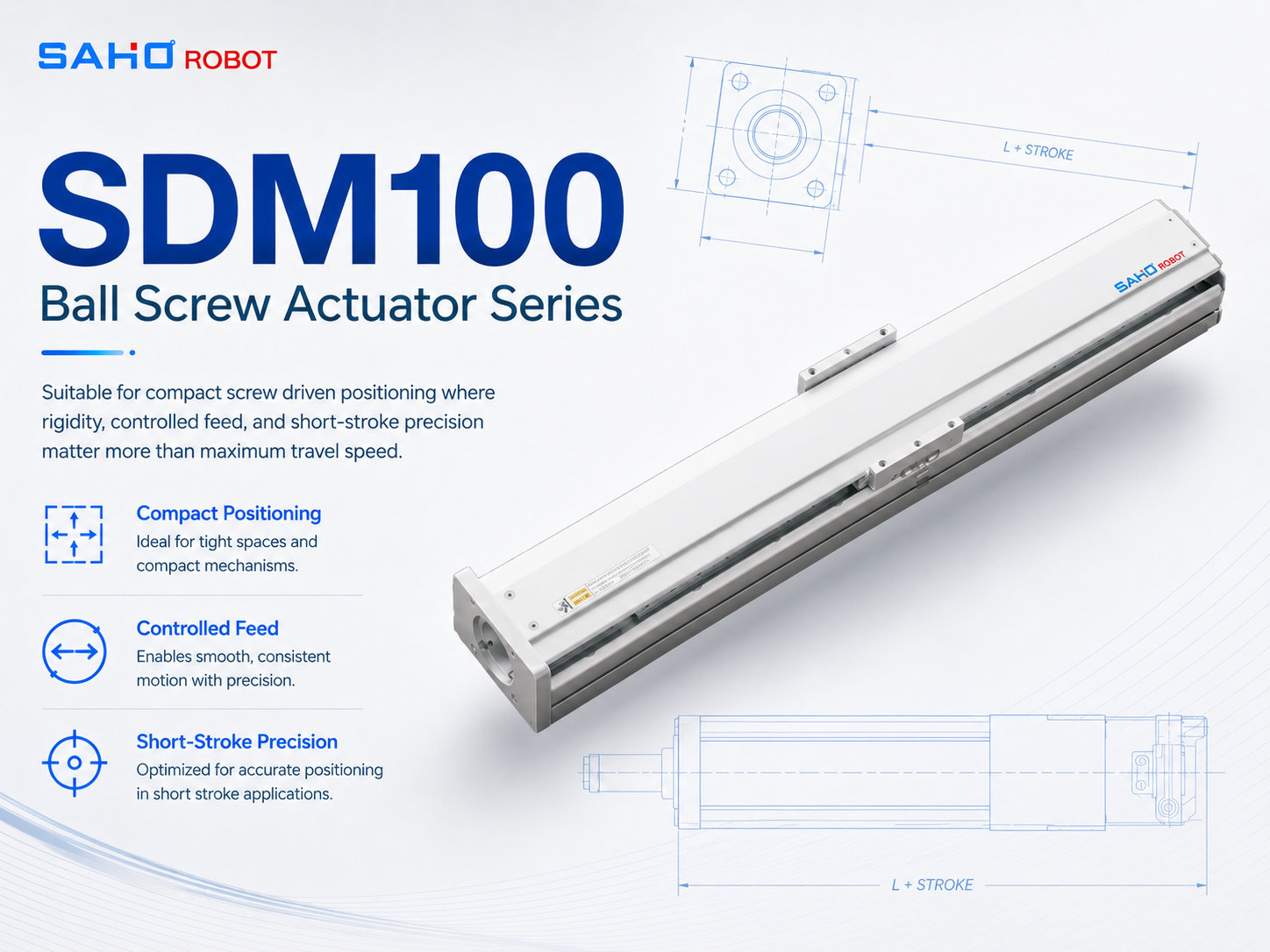
SDM100: Suitable for compact ball screw linear actuator positioning where rigidity, controlled feed, and short-stroke precision matter more than maximum travel speed.
SAHO Product Match for Complete Motion Systems
SAHO Robot organizes linear motion products by structure and application need. This helps machine builders compare belt driven linear actuator systems and ball screw linear actuator systems according to the real motion task rather than only a model name.
For long-stroke transfer in general environments, STM Series belt drive actuators provide a relevant product path. These modules suit layouts where travel length, cycle time, and repeatable station transfer define the motion value.
For compact precision movement, SDM Series screw drive actuators create a useful comparison point. They suit shorter movement where stiffness, positioning control, and axial force have higher priority.
In a complete automation layout, a machine may combine a belt driven linear rail, ball screw linear guide, servo motor interface, sensors, cable routing, and mounting components into one coherent linear motion system.
Typical Applications for Each Actuator Type
Belt driven linear actuators are commonly selected when the application prioritizes speed, efficiency, and long travel distance. Typical applications include packaging machinery, automated material handling, pick-and-place systems, gantry robots, transfer automation, conveyor interface movement, and warehouse automation.
Ball screw linear actuators are commonly selected when the application prioritizes accuracy, repeatability, and thrust force. Typical applications include precision assembly equipment, dispensing systems, laser-related positioning, inspection equipment, controlled lifting, pressing operations, and high-precision positioning systems.
In laser-related equipment, the required axis depends on the process. Laser Industry applications may involve marking, welding, cutting, inspection, or positioning. Therefore, path stability, acceleration, head mass, frame stiffness, and tolerance should be reviewed together.
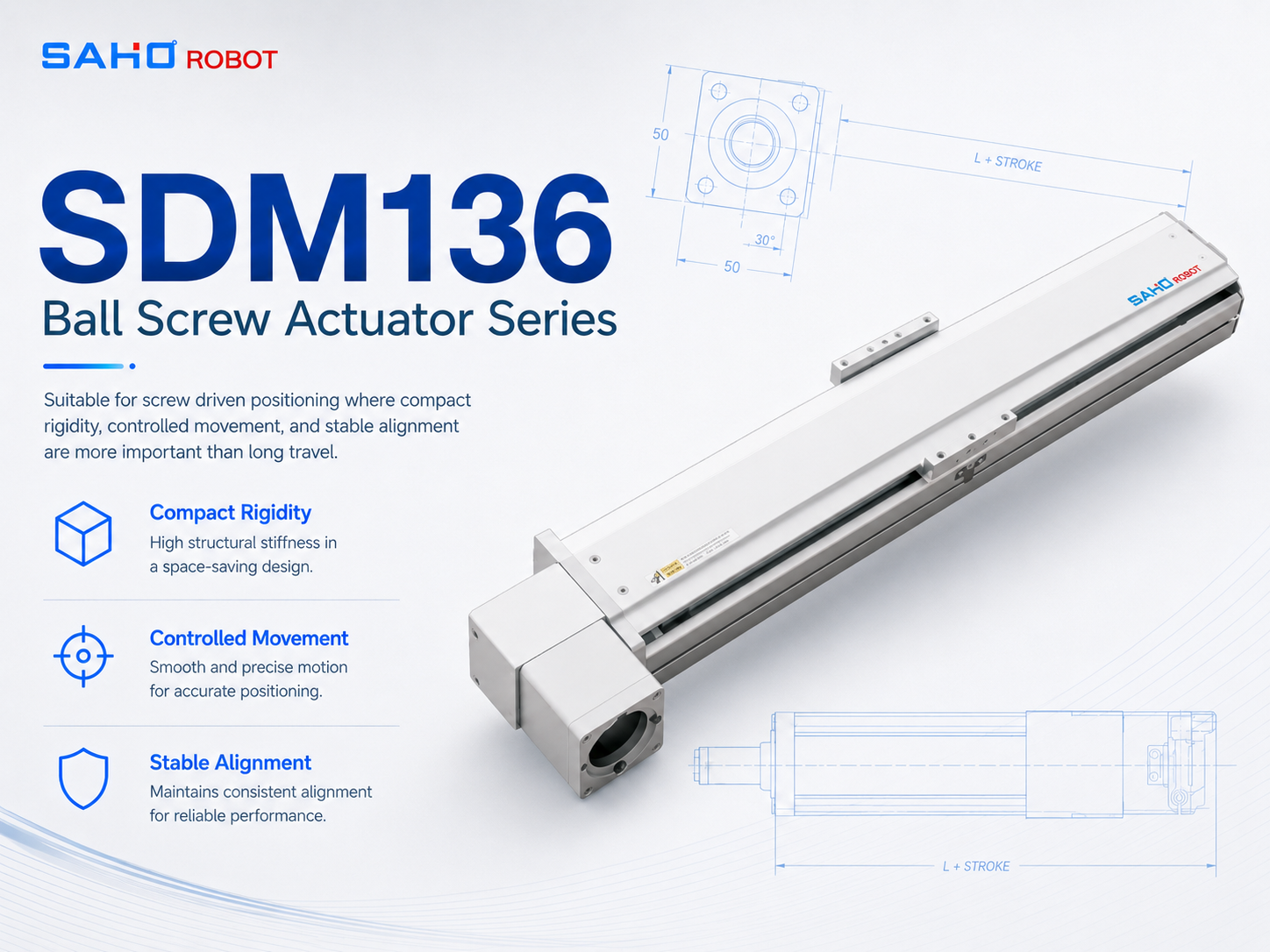
SDM136: Suitable for Automation Ball Screw Linear Module applications where compact rigidity, controlled movement, and stable alignment are more important than long travel.
Common Selection Mistakes That Raise Hidden Cost
One common mistake is choosing only by maximum speed. A fast axis can still lose time if it vibrates after every stop. Therefore, acceleration, settling time, payload shape, and fixture stiffness should receive the same attention.
Another mistake is choosing only by repeatability. A highly precise ball screw linear actuator can be unnecessary for simple long transfer. The machine may gain precision that the process does not need while losing speed, stroke efficiency, and cost balance.
A third mistake is ignoring cable routing. Moving cables, tubes, and hoses can pull the carriage, reduce smoothness, or limit usable stroke. Cable carriers and moving cable length should appear in the early layout stage.
Finally, some designs treat mounting direction as a small detail. Yet vertical mounting changes torque, braking, safety, and service requirements. Horizontal, side, and vertical installations should be checked as different load cases.
Pairing Belt and Ball Screw Axes in One Motion System
Many machines do not need one drive type everywhere. Instead, they need a motion system where each linear axis serves a different function. A long X-axis can handle fast transfer, while a short Z-axis can handle controlled height movement, pressing, focusing, or tool adjustment.
This pairing can improve the speed accuracy tradeoff. The long axis moves efficiently across the machine. Meanwhile, the short axis focuses on precision, rigidity, or thrust near the work point. Servo tuning, homing logic, software limits, acceleration curves, emergency stop behavior, and frame stiffness should be planned together.
Extended Reading and Product Paths
STM Series: Belt Driven Linear Module products for general environments and long-stroke transfer layouts.
SDM Series: ball screw linear module products for compact movement, rigidity, and positioning control.
Laser Industry: application context for high-speed and high-precision motion in laser equipment.
SAHO Robot: product navigation for linear motion solutions, electric linear actuator systems, and automation modules.
FAQ
What is the main difference between a belt driven linear actuator and a ball screw linear actuator?
A belt driven linear actuator is usually better for long stroke and fast transfer. A ball screw linear actuator is usually better for compact precision, higher thrust, and controlled short-stroke positioning.
Which actuator type is better for high-speed automation?
For high-speed transfer and long travel, a Belt Type Linear Actuator or Belt Driven Linear Module is often more practical. However, payload stability, acceleration profile, and frame stiffness still affect real cycle time.
Which actuator type is better for high accuracy?
For compact high-accuracy movement, a ball screw linear actuator often has the advantage. Final accuracy also depends on the frame, tooling, motor tuning, payload geometry, and installation quality.
Can belt drive and ball screw drive work together in one machine?
Yes. A long horizontal transfer axis may use a belt driven linear rail, while a short vertical or process axis may use a Screw Type Linear Actuator. This mixed structure can improve throughput and positioning control at the same time.
What information is needed before selecting a linear actuator?
A useful review includes stroke, payload, speed, acceleration, repeatability, mounting direction, duty cycle, environment, motor preference, cable routing, process tolerance, and expected settling time.
When should STM Series and SDM Series be considered?
STM Series should be considered when the project needs a belt driven linear actuator for longer travel, fast transfer, and repeated station-to-station movement. SDM Series should be reviewed when the project needs a ball screw linear module for compact precision or controlled thrust.
Summary and Actionable Suggestions
Both belt driven linear actuators and ball screw linear actuators play important roles in modern automation systems. Belt driven systems usually excel in speed, long travel, and cost-effective transfer motion. Ball screw systems usually provide stronger advantages in accuracy, repeatability, rigidity, and thrust force.
For projects that need a belt driven linear actuator, STM Series is the main SAHO product path for belt driven motion. For projects that need a ball screw linear actuator, SDM Series can be reviewed beside it.







-
-
 English
 -
 Français
 -
 Deutschland
 -
 Italia
 -
 Polska
 -
 España
 -
 Русский язык
 -
 日語
日語 -
 한국
한국 -
 Türkiye
 -
 português
 -
 بالعربيةês
 -
 Tiếng Việt
 -
 คนไทย
คนไทย -
 简体中文
简体中文 -
繁體中文
-