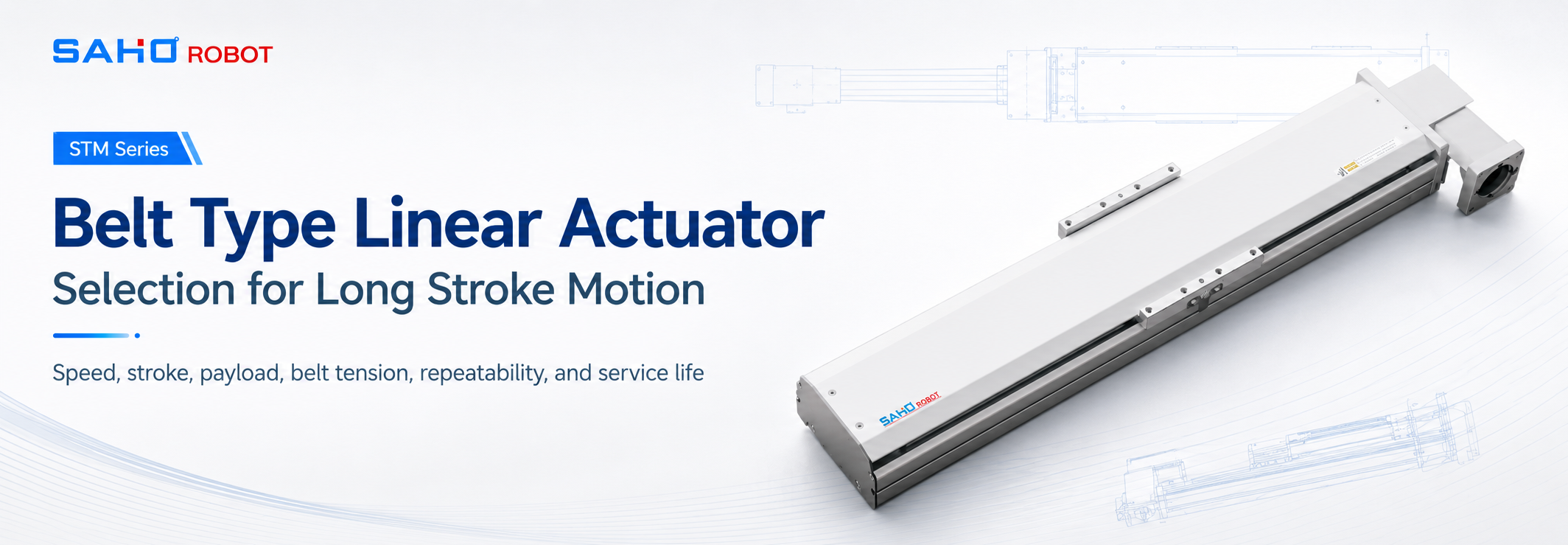
Belt Type Linear Actuator Selection for Long Stroke Motion

Date:2026-05-29 Click:17

Long stroke automation often looks simple at first. However, travel distance changes speed, acceleration, payload behavior, belt tension, repeatability, and maintenance planning. Therefore, a Belt Type Linear Actuator should be selected as a complete motion solution, not only as a long mechanical axis.

In packaging equipment, inspection systems, transfer machines, loading units, and general automation lines, the long stroke axis often decides machine rhythm. It moves products, tools, cameras, fixtures, or grippers between working areas. As a result, the chosen actuator must support the actual production task, not only the nominal travel length.

This article explains the practical benefits, suitable applications, selection checks, installation thinking, common mistakes, product matching, and frequently asked questions for long stroke belt drive actuator selection. The focus stays on finished linear actuator, linear module, and motion system use in real industrial equipment.

Long Stroke Motion in Factory Automation

In automated equipment, long stroke motion usually connects one process area to another. For example, a transfer axis may move cartons from a feeding area to a sealing area. Meanwhile, an inspection axis may carry a camera across a wide product surface.

However, the stroke itself does not define the full requirement. A long axis also affects machine width, acceleration force, frame stiffness, cable routing, and maintenance space. Therefore, selection should start from the whole motion task rather than only the required travel distance.

In packaging lines, long travel can support feeding, positioning, sorting, pushing, and product transfer. In inspection equipment, it can move sensors over a fixed workpiece. In assembly systems, it can connect several process stations with one clean motion path.

At the same time, long stroke motion creates design pressure. The machine frame must support the actuator without twisting it. The cable carrier must move cleanly through the full stroke. In addition, the drive system must accelerate and stop without causing tool vibration.

For this reason, finished belt drive modules are useful in machine design. They provide a defined actuator body, moving carriage, belt transmission, motor interface, and mounting structure. Consequently, the machine design can focus on the process instead of rebuilding every motion component from separate parts.

This approach also improves communication during project review. Mechanical design, electrical design, procurement, and assembly teams can discuss one complete axis. Moreover, the final selection can connect stroke, load, speed, mounting, and service access in one decision.

500e4783228e1fac6a726a33140bb61f.png

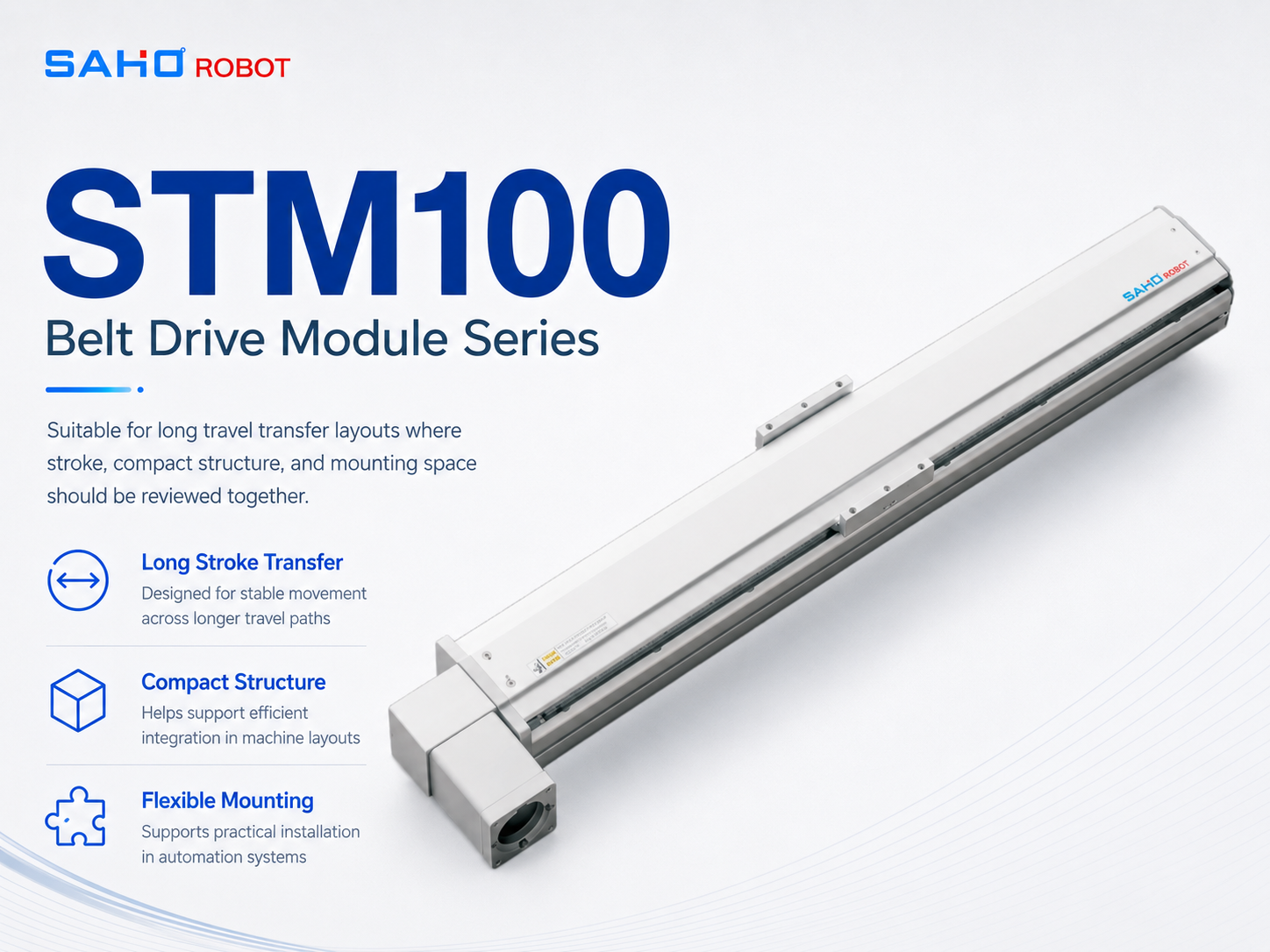
STM100 is suitable for long travel transfer layouts where stroke, compact structure, and mounting space should be reviewed together.

View STM Series Product Page

Why Belt Drive Modules Fit Longer Travel

A belt-driven module uses a timing belt and pulley system to convert motor rotation into linear motion. The carriage moves along the actuator body and carries the tooling or workpiece. Therefore, the structure works well when an application needs fast travel across a longer distance.

Compared with screw-driven axes, belt drive motion avoids the rotating length concern of a long screw. This helps the system reach higher speed over longer strokes. Moreover, the mechanical package can remain practical for transfer, scanning, loading, and general handling tasks.

Another benefit is integration efficiency. A finished actuator gives a defined body, carriage, belt path, motor interface, and mounting structure. Consequently, machine builders can reduce custom mechanical work and focus more on process flow, tooling, guarding, and controls.

In long stroke motion, return travel can affect output as much as loaded travel. A belt-driven axis can support fast reciprocating movement when the load and acceleration remain within the suitable range. As a result, packaging transfer, feeding, sorting, and inspection systems can reduce waiting time.

However, belt drive motion should not be selected only because it is fast. The correct choice also depends on payload, acceleration, repeatability target, installation direction, and service needs. A good selection balances all of these factors.

For long travel automation, the actuator should move smoothly without making the machine frame shake. Smooth acceleration helps reduce belt stress and tool vibration. In addition, controlled deceleration can improve settling at the end of each move.

Belt drive modules also support simple layout planning. The motor can be arranged according to machine space, and the carriage can carry a fixture, gripper, camera, or sensor head. Therefore, the same motion principle can serve many equipment types.

Still, the actuator should be treated as part of a complete system. The frame, motor, controller, cable carrier, sensor logic, tooling, and safety design all affect the final result. Therefore, selection should include both product capability and machine integration.

Suitable Application Scenarios

Packaging equipment is a common fit for long stroke belt motion. For example, cartons, trays, pouches, labels, and sleeves may need quick movement between stations. Meanwhile, the machine must keep the transfer path simple and easy to service.

Inspection systems can also benefit from this motion style. A camera, scanner, laser sensor, or measuring head can move across a fixed product. As a result, the workpiece may remain stable while the measuring device travels through the inspection area.

In loading and unloading machines, a belt drive axis can carry a gripper between a conveyor and a fixture. Additionally, it can pair with a vertical actuator, rotary unit, or pneumatic device. This creates a simple handling system for repetitive transfer work.

General automation applications include tray handling, material feeding, pick-and-place travel, conveyor-side rejection, sorting, assembly positioning, and light gantry motion. Still, each layout needs a separate review because the same stroke can have very different load and speed conditions.

In a tray handling machine, the axis may move between several fixed points. Accuracy at each stop matters, but the path between stops should also remain smooth. Therefore, the motion profile should avoid harsh starts and stops that shake the tray.

In a conveyor-side rejection system, the actuator may need fast response within a narrow time window. However, the load may be light and the stroke may be medium to long. In this case, acceleration, sensor timing, and controller logic become very important.

In a camera scanning system, the actuator may move at a steady speed across the product. The travel should remain smooth enough for stable image capture. Moreover, vibration from brackets or cables can reduce inspection quality even if the actuator itself moves correctly.

  • Packaging transfer and carton handling

  • Tray loading and unloading

  • Camera inspection and scanning motion

  • Conveyor-side sorting and rejection

  • Assembly station transfer

  • Light gantry and handling systems

  • Material feeding and indexing equipment

  • Robotic auxiliary travel and extended reach systems

4a3263036fc147cdc8cf838a01e332f4.png

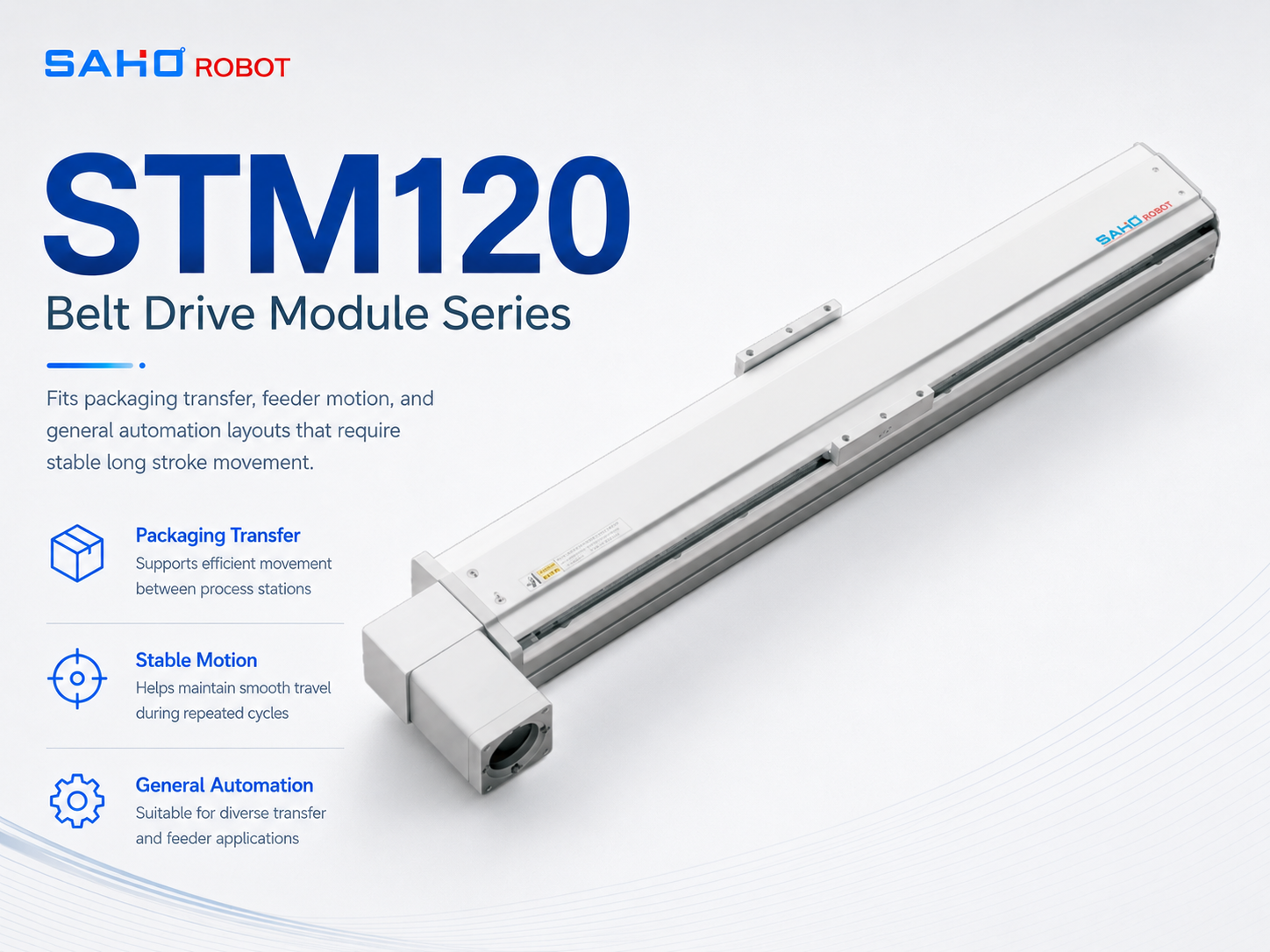
STM120 fits packaging transfer, feeder motion, and general automation layouts that require stable long stroke movement.

Open STM Series Details

Speed, Stroke, Payload, and Cycle Time

First, stroke length should include more than the working distance. End clearance, sensor space, tool overhang, cable bend area, and safety margin can reduce usable travel. Therefore, the selected stroke should leave enough room for the real installation.

Next, speed should be reviewed with acceleration and deceleration. A high maximum speed may look useful, but the axis may not reach that speed on every move. In addition, aggressive acceleration can create vibration, belt stress, and longer settling time.

Payload also needs a complete definition. The moving mass includes the product, gripper, tooling plate, bracket, hoses, cables, sensors, and fixtures. Moreover, a light tool can still create a high moment when it extends far from the carriage center.

For this reason, the load center should stay close to the carriage whenever possible. A compact bracket improves motion stability. Conversely, a tall or overhung structure may shake after the actuator stops, even when the carriage reaches the correct position.

Cycle time should include the full sequence. Pickup, release, sensor confirmation, motion start, acceleration, deceleration, and return travel all affect output. Consequently, a complete timing review is more useful than comparing maximum speed alone.

For example, a machine may only need a short loaded stroke but a long return stroke. In another case, the axis may travel a long distance but stop at several intermediate points. Therefore, the motion profile should match the real process, not only the longest movement.

Acceleration is often the hidden selection factor. A fast top speed may not cause problems, but a sudden acceleration can stress the belt and tooling. Additionally, it may create vibration that delays the next process step.

Duty cycle should also be reviewed. A machine that runs a few strokes per minute has different thermal and mechanical conditions than a line running continuously. Therefore, operating hours, movement frequency, and load should be considered together.

Selection AreaWhy It MattersPractical Review
Usable strokeClearance and tooling reduce real travel.Add process distance, end margin, sensor space, and tool overhang.
AccelerationHigh acceleration creates major mechanical stress.Review motor torque, belt load, vibration, and settling time.
Payload offsetOffset tooling increases moment load.Check distance from load center to carriage center.
Mounting directionGravity changes load and safety behavior.Review horizontal, side, inclined, or vertical mounting early.
Service accessHidden adjustment points increase downtime.Leave access for belt tension, sensors, cables, and fasteners.

Belt Tension, Alignment, and Mounting Layout

Belt tension affects motion response. If tension is too low, the axis may feel loose during acceleration and reversal. However, excessive tension can increase bearing load, noise, and wear. Therefore, the tension range should follow the product design.

Alignment also matters. The actuator body should sit on a flat and rigid mounting base. If the frame twists the module, the belt path and carriage movement may become uneven. As a result, motion noise and friction may increase.

For long spans, support along the base becomes more important. A wide frame may bend under load or during machine transport. Therefore, installation teams should check surface quality, screw sequence, and frame stiffness before operation.

Cable routing deserves the same attention. Long stroke axes often carry signal wires, air tubes, vacuum lines, and sensor cables. Moreover, cable carriers should respect bend radius and avoid side pull on the moving carriage.

In dual-axis gantry systems, parallel alignment becomes critical. Two axes that do not move squarely can rack the cross beam and increase wear. Therefore, mechanical alignment and control synchronization should be planned as one system.

The mounting surface should not force the actuator into shape. If screws pull the body against an uneven frame, internal friction may increase. Consequently, the system may run well during testing but show wear after repeated production cycles.

Service access should be planned before covers are finalized. Belt adjustment, motor access, sensor replacement, and cable carrier inspection should remain practical after installation. Otherwise, a simple maintenance task can become a long machine stop.

In dusty or film-heavy environments, the axis may need cleaning access. Packaging debris, powder, adhesive residue, and fibers can gather near moving parts. Therefore, shielding and cleaning intervals should be part of the layout discussion.

d093dc23984e2bb36c54ffb204bd77f6.png

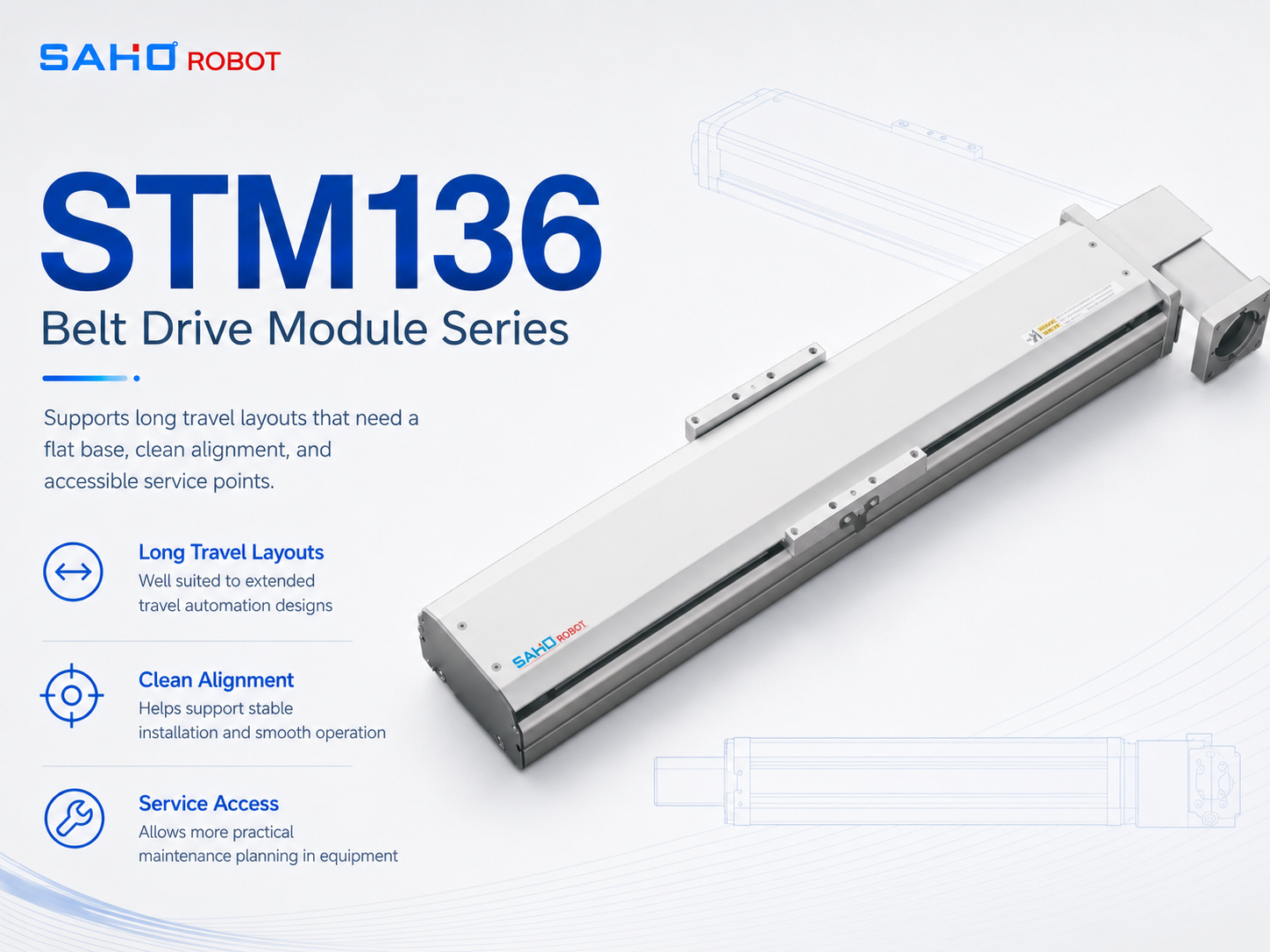
STM136 supports the mounting discussion because long travel layouts need a flat base, clean alignment, and accessible service points.

Check STM Series Models

Repeatability, Service Life, and Maintenance Planning

Repeatability means the axis can return to a commanded position under similar conditions. However, repeatability is not the same as absolute accuracy. The final process result also depends on tooling stiffness, controller settings, sensor logic, and machine structure.

In many long stroke systems, repeatability at key stop points matters most. For example, pickup, release, scan start, scan end, and home positions often define process quality. Therefore, selection should focus on real stop points and process tolerance.

Service life depends on load, acceleration, duty cycle, belt condition, alignment, contamination, and maintenance habits. Additionally, a cleaner environment usually supports smoother operation. Dust, film scraps, adhesive mist, powder, and fibers can affect moving areas over time.

Maintenance planning should include regular inspection. Common checks include belt condition, abnormal noise, mounting screws, cable routing, and surface cleanliness. In addition, lubrication needs should follow the product documentation and actual operating environment.

A serviceable layout reduces downtime. For example, belt access, sensor replacement, and motor removal should not require dismantling large machine sections. Consequently, a little extra clearance around the axis can improve the total life of the equipment.

Motion tuning also affects service life. Smooth acceleration can protect the belt and reduce vibration. In addition, controlled stops can prevent the tooling from shaking after each move.

Sensor routines should be clear and repeatable. A stable home routine helps the system recover after shutdown or alarm. Moreover, end limits and software limits should protect the axis from unexpected travel commands.

For long production runs, small mechanical problems can grow over time. Loose fasteners, cable drag, dirt buildup, and incorrect belt tension may not stop the machine immediately. However, they can slowly reduce motion quality and increase unplanned downtime.

SAHO STM Series Product Match

For long travel belt drive applications, the SAHO STM Series is the main product match. The series includes STM100, STM120, STM136, STM175, and STM210 models for general environments. As a result, different frame sizes can support different machine layouts and load requirements.

STM Series suits transfer axes, packaging lines, feeder systems, inspection travel, and horizontal handling equipment. Moreover, the product family keeps selection focused on finished actuator and module solutions rather than loose motion components.

Model selection should still follow application data. Stroke length, payload, acceleration, mounting orientation, motor interface, and service access all matter. Therefore, the right STM model is not only the one with enough travel. It is the model that keeps motion stable across the expected operating cycle.
For compact high-speed silent module layouts, the TA Series may support some machine concepts. However, STM Series remains the central match for long stroke belt drive use in general environments.

In broader equipment planning, SAHO linear motion solutions can help compare belt drive modules, screw drive modules, linear motors, and electric actuator options. Consequently, the selected product can match the full machine architecture more closely.

The STM Series is especially relevant when a machine needs longer travel and a clear mechanical envelope. It can support transfer motion, horizontal handling, inspection travel, and general automation tasks. Meanwhile, the final model should be chosen through load, speed, mounting, and duty-cycle review.

A product match should also consider future machine changes. If the process may need higher output later, acceleration margin and service access become more important. Therefore, selection should avoid using every part of the axis at its limit from the first design stage.

0d2de851b56493ab91c130384fbc168f.png

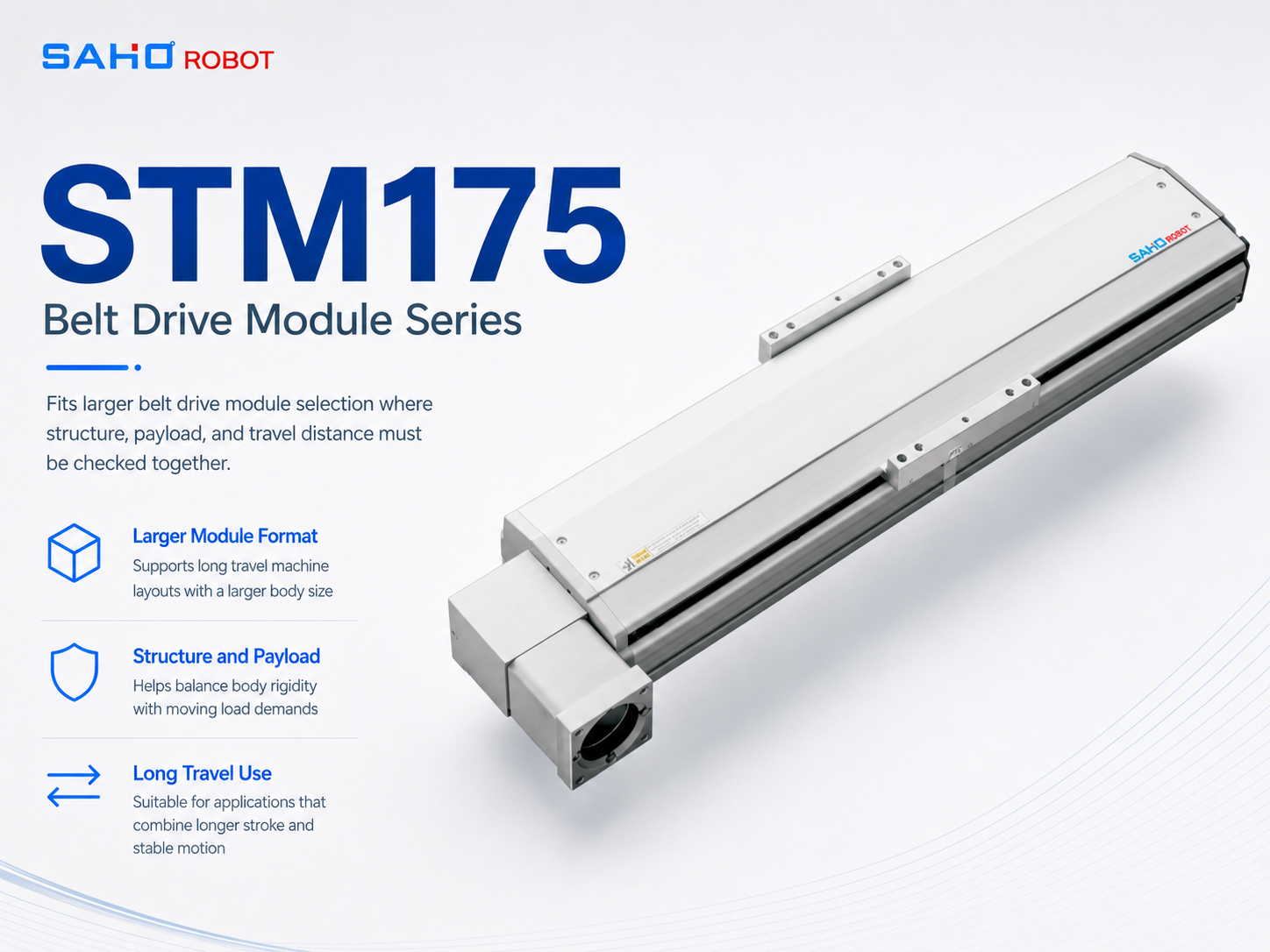
STM175 fits larger belt drive module selection where structure, payload, and travel distance must be checked together.

Go to STM Series

System Pairing Ideas for Machine Design

A long stroke belt axis often works as one part of a larger motion system. In a simple transfer design, one horizontal actuator moves the product or tool between two positions. Meanwhile, a vertical device, gripper, or vacuum unit handles pickup and release.

In a gantry layout, two parallel belt axes may support a cross beam. Then, another motion axis can move across that beam. This structure can cover a wide work area. However, the frame must remain square and rigid to avoid racking.

In a scanning layout, the actuator may carry a camera, sensor, laser head, or marking device. Because the tool moves instead of the workpiece, the product can remain fixed during measurement. As a result, handling risk can decrease in delicate inspection processes.

In a conveyor-side design, the actuator can pair with sensors that detect part position. After confirmation, the axis may move a pusher, gripper, or reject arm. Additionally, controller logic can coordinate the actuator with conveyor speed and product spacing.

Motor pairing should follow the load and cycle. Servo motors often support controlled acceleration, speed, and positioning. Stepper motors may fit lighter tasks or simpler internal equipment. Nevertheless, torque, speed, thermal behavior, and control accuracy should decide the final drive choice.

Cable systems should be selected before the machine frame is finalized. Long travel can fatigue poorly routed wires and tubes. Therefore, cable carriers should have enough length, bend radius, and clearance through the complete stroke.

End effectors should stay as compact as possible. A vacuum plate, gripper, nozzle head, or sensor bracket should avoid unnecessary overhang. In addition, the tooling should be stiff enough to stop quickly after each move.

Control logic should also support smooth motion. Motion profiles, alarm handling, home routines, limit positions, and emergency stop behavior need early review. As a result, the axis can work as part of a reliable automation system rather than a separate moving part.

Common Selection Mistakes

Selecting by stroke length only

At first glance, the actuator with enough travel may seem suitable. However, payload offset, acceleration, duty cycle, and installation direction can change the correct model. Therefore, stroke length should begin the review rather than finish it.

Ignoring real cycle time

Peak speed does not always reduce production time. The real cycle includes acceleration, deceleration, grip time, release time, sensor delay, and settling. As a result, a balanced motion profile can outperform a harsh high-speed setting.

Overlooking tooling stiffness

A flexible bracket can create process error after the carriage stops. For example, a long vacuum plate may shake at the end of a fast move. Therefore, tooling geometry should be reviewed together with actuator sizing.

Treating the frame as perfect

Long axes depend on a good mounting base. If the frame is uneven, the module may be pulled into stress during installation. Consequently, noise, friction, and uneven motion can appear later.

Hiding adjustment points

A clean machine cover can still create service trouble. If tension access, sensors, or cable carriers are blocked, maintenance work becomes slow. Therefore, service planning should be part of the first machine layout.

Forgetting vertical safety needs

Vertical or inclined installations change load behavior. If power is removed, gravity can move the load. Therefore, brake motors, holding devices, or other safety methods may be required depending on the machine design.

Choosing the motor too late

Motor size, mounting direction, cable position, and controller type affect the mechanical layout. If motor selection happens too late, the machine frame may need changes. Therefore, actuator and motor selection should move together.

Ignoring the operating environment

Dust, powder, film scraps, oil mist, adhesive residue, and fibers can affect long-term motion quality. Therefore, protection, cleaning access, and maintenance intervals should match the real production environment.

Selection Checklist

  • Define the working stroke, clearance, sensor space, and tool overhang.

  • Confirm payload mass, load center, moment load, and bracket stiffness.

  • Review acceleration, speed, dwell time, return travel, and settling behavior.

  • Check horizontal, side, inclined, or vertical installation requirements.

  • Plan belt tension access, cleaning access, sensor service, and cable routing.

  • Match the motor and controller to torque, speed, duty cycle, and heat conditions.

  • Review the process environment for dust, film scraps, powder, oil mist, and adhesive residue.

  • Keep future maintenance access visible in the first machine layout.

  • Check whether the machine frame can support the actuator across the full stroke.

  • Confirm sensor positions, home routine, limit logic, and emergency stop behavior.

  • Review cable carrier bend radius and moving mass.

  • Leave enough space for motor installation and replacement.

Extended Reading

The following SAHO pages can support product comparison and internal navigation. Each link points to an existing SAHO page for motion product review.

FAQ

What makes belt-driven motion suitable for long stroke travel?

Belt-driven motion supports longer travel because the axis does not rely on a long rotating screw. Therefore, it can offer fast movement across wider machine spans while keeping the mechanical structure practical.

How should payload be checked for a long stroke belt axis?

Payload should include the product, tooling, bracket, hoses, cables, sensors, and fixtures. In addition, the load center should be reviewed because offset mass can create a large moment load.

Does belt tension affect repeatability?

Yes. Low tension can reduce response during acceleration and reversal. However, excessive tension can increase bearing load and wear. Therefore, tension should follow the product adjustment range.

Can belt drive modules work in vertical installations?

Vertical installations need extra review because gravity can move the load during power loss. As a result, brake motors, holding devices, or other safety measures may be required.

When is STM Series more suitable than a compact high-speed module?

STM Series is more suitable when long travel, general environment use, and stronger structural planning are central to the machine. Compact high-speed modules may fit smaller spaces with different load and stroke needs.

What information helps confirm the correct model?

Useful information includes stroke, payload, tool offset, acceleration, speed, mounting direction, duty cycle, environment, motor preference, repeatability target, and service access limits.

How does mounting quality affect long stroke performance?

Mounting quality affects alignment, friction, noise, and repeatability. If the machine frame twists the actuator body, the carriage and belt path may not move smoothly. Therefore, a flat and rigid base is important.

Why should tooling offset be checked before selection?

Tooling offset changes moment load. A light tool mounted far away from the carriage can create more stress than a heavier tool mounted close to the carriage. Therefore, the load center should be part of selection review.

Can a high speed linear actuator reduce cycle time in every case?

Not always. Cycle time also includes acceleration, deceleration, dwell, sensor confirmation, pickup, release, and settling. Therefore, the complete motion profile should be reviewed before assuming that higher maximum speed will improve output.

What maintenance access should be kept around the actuator?

Practical access should remain for belt tension checks, motor removal, sensor adjustment, cable carrier inspection, cleaning, and fastener checks. In addition, guards should allow service without removing major machine sections whenever possible.

Conclusion and Practical Next Steps

Long stroke motion needs balanced selection. Therefore, the actuator should support travel length, cycle speed, payload behavior, repeatability, belt tension stability, mounting quality, and future maintenance access. When these factors align, the machine can run with fewer motion surprises.

In addition, product selection should follow the real work cycle. Packaging transfer, inspection travel, tray handling, sorting, and general automation may all need long motion. However, each task creates different load, speed, and service conditions.

  • First, define the complete motion profile, including acceleration, dwell time, return movement, and settling behavior.

  • Second, review payload mass, load center, tooling stiffness, mounting direction, and machine frame support.

  • Finally, keep belt tension access, cable routing, sensor service, and maintenance clearance visible in the machine layout.

For long travel automation that requires a Belt Type Linear Actuator, STM Series provides a focused starting point for belt drive module selection. Moreover, SAHO Robot can support product review based on stroke, load, speed, mounting method, and system pairing requirements.

View STM Series Now