


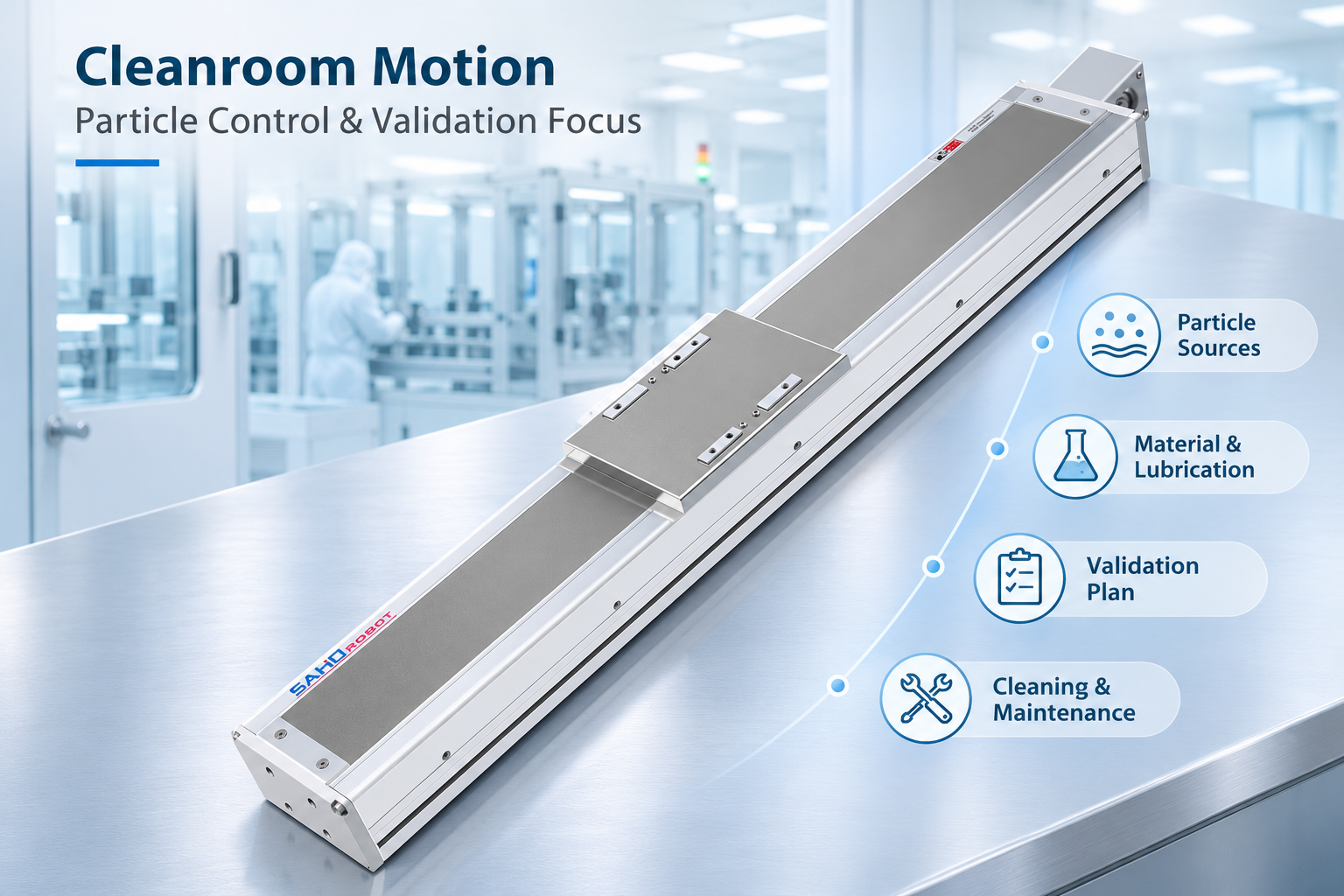
| A cleanroom belt driven linear actuator should be assessed under the movement, loading, cable-routing and cleaning conditions it will actually encounter. Start by identifying potential particle sources, agreeing on practical controls, defining representative operating tests and documenting the acceptance evidence. A product-series label alone cannot establish that a particular axis meets a project's particle limits or an ISO cleanliness class. |
| 01 | Particle sourcesMap belt, guide, lubricant and cable-related sources in the installed machine. |
| 02 | Control measuresConfirm relevant materials, routing, cleaning and service practices with engineering. |
| 03 | Validation conditionsReproduce the intended motion duty, airflow and installed cable arrangement. |
| 04 | Acceptance evidenceConnect each measured result with its test condition and agreed decision rule. |
Define the Required Evidence Before Choosing a Cleanroom Axis
A facility's air cleanliness classification and an individual machine's particle behavior are related but separate questions. A room may meet its specified airborne concentration while a moving axis introduces particles near a sensitive handling, inspection or assembly position. The equipment must be evaluated for the conditions and locations that matter to the process.
ISO 14644-14:2026 addresses equipment suitability with respect to airborne particle concentration. Referring to that standard does not certify an actuator or establish a cleanliness class for an untested configuration. Material cleanability, chemical compatibility and process-specific surface contamination may require separate assessments.
Before comparing product options, agree on relevant particle-size channels, process-sensitive sampling locations, background conditions, operating states, measurement methods and acceptance criteria. The protocol should identify whether the decision concerns total measured concentration, a permitted contribution during motion or another agreed project criterion.
SAHO's MSTM Series cleanroom belt driven linear actuator is a relevant range to review for equipment integration with cleanliness requirements. The series listing is a commercial starting point; it does not prove that a selected model or installed machine satisfies a particular particle acceptance limit.
Map Particle Sources Under Actual Movement
An axis can appear clean while stationary and still release particles when its carriage travels, reverses or runs repeated cycles. A meaningful source map follows both the movement and the path by which released particles might reach the work area. The map should include elements of the installed machine that may not be supplied as part of the actuator.
Belt and Guide Interfaces
Belt-to-pulley engagement, guide contact and carriage movement are potential locations for friction-related particle generation. Their presence does not mean that a particular MSTM configuration has unacceptable emissions. It means they deserve inspection and, where relevant, measurement under the proposed motion duty.
Payload, travel length, acceleration and reversal frequency can change the conditions represented by a particle test. Enclosure geometry and airflow matter as well: particles produced near an interface may move toward a sensitive process zone instead of remaining at the point of generation. Sampling solely beside the belt may miss that transport path.
Lubrication, Cables and Cleaning Exposure
Lubricants should be reviewed for the selected mechanical interfaces, operating duty and cleanliness requirements. Potential concerns include migration, interaction with cleaning chemicals and contamination at a lubricated contact. A generic label such as "cleanroom grease" is not a substitute for a confirmed lubricant specification or relevant compatibility evidence.
Moving cables, carriers and strain relief are equally important when they form part of the production installation. Bending or rubbing can introduce particle sources beyond the actuator housing. A test of an uncabled axis therefore may not represent a complete machine whose cables move with every cycle.
| Belt / pulley | Map the engagement path and inspect the actual motion arrangement; do not assume that normal appearance indicates low particle emission. |
| Guide / carriage | Review contact locations and the operating states that may change wear or particle transport. |
| Lubrication | Check the approved substance, application method, migration risk and cleaning-agent interaction. |
| Cable motion | Include installed cable sweep, contact points and nearby surfaces in representative testing. |
A source map becomes more useful when it also marks the intended airflow and the nearest contamination-sensitive location. These details explain why a sampling position was selected and help future engineers understand what the test actually represents.
Agree Materials and Service Requirements With Engineering
A mechanically acceptable material is not automatically suitable for every cleanroom process. Exposed surfaces, belt and guide components, lubricants, cleaning methods and replacement procedures need to be reviewed together. The actual configuration and material choices for an MSTM model require documentation from SAHO; they should not be inferred from a product photograph or series name.
Removing deposited contamination and limiting particles generated during movement are also different tasks. A surface may be easy to wipe down yet still require particle testing under motion. Conversely, a favorable particle reading does not establish chemical compatibility with the planned cleaning agent. Both questions belong in the application review when they affect the process.
| An important distinction: protection from external dust, spray or debris does not establish low particle generation by the equipment itself. For that upstream environmental definition, see SAHO's guide on how to define contamination protection requirements. This article focuses on the separate validation question for particles released during installed motion. |
Build a Representative Particle-Validation Plan
The particle test should answer an application question, not merely produce a reading. A representative plan records the proposed stroke, load, motion profile, acceleration, reversing pattern, duty cycle, orientation and test duration. It should reproduce relevant cables, machine accessories, nearby structures and environmental airflow rather than testing a convenient bare-axis arrangement.
Background concentration helps interpret measurements taken during operation. Choose sampling locations using the suspected sources, airflow direction and sensitive process area. Specify the particle counter, calibrated state, size channels, sampling arrangement, measurement duration and recording method before testing begins. Agree how repeated readings, background variation and uncertainty affect the final acceptance decision.
Particle Source to Acceptance Evidence Matrix
The compact matrix below links each possible source to a proposed control, a representative validation condition and the evidence needed for review. It is an engineering planning framework, not a completed SAHO particle test report.
| Belt and pulley interfaces | Control: approved alignment and component condition. Validation: representative travel, load and reversals. Evidence: configuration record, inspection and particle measurements. |
| Guide and carriage | Control: approved guide configuration and maintenance condition. Validation: repeated movement across specified travel. Evidence: particle data and inspection findings. |
| Lubrication | Control: approved lubricant and application procedure. Validation: defined temperature and operating duty. Evidence: lubricant specification, compatibility review and relevant tests. |
| Cables and carriers | Control: routing and contact management. Validation: full installed cable travel during operating cycles. Evidence: routing drawing, observations and particle data. |
| Cleaning and service | Control: approved cleaning and replacement procedures. Validation: specified post-cleaning or post-maintenance state. Evidence: procedure revision, service log and retest decision. |
Where a background-adjusted comparison is relevant, use a symbolic expression rather than inserting an assumed acceptance threshold:
| ΔC = Con − Cbg |
Con denotes measured airborne particle concentration during operation, Cbg the comparable background concentration, and ΔC their difference. Each quantity uses particles/m3 for the same specified particle-size channel and sampling location. The comparison assumes consistent measurement conditions; it does not prove that the actuator is the only source or establish ISO-class compliance.
The approved protocol must define whether acceptance is based on total concentration, an allowed incremental contribution or another project-specific method. A pass/fail limit should never be selected after results are available.
| Before an engineering review: prepare the particle-source matrix with intended operating conditions, proposed sample points, known materials, unresolved compatibility questions and the evidence the project will require for acceptance. |
Review Cleaning and Maintenance Changes After Validation
Initial validation applies to the configuration and conditions that were tested. Replacing a belt, changing lubricant, rerouting cables or modifying cleaning practice may affect particle generation or transport. These changes deserve an impact review; they do not necessarily require repeating every unaffected test.
A useful record identifies the component or procedure changed, the drawing or procedure revision, the affected particle source and the decision on targeted measurement or broader revalidation. This makes later maintenance traceable instead of relying on a statement that the equipment was simply "cleaned and checked."
Service access matters to procurement, too. A proposed axis may satisfy initial acceptance conditions yet be difficult to maintain within the approved cleaning and replacement procedure. Resolve those practical constraints before accepting the configuration for production.
Request an MSTM Evidence Review
The engineering review should connect the project particle limits with an identifiable MSTM configuration. Submit the motion duty, mounting arrangement, cable route, cleaning requirements, sampling plan and acceptance matrix. Request the model-specific drawings, material and lubricant details, maintenance guidance and any particle-related test documentation applicable to comparable conditions.
If the main concern is exposure to dust or other contaminants from the surrounding environment, SAHO's JTG Series may warrant a separate engineering review. Its positioning for special environments does not establish cleanroom particle suitability or make it a direct substitute for an MSTM configuration.
MSTM Series Application Review SAHO MSTM Belt Driven Linear ModuleThe MSTM100 reference image illustrates the type of belt-driven module under discussion. Its external appearance cannot confirm the exact project configuration, lubricant, particle-generation result or ISO cleanliness classification. Use the series entry to request the appropriate application documentation. MSTM100 reference image. A product photograph is not particle-validation evidence. A useful discussion starts with the proposed stroke and load, motion cycle, installation layout, airflow, cable motion and the completed acceptance matrix. Product configuration and suitability remain subject to engineering confirmation. |
A cleanroom belt driven linear actuator should move toward procurement only when the specific configuration and its available evidence can be judged against the project's particle acceptance requirements. Remaining gaps belong in an engineering review, not in an assumed product rating.
| Related ReadingFor the complementary external-exposure decision, read How to Define Contamination Protection Requirements for an Industrial Linear Actuator. It explains why contaminant type, exposure direction, cleaning and protection requirements must be defined before selecting protective measures. |
Frequently Asked Questions
| Does a cleanroom product label prove an ISO class? |
| No. A label is not an ISO cleanliness classification or a model-specific suitability certificate. Any applicable claim needs defined test conditions and supporting evidence. |
| Should cable motion be included in validation? |
| Yes, when moving cables or carriers are part of the installed system. Their routing, bending and contact behavior should be represented in the test arrangement. |
| Can a changed lubricant require revalidation? |
| Yes. A lubricant change can affect compatibility and contamination behavior. Engineering should determine whether targeted or broader testing is necessary. |
| Which documents should be requested before procurement? |
| Request configuration drawings, material and lubricant information, available particle-test evidence and its conditions, cleaning and maintenance guidance, and the project's documented acceptance criteria. |
Ready to Review the MSTM Application Evidence? Bring the particle-source matrix, motion duty, installation drawing, cable routing, cleaning requirements and proposed acceptance method into the MSTM series discussion. Confirm which configuration-specific documents and validation activities are needed before procurement. Review MSTM Options Against Your Application Data Contact SAHO for Engineering Review |