

A belt-driven linear actuator can reach its programmed stop on time while a packaging line still misses its output target. The product may need longer to settle, the sealing or filling station may need more dwell, or a downstream signal may arrive late. The useful question is not simply how fast the axis moves, but how much of each index cycle is available for motion—and whether that balance holds when package formats change.
The Index Cycle Is More Than the Move
Consider a sealing station. Even after the carriage reaches position, the package may still be settling before the jaws can close. The next index then depends on the process finishing and the relevant readiness signals. Travel time alone therefore tells only part of the throughput story.
For a serial sequence with no overlapping intervals, the cycle budget is:
| Tcycle = Tmove + Tsettle + Tprocess + Twait |
This simplified budget separates move (including acceleration and deceleration), settle (until the product meets the station's stability requirement), process (the operation's dwell) and wait (non-overlapping sensor or interlock delays). All are in seconds per index. When stations operate in parallel, the limiting path and synchronization matter more than the sum of every station's dwell.
Work backward from the output requirement. If the line needs R accepted packages per minute and produces N accepted packages per index under the stated assumptions, the target interval is Ttarget = 60N/R seconds per index. What remains after settling, process dwell and unavoidable waiting is the travel window. If those non-motion intervals already exceed the target, a higher peak actuator speed will not fix the serial sequence.
Only then does actuator selection become meaningful. A TA Series belt-driven linear actuator may be worth evaluating for the transfer axis, but index distance and catalog speed alone cannot establish suitability. Moving mass, the allowable move time, installation and verified model limits still matter.
Position Reached Is Not Process Ready
Three events that look almost simultaneous on a controller trace can mean different things: the axis reaches its commanded position, the package becomes stable enough to process, and the station is ready to operate. Treating them as a single “in position” event can hide where the cycle time is actually spent.
Why Pitch Changes Affect the Stop Point
For a direct, constant-pitch feed, the programmed index distance can be expressed as Dindex = K × P, where P is package pitch in millimeters and K is the number of pitch increments advanced per index. This relation is not transferable without adjustment to linkage-driven, tool-positioning or independently synchronized conveyor layouts.
A new carton or pouch size can shift both the physical stop point and the sensor window. Even when the commanded travel is mathematically correct, the next station may see the package in the wrong place. The meaningful check is where the package actually arrives, not just the distance reported by the axis.
What the Station Needs During Dwell
A sealer may need a validated stationary interval; a filler may need confirmation that the container remains positioned during dispensing; an inspection system may require a stable product before the capture trigger. Those windows are process-dependent. The actuator's in-position indication is not independent evidence of seal quality, fill completion or image acceptance.
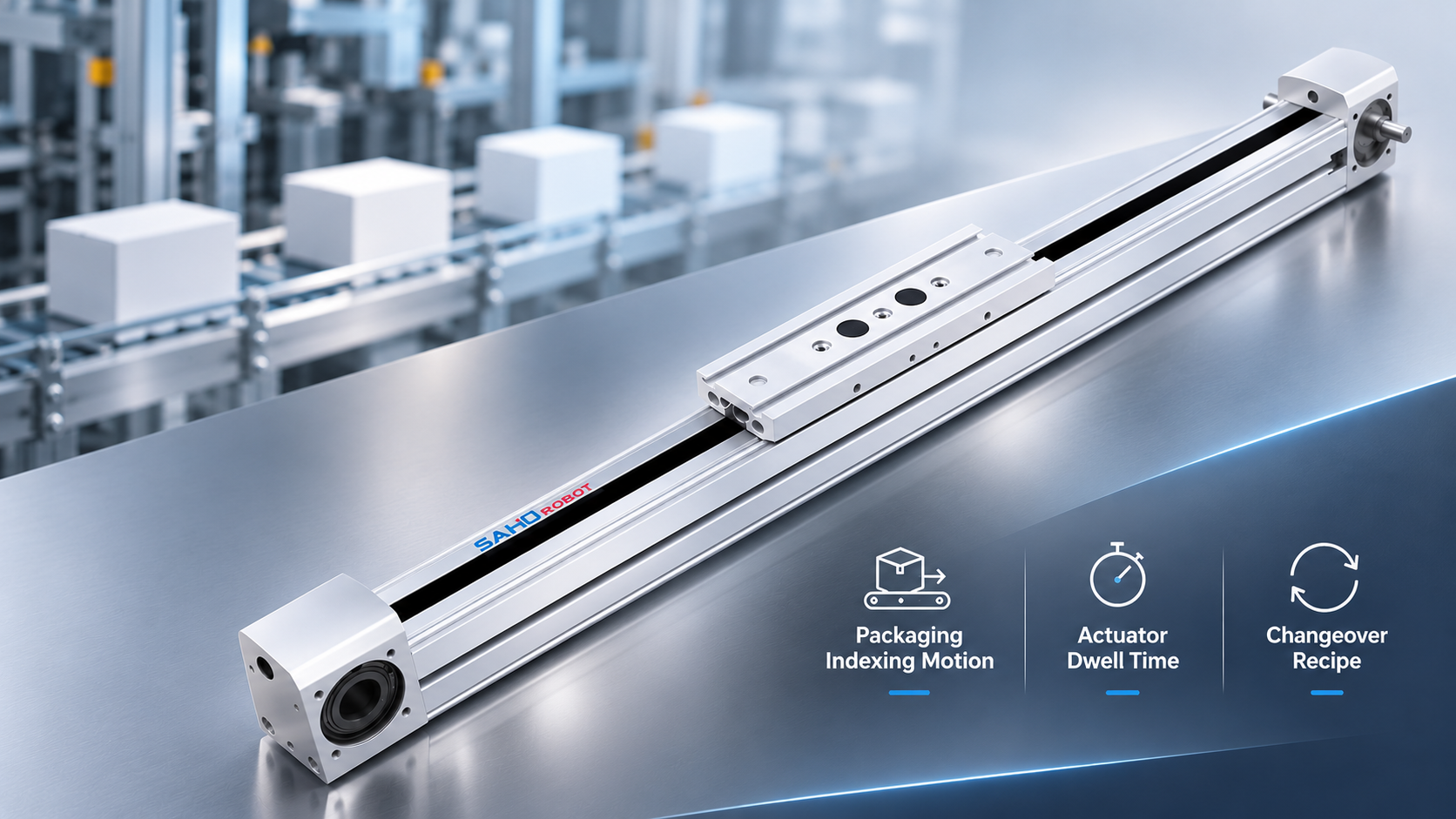
The TA Series in a Packaging Layout The TA45 photograph illustrates the rail-and-carriage layout being discussed. It can help with visualizing the transfer axis, although the feasibility of a particular indexing cycle still depends on the load, motion budget and verified model data.
TA45 layout reference; suitability must be checked against the actual application. |
Can the Axis Complete the Move in Time?
Short indexing moves are often constrained by acceleration rather than top speed: the carriage may need to begin decelerating before it reaches the programmed speed limit. That makes motion-profile assumptions central to the takt calculation.
For a simplified rest-to-rest move with equal, constant acceleration and deceleration, no cruising and no jerk limitation, Ttri = 2 × √(D/A). Here D is distance in meters and A is acceleration in meters per second squared. The relation is valid only if the resulting peak speed remains within the permitted velocity.
When a constant-speed portion exists, the equivalent idealized trapezoidal estimate is Ttrap = D/V + V/A, assuming symmetric acceleration and deceleration, cruise speed V in meters per second, and D ≥ V²/A. These are kinematic screening equations, not a drive-sizing calculation or a measured SAHO performance claim.
These equations help rule out an obviously tight cycle; they do not size the drive. Real travel and settling can be affected by jerk limits, tooling flexibility, load distribution and controller settings. If the estimate already exceeds the available motion window, it makes more sense to revisit the sequence or possible overlap before choosing an actuator. A calculation that fits on paper still needs to be checked against the full stop-and-process sequence.
Stroke, load and mounting are separate selection questions covered by SAHO's packaging and transfer selection guide. The narrower question here is whether enough of each index is left for the proposed move.
Why Changeover Is More Than a New Pitch Setting
Changeover rarely consists of entering a new pitch value. A different package format may require another stop position, tooling clearance, sensor offset, trigger window or process dwell. A recipe that changes only index distance can leave the next station operating at the wrong moment.
A reliable recipe ties the format identifier and revision to pitch, stop positions, motion settings, sensor triggers, dwell and interlocks. If a guide or sensor must also move physically, that adjustment needs its own record; changing software values alone will not reproduce the complete setup. The recipe should also distinguish process-validated settings from those still awaiting commissioning evidence.
Changeover also affects effective output across a production run, even when the stable cycle remains unchanged. For M completed indexes, a stable index time Tcycle, total changeover downtime Tchange in seconds, and U accepted packages, the observed average is Taccepted = (M × Tcycle + Tchange )/U seconds per accepted package. This simplified batch measure assumes no additional uncounted downtime; add such losses if present.
This is why a faster steady-state cycle does not always make a format more productive. A shorter production run may lose much of its advantage to changeover time, while a long run can absorb that delay. The comparison should use accepted output over the actual run, not cycle time in isolation. Recipe safeguards and controller capabilities still have to be verified at the complete-machine level.
What Missed Products and Late Signals Reveal
An uninterrupted production sequence can conceal what happens after a missed package or late sensor signal. The axis may complete its programmed motion while the machine is still waiting for a process-ready condition. Mixing that delay into ordinary travel time obscures the real constraint.
A missed package is most useful diagnostically when the event record shows what the machine was waiting for: product presence, station readiness or position confirmation. Recording the index position, timestamp, wait duration and recovery state keeps those losses separate from axis travel. On restart, a retained index count does not prove the package is still where the controller expects it; actual axis position, product occupancy and station readiness must be established.
Whether a missing package should be skipped, rejected or stopped depends on the machine's approved process logic and risk assessment. The same applies to allowable sensor delays and restart behavior. None of those functions should be inferred from the name of an actuator series.
From a Cycle Budget to an Actuator Decision
At this stage, the engineering question becomes specific: can the proposed belt axis achieve the required moves under the actual loading, mounting and duty cycle? For a belt linear actuator for a packaging machine, moving mass, tooling offset, cable drag, operating frequency and control architecture belong alongside the timing requirements. A speed figure on its own does not answer that question.
Comparing Two Package Formats
The worksheet keeps the two formats side by side so that a change in pitch, dwell or waiting time is visible in the cycle margin. A and B are symbolic examples, not product ratings or test results.
| Duty parameter | Format A | Format B |
| Package pitch (mm) | PA | PB |
| Pitch increments per index | KA | KB |
| Index distance (mm) | KA × PA | KB × PB |
| Target cycle (s/index) | TA | TB |
| Move + settle (s) | MA + SA | MB + SB |
| Process dwell (s) | QA | QB |
| Non-overlapping wait (s) | WA | WB |
| Cycle margin (s) | TA − MA − SA − QA − WA | TB − MB − SB − QB − WB |
The last row is the useful comparison: cycle margin is the time left after motion, settling, dwell and non-overlapping waits. Here M means move time, S settling, Q process dwell and W waiting, all in seconds. A negative value means the proposed serial sequence cannot fit within its target; a nonnegative value is only a preliminary screen, not proof that the machine will meet its timing or safety requirements.
Before the New Format Goes Live
The cycle comparison is only useful if the physical setup matches the recipe. Pitch, stop positions, sensor locations and trigger windows need to agree with the installed tooling; the proposed motion profile and clearances must stay within the machine's approved limits. A format that looks acceptable in the timing worksheet can still fail at the station if any of those relationships change.
The final check is how the machine behaves outside the ideal cycle: missing products, delayed sensors and restart should be exercised under the approved procedure. Measured timing, exceptions, the recipe revision and approval status make the changeover repeatable rather than dependent on an operator's memory.
Together with the complete moving assembly and layout drawings, those results give SAHO a more useful basis for evaluating the axis than a nominal travel speed. Model specifications and controller functions still need to be checked for the actual configuration.
Frequently Asked Questions
Why can a line miss its target when the actuator reaches position on time?
Because the rest of the cycle may still be occupied by product settling, process dwell or a readiness signal. Those intervals need to be measured separately before treating travel speed as the bottleneck.
What changes when the package pitch changes?
The index distance may change, but so can the required stop position, sensor window and process timing. A revised format should be checked at the physical station, not only in the motion recipe.
What should be included in a TA Series application review?
Provide index distance, target cycle, available travel and settling time, dwell, wait conditions and changeover requirements. Include moving mass, tooling arrangement, mounting orientation, operating frequency and layout drawings so the application can be reviewed against verified model data.
The deciding question is whether the whole sequence remains reliable across the formats the machine will actually run. When the timing budget makes the source of lost time visible, actuator selection becomes an informed part of the solution rather than a guess based on catalog speed.
Review TA Series with Your Application Data Share the index-cycle comparison, moving load, tooling arrangement and format-change requirements. SAHO can then review relevant TA configurations against the application data and verified model limits. Review TA Series for This Packaging Duty |