
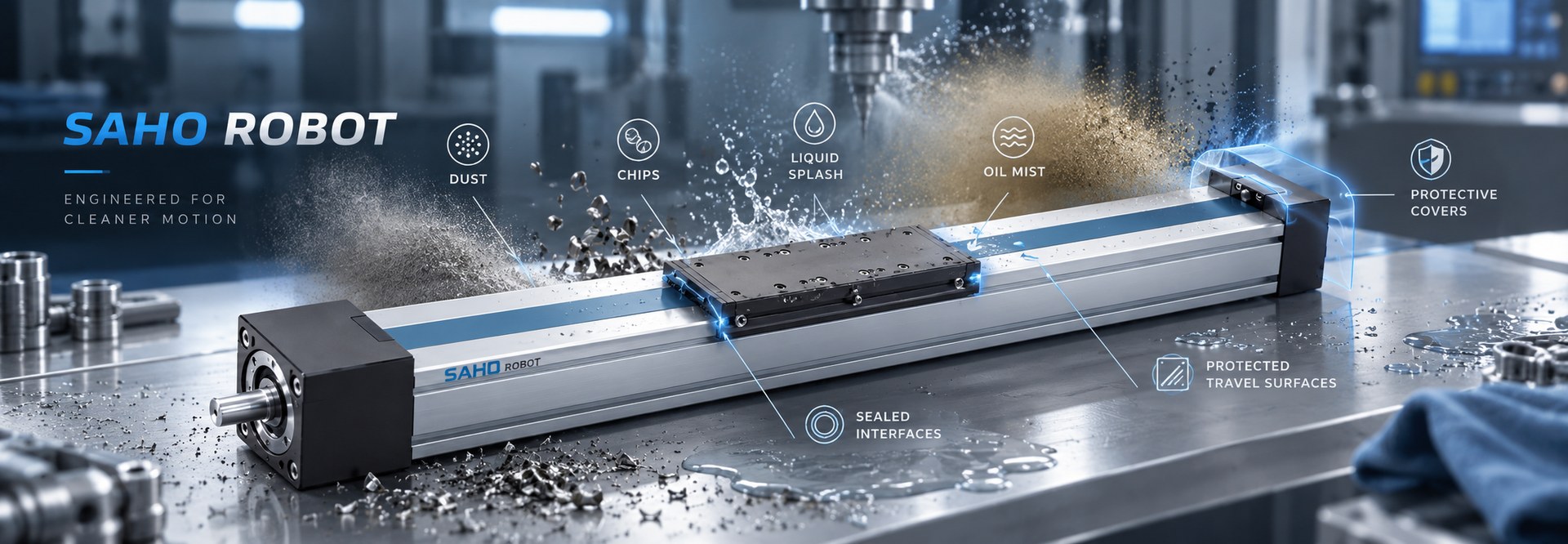
Defining linear actuator contamination protection requirements is less about choosing a reassuring protection label and more about understanding how the process exposes the moving axis. Fine powder settling near a carriage creates a different problem from chips striking a cover or coolant splashing an end section. What matters is the contaminant, its source and direction, how often exposure occurs, and whether the axis is moving at the time. Mounting orientation, cleaning practices, and an agreed acceptance test then help engineers judge which protective measures are appropriate.
Practical rule: specify the contamination event in terms that another engineer could reproduce. “Dusty machine” is vague. “Fine abrasive dust falls from above during each machining cycle and accumulates near the carriage opening” is an engineering input.
1. Specify the Contaminant and Exposure Before Naming a Protection Level
Terms such as dusty, wet, and harsh environment describe a concern, but they do not define what an actuator must withstand. A useful actuator environment specification begins with the physical material and the way it reaches the motion system.
Fine airborne dust, heavy chips, and fibrous debris do not accumulate or approach openings in the same way. The same distinction applies to liquids: occasional droplets are not equivalent to a directed cleaning spray. On one machine, chips may appear during cutting, oil mist during production, and cleaning fluid only after the shift.
Record each exposure separately. The useful question is not simply “Does the actuator need dust protection?” but “What material reaches which part of the actuator, from what direction, for how long, and under what machine state?”
Avoid an early shortcut: do not convert an incomplete environment description directly into an IP requirement. If the project requires a documented IP rating, the exact product configuration and supporting evidence still require engineering confirmation.
2. Classify Particles, Liquids, Mist, and Cleaning Exposure
Two actuators on the same production line may need different protection. Sharp chips ejected toward a moving carriage raise questions about deflection and debris removal, while persistent coolant mist calls for closer attention to ingress paths and material compatibility. Describing both environments simply as “dirty” misses that difference.
| Exposure type | Useful RFQ description | What changes the risk | Evidence to provide |
|---|---|---|---|
| Dust / powder | Material, particle size if known, airborne or settling, abrasive or non-abrasive | Fineness, abrasiveness, concentration, accumulation location | Process photo, sample description, source location |
| Chips / debris | Metal, plastic, wood, composite, fibrous debris, sharp or curled chips | Size, shape, impact direction, ability to bridge an opening | Chip photo, machine-zone sketch, typical accumulation area |
| Mist / droplets | Fluid identity, mist or droplets, intermittent or continuous exposure | Direction, deposition, wetting time, interaction with dust | Fluid identification and exposure description |
| Spray / washdown | Cleaning fluid, spray direction, event duration, cleaning frequency | Directness, distance, duration, actuator position and machine state | Cleaning procedure, photos or video, controlled pressure or flow data if available |
For particles, particle size is useful when known, but it is not the only variable. Sharp chips can bridge gaps, fine powder can migrate through narrow paths, and abrasive particles mixed with oil or coolant can behave very differently from the same material when dry.
At this stage, the goal is to define the required protection outcome rather than select a model prematurely. If the machine concept is already moving toward hardware evaluation, review SAHO industrial linear actuator solutions with the environment description attached so contamination can be considered together with the broader application requirements.
3. Map the Source, Direction, Frequency, and Duration of Exposure
An axis directly below a cutting process faces a different exposure from one mounted behind a guard, even if both run in the same workshop. The path taken by particles or liquid can matter as much as the contaminant itself.
Mark the contamination source on the machine layout and show its path toward the actuator. Record whether contamination approaches from above, below, the side, along the travel direction, or toward an end section. Then identify whether carriage movement exposes different areas as the axis travels.
Convert vague exposure language into a measurable duty
Illustrative example — not an SAHO product limit:
2 cleaning events per shift × 2 shifts per day × 5 minutes per event = 20 minutes of spray exposure per day
20 minutes per day × 300 operating days = 6,000 minutes, or 100 hours of annual exposure
The 100-hour total describes cumulative exposure, not actuator durability or an equivalent endurance test. Spray direction, pressure, fluid chemistry, and whether the axis is moving can all change the outcome. The calculation makes “frequent washdown” easier to specify, but suitability still depends on an agreed test for the actual installation.
Apply the same method to debris. Instead of “chips sometimes reach the axis,” document whether chips fall continuously, are ejected only during a machining cycle, or accumulate during several cycles before cleaning. For mist, note whether it is continuously suspended in the enclosure or appears only during one process step.
Useful review question: if an engineer who has never seen the machine reads the exposure description, could that person identify where the contamination comes from, which side of the actuator it reaches, and how long the exposure lasts? If not, the environment data is still incomplete.
4. Separate the Required Protection Outcome from an Unsupported IP Claim
On a chip-producing machine, the concern may be keeping debris away from a moving interface during operation. In a cleaning area, the question is different: can the installed system tolerate the specified spray without unacceptable ingress or loss of function? These are outcomes engineers can inspect or test, rather than assumptions based on how enclosed a product looks.
Those are application requirements. An IP rating is a different type of statement. A cover, cover strip, gasket, seal, or enclosed appearance does not automatically establish a formal rating for a complete actuator configuration.
Potential ingress paths can include moving interfaces, end areas, cable exits, connectors, sensor interfaces, and installation-dependent openings. The complete result can also depend on orientation and on how the actuator is integrated into surrounding machine guarding.
For projects that formally reference the IP Code, IEC 60529 is the relevant enclosure-protection standard. Referencing the standard does not establish a rating for a particular actuator unless the required evidence applies to the exact configuration under review.
Procurement rule: if a specific IP rating is mandatory, request documented confirmation that it applies to the exact configuration being quoted. If supporting evidence is not available, record engineering confirmation required instead of inferring a rating from appearance or a cover description.
Where a formal rating is not the actual project requirement, a defined exposure plus an agreed inspection and acceptance method may be more useful. This keeps the requirement tied to the process instead of using an unsupported label as a substitute for application data.
5. Review Orientation, Covers, Cable Exits, and Maintenance Access
Mounting orientation changes where contamination settles, drains, and approaches possible ingress paths. A horizontal axis under a chip-producing process may collect falling debris on upper surfaces. Rotate the same installation and the dominant accumulation area may move toward an end section, side interface, or cable route.
Show the installation orientation directly on the machine drawing. Add the travel direction, contamination source, expected “dirty side,” and any nearby fixed guarding. A cover should be described by the role expected from it—for example, deflecting falling particles or reducing direct splash—rather than treated as proof of a particular protection rating.
Cable exits and connectors also deserve explicit review. Routing can create collection paths or place interfaces directly inside a contaminated zone. If the machine layout constrains the cable-exit direction, record that constraint in the application data.
Maintenance access belongs in the contamination plan because inspection must be possible after exposure. If a guard, panel, or external shield must be removed to inspect the actuator, define that access before the machine structure is finalized.
Do not overlook compound exposure: dry dust plus later oil mist, or chips plus cleaning fluid, may create a different contamination condition from either exposure alone. If material compatibility or protection performance has not been verified for the combined condition, use engineering confirmation required.
6. Build a Contamination Questionnaire and Acceptance-Test Record
A purchasing specification that calls an axis “dust resistant” is of little help if the validation team has no agreed definition of success. The exposure described in the RFQ should therefore be the exposure used to plan the acceptance test.
| Contamination questionnaire and acceptance-test handoff | |
| Contaminant identity | Dust, abrasive particles, chips, droplets, oil mist, coolant, cleaning fluid, or another identified material |
| Physical description | Particle size if known, chip shape, dry or sticky behavior, abrasive nature, mist or liquid form |
| Source and direction | Process source plus above, below, side, end, along travel, or multiple directions |
| Frequency and duration | Per process cycle, hour, shift, cleaning event, or continuous; include cumulative exposure where useful |
| Actuator state | Stationary, moving, full-travel cycling, or exposed only during cleaning |
| Mounting orientation | Horizontal, vertical, inverted, side-mounted, or clearly shown on the application drawing |
| Existing machine protection | Guard, shield, enclosure, drip path, chip deflector, or none |
| Cleaning method | Wipe, vacuum, rinse, spray, washdown, or another defined method; include direction and event duration |
| Test conditions | Representative contaminant, direction, duration, carriage position, motion state, and number of exposure events |
| Inspection record | Inspection points, photographs, observations, test date, configuration, and project-defined pass/fail result |
| Acceptance criterion | Project-defined measurable condition; where not yet agreed, record engineering confirmation required |
The acceptance test should reproduce the exposure mechanism that matters. If debris is generated while the axis moves, a stationary test may not represent the actual ingress path. If cleaning occurs only with the machine stopped, record that condition rather than testing an unrelated operating state.
Photos, a machine-zone sketch, representative contaminant information, fluid identification, and a short process video can make an RFQ much clearer than descriptive adjectives alone. The objective is not to create unnecessary paperwork; it is to prevent the supplier and machine builder from testing different versions of the environment.
7. Use the Completed Environment Data to Narrow the Suitable SAHO Actuator Family
Contamination protection is one selection filter rather than the complete actuator selection process. Stroke, load, speed, acceleration, positioning requirements, duty cycle, installation direction, packaging constraints, and system architecture still need to be reviewed for the application.
If the underlying motion architecture is still open, use the related guide to compare linear-axis technologies before treating contamination protection as the only deciding factor.
A supplier can compare protection options more meaningfully when the exposure description accompanies the motion requirements. The handoff should show where contamination originates, how it reaches the axis, how long it lasts, and how orientation, guarding, cable routing, and cleaning affect the installed assembly. The intended acceptance method completes that picture.
If dust or particle exposure matters and the application also calls for screw-driven motion, the SAHO JTS Series is worth reviewing. Its enclosed module and dust-proof sliding-table design are intended to reduce particle exposure around the screw and guide components. That does not establish suitability for liquid washdown or coolant: chemical compatibility, any required IP rating, and the exact model configuration still need engineering confirmation.
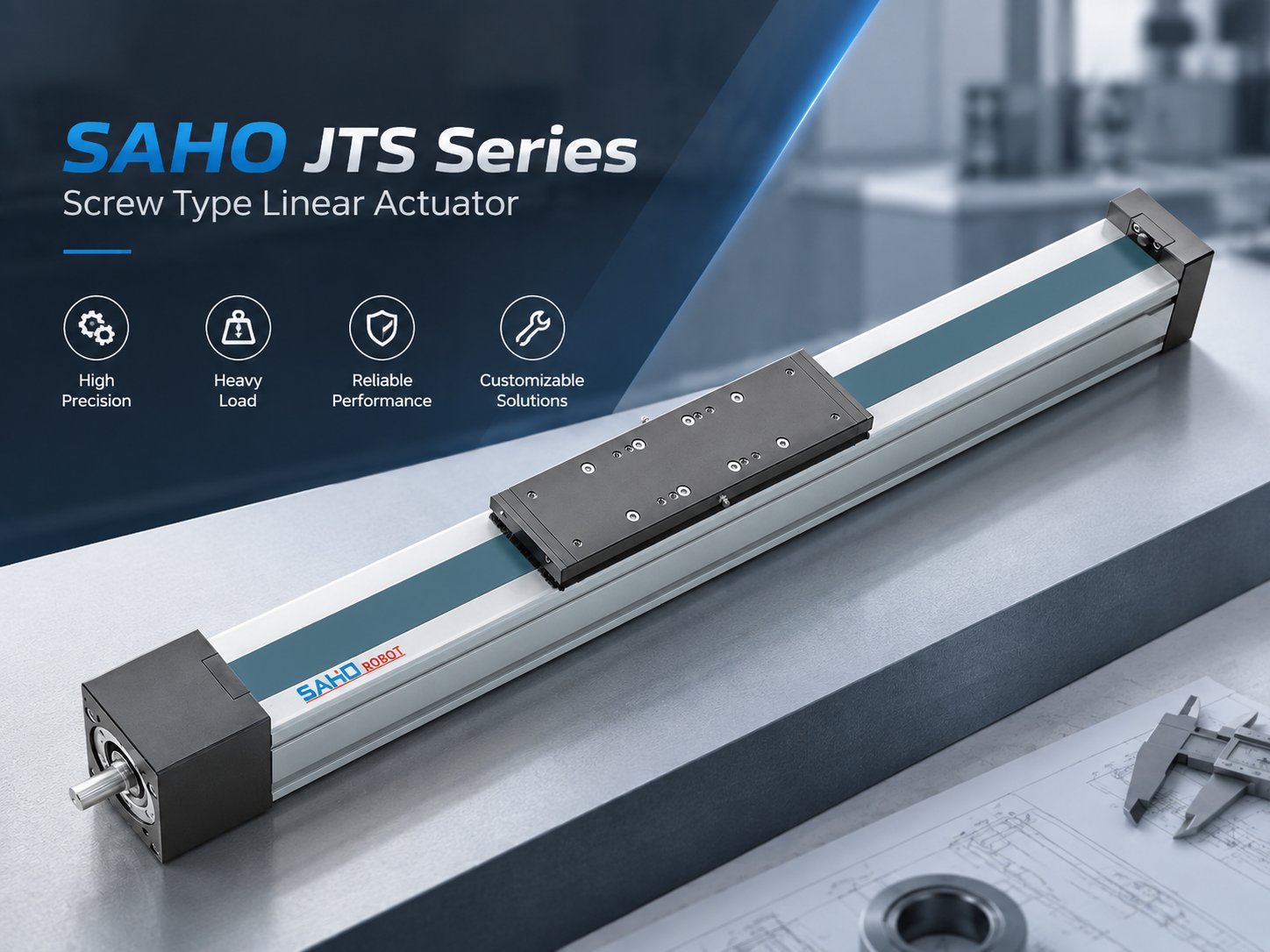 SAHO JTS Series Screw Type Linear ActuatorReview this product direction when the application data points to a dusty or particle-prone environment and a screw-driven linear axis is being considered. Do not select a model from the enclosure appearance alone; load, stroke, motion requirements, installation orientation, contamination severity, and the required protection outcome must still be confirmed. Do not treat this product image as an IP or washdown claim. If the application includes direct liquid spray, coolant, aggressive cleaning, chemical exposure, or a mandatory IP classification, request confirmation for the exact proposed configuration. View JTS Series |
A different environment or motion requirement may point to another actuator family, so the purpose of the contamination specification is to narrow the discussion rather than force every dusty, wet, or debris-producing process into one product type.
Before requesting a model: attach the machine-zone drawing and contamination questionnaire to the normal motion data. That makes the linear actuator contamination protection requirements part of the engineering selection process instead of an assumption added after the axis has already been chosen.
Common Questions About Linear Actuator Contamination Protection
| Does a dust cover automatically provide an IP rating? |
| No. A cover may reduce direct exposure, but it does not by itself establish an IP rating for the complete actuator configuration. If a formal rating is required, request documented confirmation for the exact assembly. |
| What particle information should be included in an actuator RFQ? |
| Identify the material, particle or chip type, approximate size range if known, abrasive or sticky behavior, source, direction, frequency, duration, and whether exposure occurs while the actuator is moving. |
| How does mounting orientation change contamination risk? |
| Orientation changes where dust, chips, droplets, and mist can settle, drain, or approach openings. Show both the mounting direction and contamination source on the application drawing. |
| What should an actuator contamination acceptance test record? |
| Record the contaminant, exposure direction and duration, actuator state, carriage position, cleaning method where relevant, inspection points, photographs or observations, configuration tested, and the project-specific pass/fail criterion. |
Turn the Environment Description into an Engineering Review Package
The value of the contamination specification is not the length of the checklist. It is that engineering, procurement, and validation teams can work from the same picture of what actually reaches the axis and what would count as acceptable performance afterward. That shared understanding is more useful than a broad label such as “harsh environment.”
With that context established, SAHO linear motion products can be assessed against both the environmental exposure and the motion duty. The contamination record belongs alongside the stroke, load, speed, and installation details, not in a separate discussion.
Prepare these items before requesting engineering review: machine or axis drawing, required stroke, payload and load direction, motion speed and acceleration requirements, installation orientation, duty cycle, contaminant description, source and direction of exposure, exposure frequency and duration, cleaning method, cable-routing constraints, required protection outcome, and intended acceptance criteria. Mark unresolved IP, compatibility, or environmental questions as engineering confirmation required.
Ready to move from environment definition to actuator review? Use the completed contamination checklist alongside your motion and installation data. Review the relevant SAHO actuator family, then contact the engineering team to confirm the suitable configuration and how to provide drawings or supporting files. Review SAHO Linear Actuator & Linear Motion Systems Contact SAHO for Engineering Review |